
Estimate how much money and electricity a whole house fan may save when it replaces AC for part of your cooling season.
This is not the full AC bill unless these are the only AC hours.
This uses the same daily hours and cooling-season days as the AC estimate.
Table of contents
How to use our Whole House Fan vs AC Cost Calculator
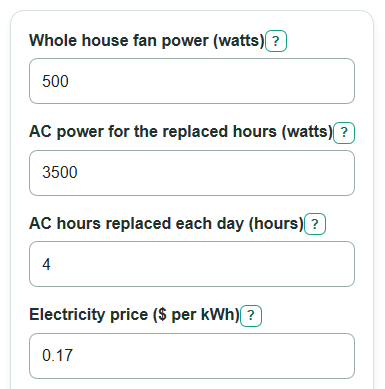
- Enter Whole house fan power using the fan's running watts, not starting watts.
- Enter AC power for the replaced hours as the average running watts during the hours the fan would take over.
- Enter AC hours replaced each day, Electricity price, and Cooling season length for the days you expect the fan to replace AC.
- Click Calculate and read Estimated savings for the cooling season first, then compare the AC and fan cost cards.
- Sanity-check the result by asking if the replaced hours are realistic: fan runtime only saves money when it actually replaces AC use.
Definitions
Watt: A measure of electric power at one moment. The calculator uses running watts for the fan and AC.
Kilowatt-hour (kWh): The energy used by 1 kilowatt running for 1 hour. Electric bills usually charge by kWh [1].
Whole house fan power: The fan's average running power in watts while it is moving air through the house.
AC power for the replaced hours: The AC's average running power in watts during the hours the fan would replace it.
AC hours replaced each day: The number of hours per day when the fan fully takes the place of AC use.
Electricity price: Your all-in price per kWh, including supply and any delivery charges that are billed per kWh.
Cooling season length: The number of days in the season when the fan is expected to replace AC for the entered hours.
Estimated savings for the cooling season: AC cost for the replaced hours minus whole house fan cost for the same hours.
Common mistakes and quick fixes
Mistake: Using the fan's startup surge for Whole house fan power .
Fix: Enter the running watts listed on the fan label, manual, or product specs.
Mistake: Entering the AC unit's maximum nameplate watts for AC power for the replaced hours when the AC cycles on and off.
Fix: Use an average running watt estimate for the hours the fan would replace, if you know it.
Mistake: Counting every fan hour as AC hours replaced each day .
Fix: Count only the hours when outdoor air is cool enough that the fan can replace AC.
Mistake: Typing a monthly bill total into Electricity price .
Fix: Enter the price per kWh from your bill, such as 0.17, including per-kWh delivery charges when they apply.
Mistake: Treating Estimated savings per 30 days as a calendar-month bill forecast.
Fix: Use it as a simple 30-day comparison based on the same daily replaced hours.
Mistake: Expecting AC cost for the replaced hours to match your full AC bill.
Fix: Remember it includes only the AC hours replaced by the fan, not all cooling use.
Limitations & Key Assumptions / Boundary Conditions
- The estimate covers only the hours entered as AC hours replaced each day. It does not estimate your full cooling bill.
- The calculator assumes the whole house fan fully replaces AC during those hours. If the AC still runs, actual savings will be lower.
- Both power inputs are treated as average running watts. Real AC power can change with outdoor temperature, thermostat setting, cycling, and equipment condition.
- Electricity price is treated as one flat $ per kWh. Time-of-use rates, demand charges, minimum bills, and tiered prices can change actual costs.
- The result is operating cost only. It does not include fan purchase cost, installation, maintenance, filter costs, or comfort differences.
- Negative savings are possible and are kept on purpose. A negative value means the fan uses more electricity or costs more under the entered assumptions.
- Whole house fans depend on outdoor air being cooler or more comfortable than indoor air. Hot, humid, smoky, or polluted outdoor air can make replacement hours unrealistic.
Methodology
Energy and cost math
The calculator compares the fan and AC over the same replacement hours and the same number of days. Watts are converted to kilowatts by dividing by 1000, then multiplied by time to get kWh. This follows the standard appliance energy estimate method: power times hours of use [1].
daily_kwh = watts / 1000 * hours_per_day
This daily energy formula is run once for the whole house fan and once for the AC.
season_cost = daily_kwh * electricity_rate * cooling_days
Season cost is calculated separately for the AC and the fan.
net_savings_per_season = ac_season_cost - fan_season_cost
A positive season savings value means the fan costs less to run for the entered replacement hours. A negative value means the fan costs more under the entered assumptions.
net_savings_per_30_days = (net_savings_per_season / cooling_days) * 30
The 30-day value is a simple daily-average comparison, not a calendar billing estimate.
electricity_saved_per_season_kwh = ac_season_kwh - fan_season_kwh
Mini-example
With a 500 W whole house fan, a 3500 W AC average, 4 replaced hours per day, $0.17 per kWh, and 120 cooling days, the fan uses 500 / 1000 * 4 * 120 = 240 kWh. The AC uses 3500 / 1000 * 4 * 120 = 1680 kWh. Electricity saved is 1680 - 240 = 1440 kWh. AC cost is 1680 * $0.17 = $285.60, fan cost is 240 * $0.17 = $40.80, and estimated cooling-season savings are $285.60 - $40.80 = $244.80.
Input checks
Whole house fan power, AC power for the replaced hours, Electricity price, and Cooling season length must be greater than 0. AC hours replaced each day can be 0 through 24. A 0-hour entry produces $0 savings and 0 kWh saved because no AC hours are replaced.