
Estimate yearly savings, rebate-adjusted payback, electricity saved, and CO2 avoided when comparing a heat pump dryer with a conventional electric dryer.
Advanced options
Table of contents
How to use our Heat Pump Dryer Savings Calculator
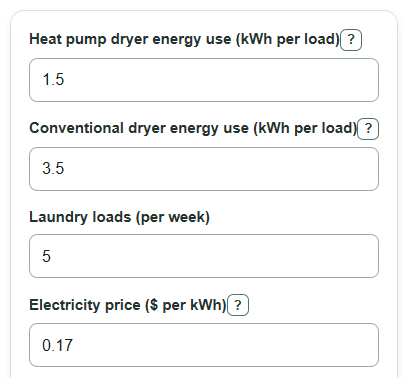
- Enter the Heat pump dryer energy use and Conventional dryer energy use in kWh per load from the EnergyGuide label, spec sheet, or a realistic estimate.
- Enter Laundry loads per week and your all-in Electricity price in $ per kWh from your electric bill.
- Enter the Extra price before rebates; use a negative number only if the heat pump dryer is cheaper than the conventional dryer before incentives.
- Open Advanced options if you want to enter a Rebate or incentive or change the CO2 rate used for the emissions estimate.
- After you calculate, sanity-check the result: Yearly energy bill savings should be positive only when the conventional dryer uses more kWh per load than the heat pump dryer.
Definitions
kWh per load: Kilowatt-hours used to dry one load. This is the main energy input for each dryer.
Electricity price: The cost you pay for each kWh of electricity, including per-kWh delivery charges if they apply.
Extra price before rebates: How much more the heat pump dryer costs than the conventional electric dryer before incentives. A negative value means it costs less.
Rebate or incentive: A dollar amount that reduces the extra upfront price for the heat pump dryer.
Simple payback: Extra price after rebates divided by yearly energy bill savings. It ignores loan interest, inflation, and the time value of money.
CO2 rate: Pounds of carbon dioxide linked to each kWh of electricity. Local rates vary by power grid and power source.
Common mistakes and quick fixes
Mistake: Entering watts or yearly kWh in Heat pump dryer energy use instead of kWh per load.
Fix: Convert the spec to kWh per load, or use the product's listed per-cycle energy number if available.
Mistake: Using a low supply-only rate for Electricity price and leaving out per-kWh delivery charges.
Fix: Use the all-in $ per kWh from your bill when those charges change with usage.
Mistake: Putting the full heat pump dryer price in Extra price before rebates .
Fix: Enter only the price difference between the heat pump dryer and the conventional dryer you would buy or keep.
Mistake: Entering a negative Rebate or incentive to model fees or taxes.
Fix: Keep the rebate at zero or more; add extra fees to Extra price before rebates instead.
Mistake: Treating Rebate-adjusted payback time as a full ownership cost forecast.
Fix: Read it as simple payback from energy savings only, then consider repairs, dryer life, and resale separately.
Limitations & Key Assumptions / Boundary Conditions
- The comparison is for a heat pump electric dryer versus a conventional electric dryer. It does not model gas dryer fuel costs.
- Both dryers are assumed to handle the same Laundry loads per week.
- Energy use per load can change with load size, fabric type, washer spin speed, sensor settings, vent condition for vented dryers, and user habits.
- The calculation uses a single Electricity price. It does not model time-of-use prices, demand charges, or seasonal rate changes.
- Rebate-adjusted payback time is simple payback only. It does not include repairs, maintenance, financing, taxes, installation, dryer lifespan, or discounting future savings.
- The CO2 rate is user-entered and can differ by utility, region, season, and time of day, so Yearly CO2 avoided is an estimate.
- Rebates may have eligibility rules, application deadlines, income limits, or product requirements that are not checked by this calculator.
Methodology
How the savings are calculated
The calculator first turns weekly laundry use into yearly loads, then calculates yearly electricity use and cost for each dryer. ENERGY STAR and DOE materials describe clothes dryer energy use and efficient dryer comparisons as energy-use questions, but the calculator uses the specific kWh per load numbers you enter instead of assuming a fixed product rating [1][4].
annual_loads = loads_per_week * 52
heat_pump_annual_kwh = heat_pump_kwh_per_load * annual_loads
conventional_annual_kwh = conventional_kwh_per_load * annual_loads
heat_pump_annual_cost = heat_pump_annual_kwh * electricity_rate
conventional_annual_cost = conventional_annual_kwh * electricity_rate
annual_energy_cost_savings = conventional_annual_cost - heat_pump_annual_cost
Payback and impact formulas
The upfront comparison uses only the extra price of the heat pump dryer, reduced by the rebate you enter. Signed results are kept, so a negative extra price after rebates means incentives more than cover the price difference.
net_extra_price_after_rebate = extra_upfront_cost - rebate_amount
annual_kwh_saved = conventional_annual_kwh - heat_pump_annual_kwh
annual_co2_avoided_lb = annual_kwh_saved * co2_rate_lb_per_kwh
Payback is shown only when yearly energy bill savings are positive. If the extra price after rebates is zero or less and savings are positive, the calculator shows 0 years because there is no remaining extra price to recover from energy savings.
payback_years_after_rebate = net_extra_price_after_rebate / annual_energy_cost_savings
Mini-example
If the heat pump dryer uses 1.5 kWh per load, the conventional dryer uses 3.5 kWh per load, you dry 5 loads per week, and electricity costs $0.17 per kWh, yearly loads are 260. The heat pump dryer uses 390 kWh per year and costs $66.30 per year. The conventional dryer uses 910 kWh per year and costs $154.70 per year, so yearly energy bill savings are $88.40. With a $400 extra price and no rebate, simple payback is $400 divided by $88.40, or about 4.52 years. With a CO2 rate of 0.8 lb per kWh, yearly CO2 avoided is 520 kWh times 0.8, or 416 lb CO2 per year.
Sources
- Home Upgrades | Department of Energy - Energy
- Do Heat Pump Clothes Dryers Make Sense for the U.S. Market? | LBL ETA Publications - LBL
- Do Heat Pump Clothes Dryers Make Sense for the U.S. Market? | Energy Analysis Division - LBL
- ENERGY STAR (PDF) - ENERGY STAR Market & Industry Scoping Report: Residential Clothes Dryers - Energystar