
Estimate a small-business value from annual profit, a value multiple, and an optional DCF cash-flow check.
Advanced options
Table of contents
How to use our Business Valuation Calculator
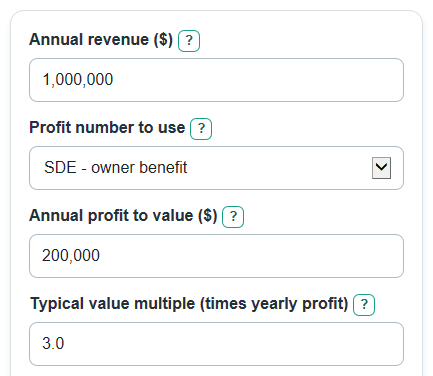
- Enter Annual revenue and Annual profit to value using the same recent 12-month period when possible.
- Choose Profit number to use, then enter a Typical value multiple that matches that profit type.
- Set Range width around typical multiple to make a low and high estimate around the typical value.
- If you want a cash-flow check, open Advanced options, set Include DCF cross-check to Yes, and enter Next-year cash flow, Discount rate, Long-term growth after forecast, Forecast years, and Sensitivity step.
- Compare Typical value from profit multiple with DCF cross-check value and the ranges. If the DCF range is very wide, the DCF answer is sensitive to your rate and growth assumptions.
Definitions
Annual revenue: The business's total sales over a year before subtracting expenses.
SDE: Seller's discretionary earnings, which is a small-business profit measure that often includes owner benefit and certain add-backs.
EBITDA: Profit before interest, taxes, depreciation, and amortization. It is often used as an operating profit measure for larger businesses.
Typical value multiple: The number multiplied by yearly profit to estimate value. A 3.0x multiple means 3 times the selected yearly profit.
Range width around typical multiple: The percent used to make a low and high multiple around the typical multiple.
Discounted cash flow (DCF): A valuation method that estimates value from expected future cash flow, adjusted back to today's dollars.
Discount rate: The yearly return a buyer would require for the risk of owning the business.
Long-term growth after forecast: The growth rate used after the forecast years in the DCF terminal value.
Sensitivity step: The number of percentage points used to retest DCF with slightly higher and lower discount and long-term growth rates.
Common mistakes and quick fixes
Mistake: Mixing Profit number to use with the wrong Typical value multiple, such as entering SDE but using an EBITDA multiple.
Fix: Match Profit number to use, Annual profit to value, and Typical value multiple to the same profit measure.
Mistake: Entering Annual revenue as profit or entering Annual profit to value as sales.
Fix: Put total sales in Annual revenue and the chosen yearly profit measure in Annual profit to value.
Mistake: Using a Range width around typical multiple that is meant as a dollar range instead of a percent.
Fix: Enter a percent, such as 20, so the low and high multiples move 20 percent below and above Typical value multiple.
Mistake: Setting Discount rate at or below Long-term growth after forecast when Include DCF cross-check is Yes.
Fix: Raise Discount rate or lower Long-term growth after forecast so the DCF terminal value can be calculated.
Mistake: Treating DCF cross-check value as more certain than Typical value from profit multiple.
Fix: Review DCF range from small rate and growth changes; a wide range means small assumption changes move the value a lot.
Limitations & Key Assumptions / Boundary Conditions
- This is a directional estimate, not a formal appraisal, fairness opinion, tax valuation, or sale price guarantee.
- The calculator does not choose an industry multiple for you. The Typical value multiple must come from your own research, broker input, comparable sales, or advisor judgment.
- SDE and EBITDA are not interchangeable. A multiple that fits one profit measure may be wrong for the other.
- The DCF cross-check depends heavily on Next-year cash flow, Discount rate, Long-term growth after forecast, and Forecast years.
- The DCF terminal formula requires Discount rate to be higher than Long-term growth after forecast, including the Sensitivity step range.
- The estimate does not separately adjust for debt, excess cash, inventory, working capital, real estate, customer concentration, owner dependence, taxes, deal structure, or buyer-specific synergies.
- Negative profit or negative cash flow can produce negative valuation outputs. That may be useful for stress testing, but it is hard to interpret as a market sale price.
Methodology
Profit-multiple estimate
The main estimate uses a market-style multiple approach. It multiplies Annual profit to value by Typical value multiple. The calculator also builds a low and high range by moving the multiple down and up by Range width around typical multiple.
typical_multiple_value = annual_earnings * typical_multiple
low_multiple = typical_multiple * (1 - range_width_percent / 100)
high_multiple = typical_multiple * (1 + range_width_percent / 100)
low_value = annual_earnings * low_multiple
high_value = annual_earnings * high_multiple
value_to_revenue_percent = typical_multiple_value / annual_revenue * 100
DCF cross-check
Discounted cash flow, or DCF, estimates value from future cash flow. The calculator grows Next-year cash flow during the forecast period, discounts each yearly cash flow back to today using Discount rate, then adds a discounted terminal value based on Long-term growth after forecast.
cash_flow_t = dcf_next_cash_flow * (1 + dcf_cash_flow_growth_rate / 100)^(t - 1)
pv_forecast = sum(cash_flow_t / (1 + dcf_discount_rate / 100)^t)
terminal_value = cash_flow_n * (1 + dcf_terminal_growth_rate / 100) / ((dcf_discount_rate / 100) - (dcf_terminal_growth_rate / 100))
dcf_cross_check_value = pv_forecast + terminal_value / (1 + dcf_discount_rate / 100)^dcf_forecast_years
dcf_vs_multiple_percent = (dcf_cross_check_value - typical_multiple_value) / abs(typical_multiple_value) * 100
Sensitivity range
When Include DCF cross-check is Yes, the calculator retests DCF using discount rates of r minus step, r, and r plus step, and long-term growth rates of g minus step, g, and g plus step. It reports the lowest valid DCF value and the highest valid DCF value.
dcf_sensitivity_low = minimum valid DCF value from the 3 by 3 rate and growth retest
dcf_sensitivity_high = maximum valid DCF value from the 3 by 3 rate and growth retest
Worked mini-example
If Annual profit to value is $200,000 and Typical value multiple is 3.0x, the Typical value from profit multiple is $600,000. With a 20 percent Range width around typical multiple, the low multiple is 2.4x and the high multiple is 3.6x, so the Low to high value from profit multiple is $480,000 to $720,000. If Annual revenue is $1,000,000, the Typical value as a percent of annual revenue is 60 percent.
Input checks
The calculator rejects blank required numbers, negative Typical value multiple, Range width around typical multiple outside 0 to 100 percent, and Forecast years outside whole years from 1 to 10. It does not divide by zero for Annual revenue or Typical value from profit multiple. It keeps negative valuation outputs when the entered profit or cash flow is negative.