
Estimate your 401(k) loan payment, repayment total, growth tradeoff, and optional job-change deadline risk in one place.
Advanced options
Table of contents
How to use our 401(k) Loan Calculator
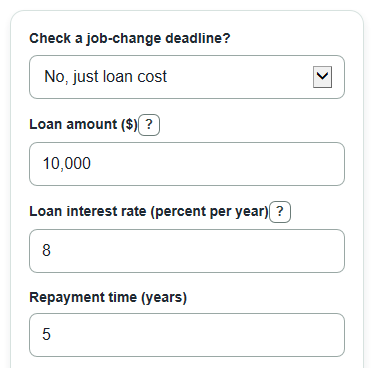
- Choose whether to use only the loan cost view or turn on Check a job-change deadline?.
- Enter Loan amount, Loan interest rate, Repayment time, and Expected investing return using yearly rates.
- If the job-change check is on, enter Job leaving date and use Advanced options only if you know the Loan balance on job leaving date, Federal tax rate for a missed deadline, or age answer.
- Select Calculate and compare Monthly paycheck payment with your real paycheck budget.
- Sanity-check the result: Loan interest rate should look like a yearly percent, Estimated account growth gap can be negative, and deadline dates are standard federal reference dates before weekend or holiday shifts.
Definitions
Monthly paycheck payment: The fixed monthly amount needed to repay the loan over the chosen Repayment time.
Interest paid back into your 401(k): The scheduled interest part of your payments. It goes back to the account, but the borrowed money may miss investing growth while it is out.
Estimated account growth gap: The projected difference between leaving the Loan amount invested and taking the loan with monthly repayments.
Job leaving date: The date you leave the employer tied to this 401(k). The calculator uses it to estimate regular and extended rollover deadline reference dates.
Loan balance on job leaving date: The unpaid loan amount at the time you leave the job. If you leave it blank, the calculator uses Loan amount.
Qualified plan loan offset: An unpaid plan loan amount that may be treated as distributed when certain plan events happen, such as a separation from employment [1].
Common mistakes and quick fixes
Mistake: Entering your full 401(k) balance in Loan amount instead of the amount you plan to borrow.
Fix: Use only the planned loan amount, such as 10000.
Mistake: Typing a decimal in Loan interest rate, such as 0.08, when you mean 8 percent per year.
Fix: Enter the yearly percent as 8, not 0.08.
Mistake: Leaving Expected investing return blank because you are unsure about market growth.
Fix: Enter your best yearly estimate, or enter 0 if you want to model no growth.
Mistake: Using a rough Repayment time that does not match the scheduled loan term.
Fix: Enter the actual scheduled years, including a decimal if the term is not a whole number of years.
Mistake: Turning on Check a job-change deadline? but using the wrong Job leaving date.
Fix: Use the date you leave the employer tied to this 401(k), not a later date when you notice the loan balance.
Mistake: Treating Estimated federal tax and penalty if missed as your final tax bill.
Fix: Use Federal tax rate for a missed deadline and Under age 59 1/2 at the deadline? as planning inputs only, then check your real tax facts.
Limitations & Key Assumptions / Boundary Conditions
- Plan rules control whether you can borrow, the maximum loan, allowed term, payment frequency, fees, and default rules. This calculator does not test plan eligibility.
- Monthly paycheck payment assumes equal end-of-month monthly payments. Real payroll deductions may be biweekly, semi-monthly, or otherwise set by the plan.
- Estimated account growth gap uses a constant Expected investing return. It does not model market ups and downs, fees, taxes, changed contributions, or changed investment mix.
- The job-change date check uses April 15 and October 15 of the year after Job leaving date as standard reference dates before weekend, federal holiday, disaster, or IRS relief shifts.
- The deadline estimate assumes the relevant loan offset is tied to the same tax year as Job leaving date. Real plan reporting can differ.
- Estimated federal tax and penalty if missed is federal only. It excludes state tax, local tax, withholding, credits, exceptions to the 10% extra tax, and other tax details.
- If Loan balance on job leaving date is blank, the calculator uses Loan amount. That can overstate or understate the tax estimate if you have already repaid part of the loan.
Methodology
Loan payment
The calculator converts Loan interest rate to a monthly rate and Repayment time to months. It then uses the standard fixed-payment loan formula, with a zero-rate fallback when the monthly rate is 0 [2].
monthly_rate = loan_rate / 100 / 12
number_of_payments = loan_term_years * 12
monthly_payment = loan_amount * monthly_rate / (1 - (1 + monthly_rate)^(-number_of_payments))
monthly_payment = loan_amount / number_of_payments when monthly_rate = 0
Total repaid
Total repaid to your 401(k) is the monthly payment times the number of payments. Interest paid back into your 401(k) is the total repaid minus the original Loan amount.
total_repaid_to_account = monthly_payment * number_of_payments
total_interest_paid_back = total_repaid_to_account - loan_amount
Growth gap
The growth gap compares two paths over the same number of months. The no-loan path leaves the Loan amount invested. The loan path treats each monthly repayment as invested at the end of the month.
return_monthly = expected_return / 100 / 12
no_loan_future_value = loan_amount * (1 + return_monthly)^number_of_payments
repayment_future_value = monthly_payment * (((1 + return_monthly)^number_of_payments - 1) / return_monthly)
repayment_future_value = monthly_payment * number_of_payments when return_monthly = 0
estimated_account_growth_gap = no_loan_future_value - repayment_future_value
A positive Estimated account growth gap means the loan path is lower under the entered rates. A negative value means the repayment path is higher under the entered rates.
Job-change deadline check
When Check a job-change deadline? is yes, the calculator reads Job leaving date, takes its calendar year, and displays April 15 and October 15 of the next calendar year as the standard regular and extended reference dates. A qualified plan loan offset can have different tax treatment from a deemed distribution, so the date output is a planning estimate, not a plan ruling [1].
tax_year = year(separation_date)
standard_regular_rollover_deadline_date = April 15 of (tax_year + 1)
standard_extended_rollover_deadline_date = October 15 of (tax_year + 1)
days_to_standard_extended_rollover_deadline = calendar_days_between(separation_date, standard_extended_rollover_deadline_date)
Missed-deadline estimate
The tax estimate uses Loan balance on job leaving date when entered. If that field is blank, it uses Loan amount. The penalty rate is 0.10 when Under age 59 1/2 at the deadline? is yes, and 0 otherwise.
balance_for_tax = loan_balance_on_job_leaving_date if entered, otherwise loan_amount
penalty_rate = 0.10 when under_59_5 = yes, otherwise 0
missed_deadline_tax_and_penalty_estimate = balance_for_tax * (federal_tax_rate / 100 + penalty_rate)
Mini example
With Loan amount $10,000, Loan interest rate 8, Repayment time 5, and Expected investing return 6, the monthly rate is about 0.006667 and there are 60 payments. Monthly paycheck payment is about $202.76, Total repaid to your 401(k) is about $12,165.84, Interest paid back into your 401(k) is about $2,165.84, and Estimated account growth gap is about -$660.30. If the Job leaving date is 2026-05-20, Loan balance on job leaving date is $8,000, Federal tax rate for a missed deadline is 22, and the age answer is yes, the standard extended rollover deadline date is 2027-10-15, the day count is 512, and the missed-deadline estimate is $2,560.