
Estimate how a rental refinance changes cash flow, debt coverage, monthly loan payment, break-even timing, and cash from closing.
Table of contents
How to use our Rental Property Refinance Calculator
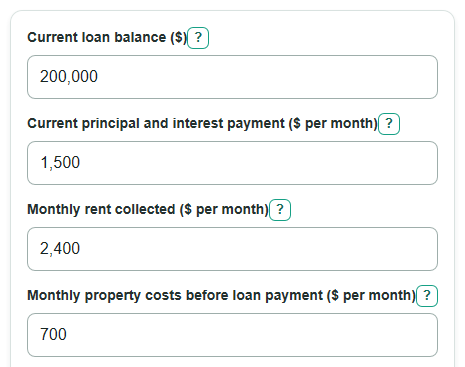
- Enter Current loan balance, Current principal and interest payment, Monthly rent collected, and Monthly property costs before loan payment.
- Enter the New interest rate, New loan length, and Refinance costs from your refinance quote or estimate.
- Open Advanced options if you need to add Extra cash taken out, choose How to pay refinance costs, or adjust Expected empty-time rate.
- Select Calculate and read Monthly cash flow after refinance first, then Debt coverage after refinance and Months to earn back refinance costs.
- Sanity-check the output by confirming New principal and interest payment is close to your lender quote and that rent, costs, and vacancy were not double-counted.
Definitions
Current loan balance: The unpaid principal balance on the existing rental property loan.
Principal and interest payment: The loan payment portion that repays borrowed money and interest. It does not include taxes, insurance, repairs, HOA dues, or management fees.
Refinance costs: Fees needed to close the refinance, such as lender fees, title fees, appraisal fees, and points.
Cash out: Extra money borrowed above the amount needed to pay off the current loan and any rolled-in costs.
Effective monthly rent: Monthly rent collected after reducing it by Expected empty-time rate.
Monthly net rent before debt: Effective monthly rent minus Monthly property costs before loan payment.
Debt coverage: Net rent before the loan payment divided by the loan payment. This is also called debt service coverage ratio, or DSCR.
Break-even months: The number of months of positive Monthly loan payment saved needed to recover Refinance costs.
Common mistakes and quick fixes
Mistake: Putting taxes, insurance, repairs, or HOA dues into Current principal and interest payment.
Fix: Put only the loan principal and interest in Current principal and interest payment, and put those property expenses in Monthly property costs before loan payment.
Mistake: Entering Monthly rent collected after subtracting vacancy and then also using Expected empty-time rate.
Fix: Use rent before vacancy in Monthly rent collected, or set Expected empty-time rate to 0 if the rent number is already reduced.
Mistake: Typing a monthly rate in New interest rate instead of an annual rate.
Fix: Enter the yearly rate in New interest rate, such as 6 for 6% per year.
Mistake: Adding Refinance costs to the new loan by increasing Current loan balance and also choosing Add costs to new loan in How to pay refinance costs.
Fix: Leave Current loan balance as the unpaid principal balance, enter the fees in Refinance costs, and let How to pay refinance costs handle the roll-in choice.
Mistake: Treating Monthly loan payment saved as total profit from the refinance.
Fix: Compare Monthly cash flow after refinance with Monthly cash flow before refinance because rent, vacancy, and property costs affect rental profit.
Mistake: Reading Months to earn back refinance costs when Monthly loan payment saved is zero or negative.
Fix: If Monthly loan payment saved is not positive, there is no payment-savings break-even month from the loan payment alone.
Limitations & Key Assumptions / Boundary Conditions
- The calculator estimates principal and interest only. It does not calculate escrow, taxes, insurance, private mortgage insurance, lender reserves, or adjustable-rate changes.
- Monthly property costs before loan payment are treated as one monthly amount. Real expenses can vary by season and by repair timing.
- Expected empty-time rate reduces rent as a simple percent. It does not model lease dates, eviction time, concessions, or bad debt separately.
- Debt coverage is a simplified monthly DSCR-style ratio using rent after vacancy minus non-loan property costs. A lender may use annual figures, different expense rules, and required reserves.
- Months to earn back refinance costs is based only on Monthly loan payment saved. It does not include tax effects, appreciation, sale timing, opportunity cost, or the value of cash taken out.
- If Refinance costs are added to the new loan, the calculator increases the new loan principal and payment. It still uses total Refinance costs for the payment-savings break-even calculation.
- Negative cash flow, negative Monthly loan payment saved, and negative Net cash from closing are valid outputs. They mean the property is short on cash, the new payment is higher, or you need cash at closing.
Methodology
Loan amount and payment
The new loan principal starts with Current loan balance, then adds Extra cash taken out and any Refinance costs that are rolled into the new loan. Principal and interest are the loan-payment parts used here [1].
rolled_costs = closing_costs if costs_treatment is roll_into_loan, otherwise 0
new_principal = current_balance + cash_out + rolled_costs
monthly_rate = new_rate_percent / 100 / 12
number_of_payments = new_term_years * 12
if monthly_rate = 0, new_monthly_pi = new_principal / number_of_payments
otherwise, new_monthly_pi = new_principal * monthly_rate / (1 - (1 + monthly_rate)^(-number_of_payments))
Rental cash flow and debt coverage
Rent is reduced by Expected empty-time rate before the calculator subtracts monthly non-loan property costs. Debt coverage is then computed from net rent before debt divided by the loan payment.
effective_rent = monthly_rent * (1 - vacancy_rate_percent / 100)
monthly_noi = effective_rent - monthly_non_loan_costs
current_cash_flow = monthly_noi - current_monthly_pi
cash_flow_after_refi = monthly_noi - new_monthly_pi
dscr_before_refi = monthly_noi / current_monthly_pi
dscr_after_refi = monthly_noi / new_monthly_pi
If a loan payment is 0, the matching debt coverage ratio is shown as N/A instead of dividing by zero.
Savings, break-even, and closing cash
Refinancing can involve lender and settlement costs, so the break-even result compares the total Refinance costs with the monthly principal and interest savings [2].
monthly_payment_saved = current_monthly_pi - new_monthly_pi
break_even_months = closing_costs / monthly_payment_saved when monthly_payment_saved > 0
upfront_costs = closing_costs if costs_treatment is pay_upfront, otherwise 0
net_cash_from_closing = cash_out - upfront_costs
If Monthly loan payment saved is 0 or negative, the calculator shows no payment-savings break-even month because the new payment does not recover costs through a lower loan payment.
Worked mini-example
For a $200,000 current balance, $1,500 current principal and interest payment, $2,400 rent, $700 monthly non-loan costs, 5% empty-time rate, 6% new rate, 30-year term, and $5,000 costs paid at closing, effective rent is $2,280 and monthly net rent before debt is $1,580. The new principal and interest payment is about $1,199.10, so Monthly cash flow after refinance is about $380.90. Debt coverage after refinance is about 1.32, Monthly loan payment saved is about $300.90, and Months to earn back refinance costs is about 16.62 months. Net cash from closing is -$5,000 because costs are paid upfront and no cash out is taken.