
Compare keeping your mortgage, recasting after a lump-sum payment, or refinancing with new loan costs and monthly escrow items.
Advanced options
Loan cost choices
Monthly housing budget
Mortgage comparison
Table of contents
How to use our Mortgage Recast vs Refinance Calculator
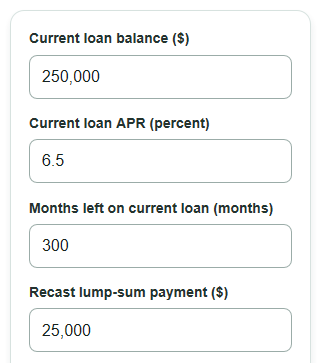
- Enter your Current loan balance, Current loan APR, and Months left on current loan from your mortgage statement.
- Enter the Recast lump-sum payment, New refinance APR, New refinance term, and Refinance closing costs you want to compare.
- Open Advanced options if you want to include Recast fee, whether to add closing costs to the new loan, Property tax, Home insurance, HOA dues, and PMI.
- Select Calculate, then compare Lowest monthly out-of-pocket payment first and review the principal-and-interest payments, break-even times, and long-term cost estimates.
- Sanity-check the output: a larger Recast lump-sum payment should usually lower Recast principal-and-interest payment, and a longer New refinance term often lowers the monthly payment but can increase total interest.
Definitions
Recast: A lender recalculates the payment after you make an extra principal payment, while the same loan, APR, and remaining term stay in place.
Refinance: A new mortgage replaces the old mortgage, usually with a new APR, new term, and closing costs.
APR: Annual percentage rate. In this calculator, it is the yearly rate used to find the monthly loan payment.
Principal-and-interest payment: The loan payment before property tax, home insurance, HOA dues, and PMI are added.
Escrow: Money collected with the mortgage payment for bills such as property tax and home insurance. This calculator also groups HOA dues and PMI into the monthly add-on for budgeting.
Closing costs: Fees and charges paid to finish a mortgage refinance, such as lender and title charges [1].
Break-even time: The number of months needed for monthly payment savings to cover a fee or closing cost.
PMI: Private mortgage insurance, a monthly cost that may apply when the loan balance is high compared with the home value.
Common mistakes and quick fixes
Mistake: Entering the original mortgage amount as Current loan balance.
Fix: Use the unpaid Current loan balance from your latest statement, not the price of the home or the starting loan amount.
Mistake: Typing a monthly rate into Current loan APR or New refinance APR.
Fix: Enter the yearly APR percent, such as 6.5, not 0.54 or a monthly interest rate.
Mistake: Using years in Months left on current loan or New refinance term.
Fix: Convert years to months, such as 25 years = 300 months and 30 years = 360 months.
Mistake: Putting yearly taxes into Property tax.
Fix: Enter Property tax as a monthly amount. Divide the yearly tax bill by 12 before entering it.
Mistake: Comparing Refinance monthly payment savings before escrow without looking at Refinance closing-cost break-even time.
Fix: Check how many months of savings are needed to recover Refinance closing costs, especially if you may sell or refinance again soon.
Mistake: Choosing Add closing costs to the new loan? without understanding the payment change.
Fix: If you choose Yes, Refinance principal-and-interest payment is based on Current loan balance plus Refinance closing costs.
Limitations & Key Assumptions / Boundary Conditions
- The calculator assumes fixed-rate, fully amortizing loans. It is not designed for adjustable-rate mortgages, interest-only loans, balloon loans, or loans with changing payment schedules.
- The same Property tax, Home insurance, HOA dues, and PMI amounts are added to each option. Real escrow amounts can change after a refinance, tax reassessment, insurance renewal, or PMI removal.
- Recast availability depends on the lender and loan type. Some loans cannot be recast, and some lenders require a minimum lump-sum payment.
- Refinance results do not include taxes, prepaid interest, escrow setup deposits, points, cash-out amounts, lender credits, or payoff statement adjustments unless you include them in Refinance closing costs.
- Break-even time uses principal-and-interest monthly savings only. It does not measure home equity, tax effects, investment returns, or the value of cash used for the Recast lump-sum payment.
- If monthly savings are zero or negative, the related break-even time is shown as not available because the fee is not recovered through lower monthly payments.
- Inputs must be nonnegative numbers, terms must be at least 1 month, and Recast lump-sum payment cannot be greater than Current loan balance.
Methodology
How the loan payments are calculated
The calculator uses the standard fixed-rate payment formula for each loan option. It first converts APR percent to a monthly rate by dividing by 100 and then by 12.
monthly_rate = APR_percent / 100 / 12
payment = principal * monthly_rate / (1 - (1 + monthly_rate)^(-months))
if monthly_rate = 0, payment = principal / months
Current principal-and-interest payment uses Current loan balance, Current loan APR, and Months left on current loan.
current_pi_payment = payment(current_balance, current_apr, remaining_months)
Recast principal-and-interest payment subtracts Recast lump-sum payment from Current loan balance, then keeps the current APR and remaining months.
recast_balance = current_balance - recast_lump_sum
recast_pi_payment = payment(recast_balance, current_apr, remaining_months)
Refinance principal-and-interest payment uses the current balance plus financed closing costs if Add closing costs to the new loan? is set to Yes.
financed_closing_costs = closing_costs if financed, otherwise 0
refinance_pi_payment = payment(current_balance + financed_closing_costs, new_apr, new_term_months)
How monthly out-of-pocket payment is calculated
The calculator adds the same monthly escrow amount to the principal-and-interest payment for each option.
monthly_escrow_added = monthly_property_tax + monthly_insurance + monthly_hoa + monthly_pmi
current_monthly_out_of_pocket = current_pi_payment + monthly_escrow_added
recast_monthly_out_of_pocket = recast_pi_payment + monthly_escrow_added
refinance_monthly_out_of_pocket = refinance_pi_payment + monthly_escrow_added
lowest_out_of_pocket_payment = min(current_monthly_out_of_pocket, recast_monthly_out_of_pocket, refinance_monthly_out_of_pocket)
How savings, break-even time, and long-term costs are calculated
Monthly savings compare principal-and-interest payments only, because the same escrow amount is added to each option.
recast_monthly_payment_savings = current_pi_payment - recast_pi_payment
refinance_monthly_payment_savings = current_pi_payment - refinance_pi_payment
Break-even time divides the fee or closing costs by monthly payment savings. If savings are zero or negative, break-even time is not available.
recast_fee_break_even_months = recast_fee / recast_monthly_payment_savings
refinance_fee_break_even_months = closing_costs / refinance_monthly_payment_savings
The long-term cost outputs estimate interest plus fees or closing costs beyond the current balance. For a recast, the lump-sum payment is included in the cash flow and then offset when the current balance is subtracted, so it is not treated as an added cost.
current_remaining_interest = current_pi_payment * remaining_months - current_balance
recast_remaining_interest_and_fee = recast_pi_payment * remaining_months + recast_lump_sum + recast_fee - current_balance
upfront_closing_costs = closing_costs if not financed, otherwise 0
refinance_interest_and_closing_costs = refinance_pi_payment * new_term_months + upfront_closing_costs - current_balance
Mini example
Suppose Current loan balance is $120,000, Current loan APR is 0 percent, Months left on current loan is 120, Recast lump-sum payment is $24,000, New refinance APR is 0 percent, New refinance term is 240 months, Refinance closing costs are $6,000 paid upfront, and Monthly escrow added to each option is $300.
The current payment is $120,000 / 120 = $1,000 per month before escrow. The recast payment is ($120,000 - $24,000) / 120 = $800 per month before escrow. The refinance payment is $120,000 / 240 = $500 per month before escrow.
After adding $300 of escrow, the out-of-pocket payments are $1,300 current, $1,100 recast, and $800 refinance, so Lowest monthly out-of-pocket payment is $800 per month. Refinance monthly payment savings before escrow are $500, so the $6,000 Refinance closing-cost break-even time is 12 months.
Sources
- What is a mortgage "closing?" What happens at the closing? | Consumer Financial Protection Bureau - Consumerfinance
- Mortgages | Consumer Financial Protection Bureau - Consumerfinance
- Mortgage answers | Consumer Financial Protection Bureau - Consumerfinance
- CFPB - 'Should I refinance?' handout (PDF) - Consumerfinance