
Compare your current debts with a consolidation loan and see when the upfront fee is paid back.
Table of contents
How to use our Debt Consolidation Break-Even Calculator
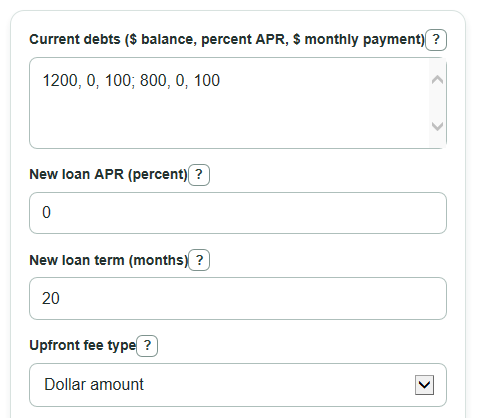
- Enter each item in Current debts (balance, APR, monthly payment) as balance, APR, payment, using one line or a semicolon for each debt.
- Enter the New loan APR and New loan term for the consolidation loan you are considering.
- Choose the Upfront fee type, then enter the Upfront fee as either a dollar amount or a percent of the debt.
- Open Advanced options if you want to change Check-in time or set a Start date for the estimated break-even date.
- Click Calculate, then sanity-check the results by comparing New loan monthly payment with Current first-month debt payments and checking whether Total paid change including fee agrees with your goal.
Definitions
APR: Annual percentage rate, or APR, is the yearly borrowing rate shown as a percent. In this calculator, APR is divided by 12 to estimate monthly interest [2].
Debt consolidation: Combining several debts into one new loan or balance, usually to change the payment, rate, payoff time, or fee structure.
Upfront fee: A cost paid to switch to the new loan, such as an origination fee or balance transfer fee. This calculator treats it as paid upfront, not added to the new loan balance.
Fee break-even month: The first month when the new plan has kept enough cash to pay back the upfront fee.
Cash kept by check-in time: Current plan payments minus new loan payments minus the upfront fee through the month you choose.
Total paid change including fee: Current plan total payments minus new loan total payments and the upfront fee. Positive means the new plan lowers the total paid; negative means it raises the total paid.
Common mistakes and quick fixes
Mistake: Entering Current debts (balance, APR, monthly payment) as one total balance with one guessed rate when your debts have different APRs or payments.
Fix: Enter each debt separately so Fee break-even month uses the actual month-by-month payment pattern.
Mistake: Leaving New loan APR blank because the loan is interest-free.
Fix: Type 0 in New loan APR if the rate is really 0 percent.
Mistake: Using years in New loan term instead of months.
Fix: Convert the term before entering it, such as 5 years = 60 months in New loan term.
Mistake: Choosing Upfront fee type as Percent of debt but entering a dollar fee in Upfront fee.
Fix: Choose Dollar amount for a fixed fee, or enter the percent number when Upfront fee type is Percent of debt.
Mistake: Reading Cash kept by check-in time as total savings over the whole loan.
Fix: Use Cash kept by check-in time for the month you picked, and use Total paid change including fee for the full payoff comparison.
Mistake: Ignoring a negative Total paid change including fee because First-month payment lower by is positive.
Fix: Treat a lower payment and a higher total cost as a tradeoff, not as automatic savings.
Limitations & Key Assumptions / Boundary Conditions
- The upfront fee is treated as paid at the start and is not added to the new loan principal.
- Each current debt payment is assumed to stay the same until that debt is paid off.
- The new loan uses a fixed monthly payment based on the entered APR and term.
- The calculator does not model late fees, changing minimum payments, promotional rate expiration, taxes, credit score changes, or lender approval rules.
- APR is converted to a monthly rate by dividing by 12, so exact lender statements can differ when interest is compounded or billed differently.
- Schedules stop at 1,200 months. If a payment does not reduce a balance fast enough, the calculator asks you to fix the input instead of showing a misleading result.
- The Estimated break-even date is a calendar estimate from the Start date, not a lender payoff quote.
Methodology
How the comparison is built
The calculator reads each debt as a balance, APR, and monthly payment. It adds the current balances to get the new loan principal, then simulates the current debts and the new loan one month at a time.
monthly_rate = apr_percent / 100 / 12
For the consolidation loan, the scheduled payment uses the fixed-payment loan formula. If the monthly rate is zero, the payment is the principal divided by the term.
payment = principal / months when monthly_rate = 0
payment = principal * monthly_rate / (1 - (1 + monthly_rate)^(-months)) when monthly_rate is not 0
Monthly payoff simulation
Each month, interest is added first. The actual payment is the smaller of the scheduled payment or the payoff amount needed for that month, so the final payment can be smaller than the regular payment.
interest = balance * monthly_rate
actual_payment = min(scheduled_payment, balance + interest)
new_balance = balance + interest - actual_payment
Fee and break-even math
The fee is based on the Upfront fee type. A percent fee is applied to the total current balance. A dollar fee is used as entered.
fee = total_current_balance * fee_value / 100 for a percent fee
fee = fee_value for a dollar fee
For each month, the calculator compares cumulative cash paid under the current plan with cumulative cash paid under the new loan, then subtracts the upfront fee. The first month where this number is zero or positive is the Fee break-even month.
net_by_month = cumulative_current_payments - cumulative_new_payments - fee
break_even_month = first month where net_by_month >= 0
The full payoff comparison keeps the sign so a higher-cost consolidation plan is visible.
total_paid_change_including_fee = total_current_payments - total_new_loan_payments - fee
Mini-example
Suppose the current debts are $1,200 at 0 percent APR with a $100 payment and $800 at 0 percent APR with a $100 payment. The new loan is $2,000 at 0 percent APR for 20 months, so the New loan monthly payment is $100. With a $200 upfront fee, the first-month payment is $100 lower than the current plan. After 2 months, the cash-flow savings are $200, so the Fee break-even month is 2. By month 12, the current plan has paid $2,000 and the new loan has paid $1,200; after subtracting the $200 fee, Cash kept by check-in time is $600. Over the full payoff, Total paid change including fee is -$200 because both plans repay the same $2,000 principal but the new plan adds the fee.