
Compare your credit card payoff plan with a personal loan, including interest, payoff time, and any origination fee.
Table of contents
How to use our Personal Loan vs Credit Card Payoff Calculator
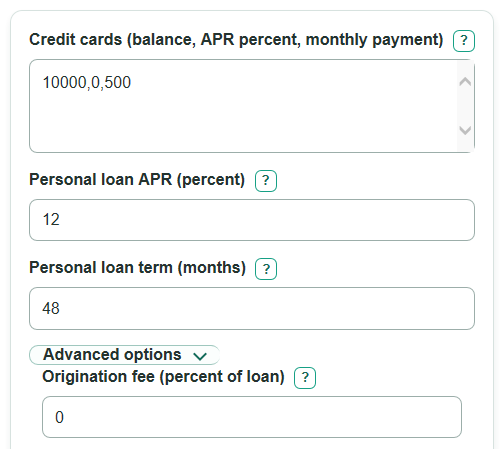
- Enter each card in Credit cards (balance, APR percent, monthly payment), with one card per line in that order.
- Enter "Personal loan annual interest rate (percent)" using the contract interest rate, excluding fees, and enter "Personal loan term (months)" from the offer.
- Open Advanced options if the loan has an Origination fee, then choose How the fee is paid.
- Click Calculate and read Interest and fees saved with the personal loan first; a negative number means the loan costs more.
- Sanity-check the answer by comparing Personal loan monthly payment with what you can afford and by making sure every card payment is more than one month of interest.
Definitions
Credit card APR: The annual rate used here to estimate card interest with a monthly-rate approximation. Credit card APR is usually shown on your statement or account page [1].
Credit cards (balance, APR percent, monthly payment): The card balance you want to pay off, the card APR, and the fixed payment you plan to keep making each month.
Personal loan annual interest rate (percent): The fixed contract rate charged on the loan balance. A disclosed loan APR can include fees; do not enter that fee-inclusive APR here because the calculator adds the origination fee separately.
Personal loan term: The number of monthly payments on the personal loan.
Origination fee: A one-time loan charge entered as a percent of the card balances being paid off.
Interest and fees saved with the personal loan: Credit card interest minus personal loan interest and origination fee cost. Positive means the loan costs less. Negative means it costs more.
Common mistakes and quick fixes
Mistake: Putting a percent sign, dollar sign, or extra note inside Credit cards (balance, APR percent, monthly payment) can make a row hard to read.
Fix: Use one plain row per card, such as 2500,24.99,90.
Mistake: Entering only the minimum due in Credit cards (balance, APR percent, monthly payment) when that payment is not more than one month of interest.
Fix: Raise the payment for that card or remove it from the comparison until you have a payoff plan that can reduce the balance.
Mistake: Entering a fee-inclusive loan APR or a monthly rate in "Personal loan annual interest rate (percent)". Fix: Enter the contract annual interest rate, such as 12 for 12 percent annual interest, and model the origination fee separately.
Mistake: Entering years in Personal loan term instead of months.
Fix: Convert the offer term to months, such as 48 for a 4-year loan.
Mistake: Leaving out an Origination fee because it is charged only once.
Fix: Enter the fee percent if the loan offer has one, because it can change whether the personal loan is cheaper.
Mistake: Choosing the wrong How the fee is paid option.
Fix: Pick Add fee to the loan if the lender finances the fee, or Pay fee upfront if you must pay it in cash today.
Limitations & Key Assumptions / Boundary Conditions
- The credit card side assumes no new purchases, no late fees, no annual fees, and no payment changes.
- For multiple cards, the payoff time is the longest individual card payoff time. The method does not move freed-up payments from paid-off cards to remaining cards.
- The personal loan side assumes a fixed contract annual interest rate, fixed monthly payment, and the exact term you enter. It does not derive a contract rate from a fee-inclusive APR.
- The origination fee is modeled as a percent of the card balances. It does not handle flat dollar fees or lender-specific fee caps.
- If the fee is added to the loan, the calculator assumes you borrow the fee and pay interest on it. If it is paid upfront, the calculator counts it as a cost but not as part of the loan payment.
- Real card interest can differ because many cards use a daily balance method, grace period rules, and transaction timing [2].
- This is a payoff-cost comparison only. It does not decide loan approval, credit score effects, tax issues, or whether closing cards is a good idea.
Methodology
How the credit card side is calculated
Each card row is calculated by turning APR into a monthly rate, then finding how many fixed monthly payments are needed to pay the balance to zero.
monthly_rate = apr_percent / 100 / 12
payoff_months = ceil(-ln(1 - balance * monthly_rate / monthly_payment) / ln(1 + monthly_rate))
If the card APR is 0, the calculator uses straight division instead.
payoff_months = ceil(balance / monthly_payment)
Card interest is the total paid through the final payoff month minus the starting balance. For more than one card, the calculator adds the balances, payments, and interest. The card payoff time is the longest payoff time among the entered cards.
card_interest = payments_through_final_payoff - balance
How the personal loan side is calculated
The origination fee is based on the total card balance entered.
fee_amount = total_card_balance * origination_fee_percent / 100
If the fee is added to the loan, the loan principal includes the fee and the upfront fee is 0. If the fee is paid upfront, the loan principal is only the card balance and the upfront fee equals the fee amount.
loan_principal = total_card_balance + fee_amount when fee is added to the loan
loan_principal = total_card_balance when fee is paid upfront
The personal loan payment uses the standard fixed-payment formula with monthly_rate = contract annual interest rate / 1200. If the interest rate is 0, payment is principal divided by term months.
loan_payment = loan_principal * monthly_rate / (1 - (1 + monthly_rate)^(-term_months))
loan_payment = loan_principal / term_months when monthly_rate = 0
How the comparison is calculated
The main answer compares credit card interest with personal loan interest plus the origination fee. Negative savings are not hidden, because a negative result means the personal loan costs more.
loan_interest_and_fees = loan_payment * term_months + upfront_fee - total_card_balance
interest_and_fees_saved = total_card_interest - loan_interest_and_fees
monthly_payment_change_with_loan = loan_payment - total_card_payment
payoff_months_change_with_loan = loan_term_months - credit_card_payoff_months
Mini-example
Suppose one card has a $1,200 balance, 0 percent APR, and a $100 monthly payment. It pays off in 12 months with $0 interest. A 12-month personal loan at 12 percent contract annual interest, with a 10 percent origination fee paid upfront, has a $106.62 monthly payment and a $120 fee. Loan interest and fees total about $199.42, so the savings result is -$199.42: the loan costs more despite the same payoff time.
Sources
CFPB: loan interest rate versus APR explains why the contract interest rate and the fee must be treated separately here.