
Calculate both rental expense ratio definitions from rent, vacancy, other income, and monthly operating expenses.
Table of contents
How to use our Rental Property Expense Ratio Calculator
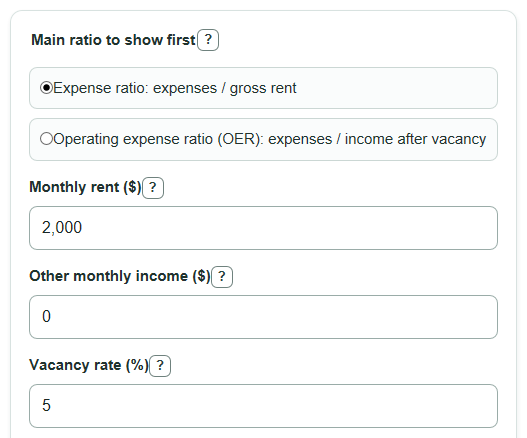
- Choose Main ratio to show first based on the definition you want highlighted: gross rent expense ratio or OER.
- Enter Monthly rent before vacancy, then add Other monthly income such as parking, laundry, storage, or pet rent.
- Enter Vacancy rate as a percent and Monthly operating expenses before any mortgage payment, depreciation, or major upgrade costs.
- Click Calculate and compare Selected expense ratio with the other ratio shown below it.
- Sanity-check the output: if Monthly income left before loan payments (NOI) is negative or either ratio is over 100%, expenses are larger than the chosen income base.
Definitions
Monthly rent: The scheduled rent for the property before vacancy, missed rent, or expenses are subtracted.
Other monthly income: Extra rental income besides base rent, such as parking, laundry, pet rent, or storage fees.
Vacancy rate: The percent of scheduled rent you expect to lose because the property is empty or rent is not collected.
Monthly operating expenses: Regular costs to run the rental, such as property taxes, insurance, repairs, utilities, HOA fees, and management. This calculator excludes mortgage payments, depreciation, and major upgrades.
Gross rent expense ratio: Monthly operating expenses divided by Monthly rent, before vacancy and other income.
Operating expense ratio (OER): Monthly operating expenses divided by income after vacancy. OER is often used to compare the cost to operate a rental property with the income it produces.
NOI: Net operating income, meaning income after vacancy minus operating expenses before loan payments.
Common mistakes and quick fixes
Mistake: Entering rent after vacancy in Monthly rent.
Fix: Use scheduled rent before vacancy in Monthly rent, then put the expected loss in Vacancy rate.
Mistake: Adding parking, laundry, or pet rent into Monthly rent.
Fix: Keep base rent in Monthly rent and put those add-ons in Other monthly income.
Mistake: Including a mortgage payment in Monthly operating expenses.
Fix: Use regular property operating costs in Monthly operating expenses; the NOI outputs are before loan payments.
Mistake: Comparing Selected expense ratio to a benchmark without checking the definition.
Fix: Read Definition comparison note and compare gross-rent ratios only with gross-rent ratios, or OER only with OER.
Mistake: Treating Expenses divided by income after vacancy (OER) as the same as Expenses divided by gross rent.
Fix: Use Expenses divided by gross rent when the source ignores vacancy and other income, and use Expenses divided by income after vacancy (OER) when it uses effective income.
Limitations & Key Assumptions / Boundary Conditions
- Monthly rent must be greater than $0 because the gross-rent ratio divides by Monthly rent.
- Vacancy rate must be from 0% to 100%. A blank or invalid percent should be corrected instead of treated as 0%.
- Other monthly income and Monthly operating expenses are treated as nonnegative monthly amounts.
- Vacancy is applied only to Monthly rent. Other monthly income is added after the vacancy allowance.
- If income after vacancy is $0, OER cannot be calculated because it would divide by zero.
- Monthly operating expenses exclude mortgage payments, depreciation, income taxes, and major capital upgrades. Including them will make the ratios too high for an operating expense comparison.
- The calculator is a simple operating view. It does not model taxes, loan amortization, reserves, rent growth, seasonal vacancy, or one-time repairs.
Methodology
Calculation steps
The calculator first finds income after vacancy by reducing scheduled rent for vacancy, then adding Other monthly income.
effective_monthly_income = monthly_rent * (1 - vacancy_rate / 100) + other_income
It then calculates the gross-rent expense ratio. This definition ignores vacancy and other income.
gross_rent_expense_ratio_pct = monthly_operating_expenses / monthly_rent * 100
It also calculates OER using income after vacancy as the income base.
effective_income_oer_pct = monthly_operating_expenses / effective_monthly_income * 100
The selected ratio is only the ratio shown first. Both definitions are still calculated.
highlighted_expense_ratio_pct = gross_rent_expense_ratio_pct if ratio_basis = gross_rent; otherwise effective_income_oer_pct
NOI is calculated before loan payments.
monthly_noi_before_loan = effective_monthly_income - monthly_operating_expenses
annual_noi_before_loan = monthly_noi_before_loan * 12
Mini example
For Monthly rent of $2,000, Other monthly income of $150, Vacancy rate of 10%, and Monthly operating expenses of $800, income after vacancy is $2,000 * 0.90 + $150 = $1,950.
The gross-rent expense ratio is $800 / $2,000 * 100 = 40.00%. The OER is $800 / $1,950 * 100 = 41.03%. Monthly NOI is $1,950 - $800 = $1,150, and yearly NOI is $13,800.