
Use this calculator to split a full-year property tax bill and see the signed closing credit for your closing date.
Advanced options
Table of contents
How to use our Property Tax Proration Calculator
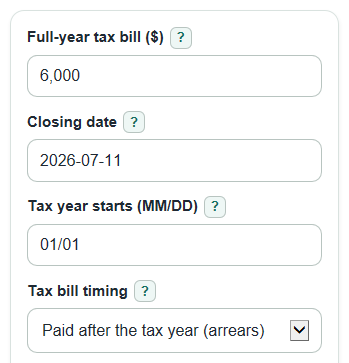
- Enter the Full-year tax bill for the whole tax period, not just the part paid at closing.
- Set the Closing date and Tax year starts so the calculator can find the tax period that contains the closing.
- Choose Tax bill timing and Who gets the closing day to match the contract, title company worksheet, or local custom.
- Open Advanced options only if you need to change the Day count rule or use a Tax bill estimate factor because the final bill is not known.
- Check that Seller proration days plus Buyer proration days equals Tax days in the full period, then read Credit to buyer at closing as positive for a seller credit and negative for a buyer reimbursement.
Definitions
Property tax proration: A split of one tax period between buyer and seller based on the days each side is treated as owning the property.
Arrears: Paid after the tax year. If taxes are in arrears, the seller usually credits the buyer for the seller's days because the buyer may handle a later bill.
Advance: Paid before or during the tax year. If taxes are paid in advance, a negative buyer credit means the buyer reimburses the seller for the buyer's days.
Proration days: The counted days assigned to the seller or buyer under the selected closing-day rule.
Day count rule: The way days are counted. Actual days uses the real calendar. The 360-day rule treats each month as 30 days.
Adjusted full-year tax bill: The full-year tax bill after applying the estimate factor percent.
Credit to buyer at closing: The signed settlement-style amount. Positive means the seller credits the buyer. Negative means the buyer reimburses the seller.
Common mistakes and quick fixes
Mistake: Entering a half-year installment in Full-year tax bill when the split should use the whole tax period.
Fix: Enter the full-year amount, or adjust it first so Adjusted full-year tax bill matches the tax amount being prorated.
Mistake: Leaving Tax year starts at 01/01 when the property uses a fiscal tax year.
Fix: Enter the real month and day, such as 07/01, so Seller proration days and Buyer proration days are counted in the right period.
Mistake: Choosing the wrong Tax bill timing and treating the shares as the closing credit.
Fix: Use arrears if the bill is paid after the tax year and advance if it is paid before the tax year; then rely on Credit to buyer at closing for the signed settlement amount.
Mistake: Ignoring Who gets the closing day when the closing happens near the start or end of the tax period.
Fix: Match the contract wording because moving one day can change Seller tax share and Buyer tax share .
Mistake: Comparing a result that uses Day count rule actual days with a worksheet that uses 30-day months.
Fix: Set Day count rule to the same method before comparing Tax cost per proration day .
Mistake: Typing 1.10 in Tax bill estimate factor to mean a 10 percent increase.
Fix: Enter 110 for a 10 percent increase, or 100 when the Full-year tax bill is final.
Limitations & Key Assumptions / Boundary Conditions
- This calculator does not choose state, county, title company, lender, or contract defaults for you. Use the convention required for your closing.
- It prorates one full tax period. It does not separately handle exemptions, supplemental bills, reassessments, special assessments, penalties, escrow rules, or multiple tax parcels.
- The final tax bill can differ from an estimate. Use Tax bill estimate factor only when you know why the entered bill should be scaled.
- The 360-day method is a simple 30-day-month convention. It may not match every local worksheet that uses a different 30/360 variant.
- If Tax year starts is 02/29, local practice may use 02/28 or 03/01 in non-leap years. The calculator asks you to enter a usable convention instead of guessing.
- Rounding is for display. Small penny differences can appear if a closing statement rounds the per-day amount before multiplying by days.
Methodology
How the split is calculated
Property tax proration splits a tax bill between buyer and seller based on the days assigned to each side during the tax period [2]. The calculator first finds the one-year tax period that contains the Closing date using Tax year starts. For example, if Tax year starts is 01/01 and the Closing date is 2025-06-30, the tax period is the 2025 calendar year.
adjusted_tax_bill = annual_tax * (tax_bill_factor / 100)
If Day count rule is actual days, the calculator counts calendar days from the period start up to the closing date. If the seller gets the closing day, one more day is added to the seller count. The buyer receives the remaining days.
seller_days = days_between(period_start, closing_date) + 1 if seller gets the closing day, otherwise days_between(period_start, closing_date)
buyer_days = period_days - seller_days
If Day count rule is 30-day months, 360-day year, the full period is 360 days. The day count before closing uses 30 days for each month and caps the start day and closing day at 30.
seller_days_before_closing = 360 * (close_year - start_year) + 30 * (close_month - start_month) + (min(close_day, 30) - min(start_day, 30))
tax_per_day = adjusted_tax_bill / period_days
seller_tax_share = tax_per_day * seller_days
buyer_tax_share = tax_per_day * buyer_days
Credit direction
The shares show who owes tax for the period. The signed closing credit depends on Tax bill timing. With arrears, the seller's share becomes a positive credit to the buyer. With advance payment, the buyer's share becomes a negative credit to buyer, which means the buyer reimburses the seller.
credit_to_buyer_at_closing = seller_tax_share if billing_timing = arrears
credit_to_buyer_at_closing = -buyer_tax_share if billing_timing = advance
Mini-example
For a $6,000 full-year bill, a 2025-06-30 closing, a 01/01 tax year start, actual days, arrears billing, and buyer gets the closing day, the period has 365 days. The seller has 180 days and the buyer has 185 days. The daily tax cost is $16.438356, so the seller share is $2,958.90 and the buyer share is $3,041.10. Because billing is in arrears, the Credit to buyer at closing is +$2,958.90.