
Compare an EV and a gas car using purchase price, miles, energy prices, maintenance, insurance, incentives, and resale value.
Advanced options
Table of contents
How to use our EV vs Gas Car Total Cost Calculator
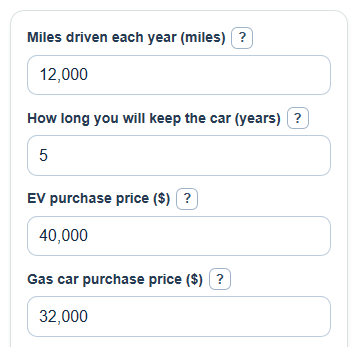
- Enter Miles driven each year (miles), How long you will keep the car (years), EV purchase price ($), and Gas car purchase price ($).
- Enter EV efficiency (kWh per 100 miles), Electricity price ($ per kWh), Gas car fuel economy (MPG), and Gas price ($ per gallon).
- Open Advanced options if you want to include EV incentive or rebate ($), Home charger setup cost ($), maintenance, insurance, or value when sold.
- Select Calculate and read EV savings over gas first; a positive number means the EV costs less, while a negative number means the gas car costs less.
- Sanity-check the result by comparing EV cost per mile and Gas car cost per mile, then look at Gas price where totals tie and Electricity price where totals tie to see how much energy prices would need to change.
Definitions
Total ownership cost: The out-of-pocket cost over your chosen years: purchase price minus incentives, plus energy, maintenance, optional charger setup, optional insurance, and minus value when sold.
EV savings over gas: Gas car total cost minus EV total cost. Positive means the EV costs less. Negative means the EV costs more.
EV efficiency (kWh per 100 miles): The electricity the EV uses to drive 100 miles. Lower is better for electricity cost.
Gas car fuel economy (MPG): Miles per gallon. Higher is better for gasoline cost.
Value when sold: The resale or trade-in amount subtracted at the end of the ownership period.
Gas price where totals tie: The gasoline price that would make EV total cost and gas car total cost equal, with other inputs unchanged.
Electricity price where totals tie: The charging price that would make EV total cost and gas car total cost equal, with other inputs unchanged.
Years until EV catches up: The time needed for lower EV running costs to pay back a higher starting cost, if that happens.
Common mistakes and quick fixes
Mistake: Putting monthly miles in Miles driven each year (miles).
Fix: Enter a yearly total, such as 12,000, or multiply your monthly miles by 12 first.
Mistake: Entering EV efficiency (kWh per 100 miles) as miles per kWh.
Fix: Use kWh per 100 miles from the vehicle label or FuelEconomy.gov; lower numbers mean less electricity used.
Mistake: Leaving Electricity price ($ per kWh) or Gas price ($ per gallon) blank.
Fix: Enter the expected price for charging and gasoline; required energy price fields cannot be blank.
Mistake: Counting a tax credit twice by lowering EV purchase price ($) and also entering EV incentive or rebate ($).
Fix: Either reduce the purchase price or use the incentive field, but do not do both for the same discount.
Mistake: Entering EV value when sold ($) or Gas car value when sold ($) as a percent instead of dollars.
Fix: Enter the expected sale or trade-in amount in dollars, such as 18,000.
Mistake: Comparing different insurance choices in EV insurance cost ($ per year) and Gas car insurance cost ($ per year).
Fix: Use quotes with the same driver, coverage, deductible, and location so the comparison stays fair.
Limitations & Key Assumptions / Boundary Conditions
- The result is a planning estimate, not a quote from a dealer, lender, insurer, utility, or tax agency.
- Financing, sales tax, registration fees, repair surprises, tires, parking, tolls, and charging network fees are not included unless you fold them into one of the editable fields.
- EV incentive or rebate ($) should be entered only when you are sure you qualify. Clean vehicle credit rules can depend on vehicle, buyer, price, income, date, and other requirements.
- Electricity price ($ per kWh) is treated as the billed charging price. Real charging cost can differ because of time-of-use rates, charging losses, demand charges, free charging, or public fast charging prices.
- Gas price ($ per gallon), Gas car fuel economy (MPG), and EV efficiency (kWh per 100 miles) are treated as average values for the full ownership period.
- EV value when sold ($) and Gas car value when sold ($) are subtracted only at the end. The calculator does not predict depreciation.
- Years until EV catches up excludes resale values because resale happens when you sell the car, not every year.
- Negative savings, negative break-even energy prices, or negative total costs are shown when the math produces them. Check resale, incentives, and price inputs if that looks unrealistic.
Methodology
Core math
The calculator compares two total ownership costs over the same miles and years. It uses annual miles, MPG, and EV kWh per 100 miles because those are common inputs for comparing gas vehicles and EVs [3].
total_miles = annual_miles * ownership_years
ev_energy_cost = total_miles * (ev_kwh_per_100_miles / 100) * electricity_price_per_kwh
gas_fuel_cost = (total_miles / gas_mpg) * gas_price_per_gallon
ev_maintenance_cost = total_miles * ev_maintenance_per_mile
gas_maintenance_cost = total_miles * gas_maintenance_per_mile
ev_insurance_cost = ownership_years * ev_insurance_per_year
gas_insurance_cost = ownership_years * gas_insurance_per_year
ev_total_cost = ev_purchase_price - ev_incentives + home_charger_cost + ev_energy_cost + ev_maintenance_cost + ev_insurance_cost - ev_resale_used
gas_total_cost = gas_purchase_price - gas_incentives + gas_fuel_cost + gas_maintenance_cost + gas_insurance_cost - gas_resale_used
ev_savings_over_gas = gas_total_cost - ev_total_cost
ev_cost_per_mile = ev_total_cost / total_miles
gas_cost_per_mile = gas_total_cost / total_miles
Break-even checks
The break-even gas price keeps the EV side fixed and solves for the gasoline price that would make the gas total match the EV total.
break_even_gas_price_per_gallon = (ev_total_cost - gas_non_fuel_cost) * gas_mpg / total_miles
gas_non_fuel_cost = gas_purchase_price - gas_incentives + gas_maintenance_cost + gas_insurance_cost - gas_resale_used
The break-even electricity price keeps the gas side fixed and solves for the charging price that would make the EV total match the gas total.
break_even_electricity_price_per_kwh = (gas_total_cost - ev_non_energy_cost) / (total_miles * (ev_kwh_per_100_miles / 100))
ev_non_energy_cost = ev_purchase_price - ev_incentives + home_charger_cost + ev_maintenance_cost + ev_insurance_cost - ev_resale_used
For Years until EV catches up, the calculator compares the EV's higher or lower starting cost with yearly running-cost savings. Resale values are not used in this payback check.
fixed_gap = (ev_purchase_price - ev_incentives + home_charger_cost) - (gas_purchase_price - gas_incentives)
annual_running_savings = ((annual_miles / gas_mpg) * gas_price_per_gallon + annual_miles * gas_maintenance_per_mile + gas_insurance_per_year) - (annual_miles * (ev_kwh_per_100_miles / 100) * electricity_price_per_kwh + annual_miles * ev_maintenance_per_mile + ev_insurance_per_year)
if fixed_gap <= 0, break_even_years = 0; else if annual_running_savings > 0, break_even_years = fixed_gap / annual_running_savings; else break_even_years = N/A
Default maintenance rates
The default EV maintenance cost is $0.061 per mile and the default gas car maintenance cost is $0.101 per mile, based on a DOE scheduled maintenance estimate for battery-electric and conventional light-duty vehicles [1]. You can replace those rates in Advanced options.
Mini-example
Using 12,000 miles per year for 5 years gives 60,000 total miles. With a $40,000 EV, a $32,000 gas car, 30 kWh per 100 miles, $0.16 per kWh, 30 MPG, $3.50 per gallon, and the default maintenance rates, the EV electricity cost is $2,880 and the gas fuel cost is $7,000.
ev_total_cost = 40000 + 2880 + (60000 * 0.061) = 46540
gas_total_cost = 32000 + 7000 + (60000 * 0.101) = 45060
ev_savings_over_gas = 45060 - 46540 = -1480
In that example, the negative savings means the EV costs $1,480 more over 5 years. The same inputs give a gas tie price of about $4.24 per gallon and an electricity tie price of about $0.078 per kWh.