
Estimate your fixed monthly payment, payoff time, interest, fees, and total cost for an installment loan.
Table of contents
How to use our Installment Loan Calculator
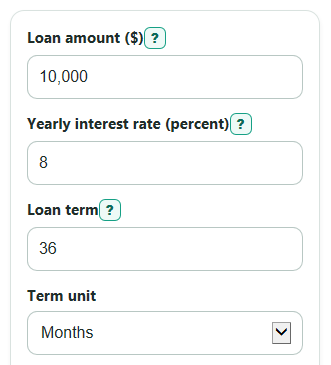
- Enter the Loan amount ($), Yearly interest rate (percent), Loan term, Term unit, and First payment date from your loan offer.
- Open Advanced options if your offer has an Origination fee (percent), a special How the fee is handled choice, or an Extra monthly payment ($).
- Click Calculate to see the Required monthly payment, Time to pay off, Estimated payoff month, and total cost results.
- Check Cash you receive and Starting balance used for payment. If they do not match how the lender explains the fee, change How the fee is handled.
- Sanity-check the result by confirming that Total paid to lender and upfront is higher than Loan amount ($) when the rate or fee is above 0, and that Interest saved by paying extra is 0 when Extra monthly payment ($) is 0.
Definitions
Loan amount ($): The stated amount of the loan offer before the optional origination fee adjustment.
Yearly interest rate (percent): The annual rate used to calculate monthly interest. If the offer gives APR and no separate rate, use that percent for this estimate.
Loan term: The planned length of the loan, entered in months or years using Term unit.
Origination fee (percent): A one-time lender fee for making or processing the loan, entered as a percent of Loan amount ($) [2].
How the fee is handled: The choice that decides whether the fee lowers Cash you receive, increases Starting balance used for payment, or is paid upfront separately.
Starting balance used for payment: The balance the fixed-payment formula pays off.
Cash you receive: The money available to you after the selected fee treatment.
Total borrowing cost: Total paid to lender and upfront minus Cash you receive. This is the cost above the cash you actually get.
Common mistakes and quick fixes
Mistake: Entering the cash you want in Loan amount ($) when the lender subtracts a fee first.
Fix: Enter the stated loan offer amount in Loan amount ($), then use Origination fee (percent) and How the fee is handled to see Cash you receive.
Mistake: Typing a monthly rate in Yearly interest rate (percent).
Fix: Use the annual percent from the offer, such as 8 for 8 percent per year.
Mistake: Choosing Years in Term unit but leaving Loan term as a month count.
Fix: If the loan is 36 months, choose Months or enter 3 and choose Years.
Mistake: Ignoring How the fee is handled when comparing offers.
Fix: Match the lender wording: taken from cash, added to the loan balance, or paid upfront separately.
Mistake: Treating Extra monthly payment ($) as part of the Required monthly payment.
Fix: Read Required monthly payment as the scheduled payment, then add Extra monthly payment ($) only if you plan to pay more each month.
Limitations & Key Assumptions / Boundary Conditions
- The estimate assumes a fixed yearly interest rate and equal monthly payments.
- Interest is added once per monthly period before each payment. A lender using daily interest can give a slightly different payoff amount.
- The calculator includes the origination fee choices shown, but it does not include late fees, insurance, taxes, skipped payments, prepayment penalties, or other lender charges.
- First payment date is used only to estimate the payoff month. It does not change the payment amount.
- If a lender quotes APR, finance charge, or payment schedule in a legally required disclosure, use the lender disclosure for the final borrowing decision.
- If Origination fee (percent) is large enough that Cash you receive is zero or negative, the offer needs a careful lender check before using the result.
Methodology
Payment math
The calculator first converts the loan length to monthly payments.
n = loan_term if term_unit = months
n = loan_term * 12 if term_unit = years
It converts the yearly percent rate to a monthly decimal rate.
monthly_rate = annual_rate_percent / 100 / 12
If the monthly rate is 0, the required payment is the starting balance divided by the number of payments.
monthly_payment = starting_balance / n
If the monthly rate is above 0, the fixed-payment formula is used.
monthly_payment = starting_balance * monthly_rate * (1 + monthly_rate)^n / ((1 + monthly_rate)^n - 1)
Fee handling
The origination fee is calculated from the stated loan amount.
fee = loan_amount * origination_fee_percent / 100
If the fee is added to the loan balance, the starting balance is loan amount plus fee and cash received stays equal to the loan amount. If the fee is taken from cash you receive, the starting balance stays equal to the loan amount and cash received is loan amount minus fee. If the fee is paid upfront separately, the starting balance and cash received both equal the loan amount, and the fee is added to total paid.
Extra payment loop
When Extra monthly payment ($) is above 0, the calculator pays down the balance month by month. Interest is added first, then the scheduled payment plus the extra payment is applied. The final payment is reduced if the planned payment would overpay the loan.
interest = balance * monthly_rate
amount_due = balance + interest
actual_payment = min(monthly_payment + extra_monthly_payment, amount_due)
balance = amount_due - actual_payment
Total interest is the sum of monthly interest amounts. Total paid to lender and upfront is the sum of actual payments plus any separate upfront fee.
total_borrowing_cost = total_paid - cash_received
interest_saved_with_extra = scheduled_borrowing_cost - total_borrowing_cost
Mini example
For a $10,000 loan at 8 percent for 36 months, with no origination fee and no extra payment, the required monthly payment is about $313.36. Total paid is about $11,281.09, so total interest and cost above the cash received are both about $1,281.09.
Calculation choices
The payoff month is the First payment date advanced by the number of payoff payments minus 1 month. Balance comparisons are handled to the nearest cent so tiny floating-point remainders do not create an extra payment.