
Check if an annual-fee credit card beats a no-fee card after the benefits and extra reward rate you actually expect to use.
Table of contents
How to use our Credit Card Annual Fee Break-Even Calculator
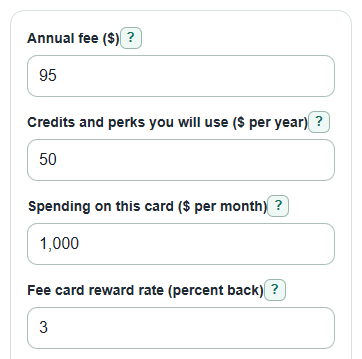
- Enter the Annual fee ($) and the Credits and perks you will use ($ per year), counting only benefits that replace spending you would have made anyway.
- Enter Spending on this card ($ per month), then add the Fee card reward rate (percent back) and No-fee card reward rate (percent back) for the same purchases.
- Open Advanced options if you want to include Welcome bonus value ($) or Extra costs to use benefits ($ per year).
- Click Calculate and read Ongoing value vs no-fee card first for the normal renewal-year answer.
- Sanity-check the result: if the fee card reward rate is only slightly higher than the no-fee card rate, the Monthly spending needed to break even can be high unless credits and perks cover much of the fee.
Definitions
Annual fee: The yearly cost charged for holding the card.
Credits and perks you will use: The dollar value of benefits that replace money you would have spent anyway.
Reward rate: The value earned back from purchases, shown as a percent of spending. A 3 percent rate means about $3 of value per $100 spent.
No-fee card reward rate: The reward rate you could get from a card with no annual fee for the same purchases. It is the baseline in this calculator.
Extra rewards from the fee card: The added rewards from the fee card above the no-fee card, not the fee card's total rewards.
Cost left after credits and perks: Annual fee plus extra costs, minus the credits and perks you use. A positive number still needs to be covered by extra rewards.
Welcome bonus value: A one-time dollar value for a new-card bonus after subtracting any costs needed to earn it.
Common mistakes and quick fixes
Mistake: Putting total household spending into Spending on this card ($ per month) even though only part of it will go on this card.
Fix: Enter only the monthly spending you realistically expect to charge to this card.
Mistake: Counting the full fee card rewards instead of comparing Fee card reward rate (percent back) with No-fee card reward rate (percent back) .
Fix: Use the reward rates for the same purchases; the calculator uses only the extra reward rate above the no-fee card.
Mistake: Overstating Credits and perks you will use ($ per year) by including benefits you might forget or would not buy without the card.
Fix: Count only dollar value that replaces real spending you already planned.
Mistake: Leaving Extra costs to use benefits ($ per year) at $0 when a credit requires extra travel, subscriptions, or purchases.
Fix: Add those extra costs so they reduce the card's yearly value.
Mistake: Treating First-year value with bonus as the renewal answer.
Fix: Use Ongoing value vs no-fee card for renewals and use First-year value with bonus only for the first year.
Limitations & Key Assumptions / Boundary Conditions
- The calculator compares reward value, credits, perks, bonus value, annual fee, and extra costs only. It does not include interest, late fees, balance transfer costs, credit score effects, taxes, or opportunity cost.
- Reward rates must be your own average dollar value. If a card earns different rates by category, combine them into one realistic average before entering Fee card reward rate (percent back) or No-fee card reward rate (percent back).
- Credits and perks are user-entered. If a benefit expires, is hard to use, has enrollment rules, or changes later, the real value can be lower.
- Welcome bonus value ($) is treated as one-time value. It is included in First-year value with bonus, but not in Ongoing value vs no-fee card.
- If the fee card reward rate is not higher than the no-fee card reward rate and there is still cost left after benefits, spending alone cannot create a break-even point.
- Negative dollar results are meaningful. A negative Ongoing value vs no-fee card means the no-fee card is ahead by that amount for a normal year.
Methodology
How the comparison works
The calculator treats the no-fee card as the baseline. That means it does not count all rewards from the fee card. It counts only the extra rewards above what the no-fee card could have earned on the same spending.
extra_reward_rate = (fee_card_reward_rate - no_fee_reward_rate) / 100
annual_reward_lift = monthly_spend * 12 * extra_reward_rate
ongoing_net_value = credits_perks_used + annual_reward_lift - annual_fee - extra_costs_to_use_benefits
first_year_net_value = ongoing_net_value + welcome_bonus_value
effective_cost_after_benefits = annual_fee + extra_costs_to_use_benefits - credits_perks_used
if effective_cost_after_benefits <= 0, break_even_monthly_spend = 0
if effective_cost_after_benefits > 0 and extra_reward_rate > 0, break_even_monthly_spend = effective_cost_after_benefits / (12 * extra_reward_rate)
if effective_cost_after_benefits > 0 and extra_reward_rate <= 0, break_even_monthly_spend = N/A
Worked mini-example
Suppose the annual fee is $95, credits and perks used are $50 per year, spending is $1,000 per month, the fee card earns 3 percent back, and the no-fee card earns 2 percent back. The extra reward rate is (3 - 2) / 100, or 0.01. The annual reward lift is $1,000 * 12 * 0.01 = $120. The ongoing value is $50 + $120 - $95 - $0 = $75 per year, so the annual-fee card is ahead by $75 for a normal year. The cost left after credits and perks is $95 + $0 - $50 = $45, so the break-even monthly spending is $45 / (12 * 0.01) = $375.
Calculation choices
Money inputs are kept signed where the sign matters. For example, a negative ongoing value means the fee card trails the no-fee card. A negative cost left after credits and perks means credits and perks already exceed the annual fee plus extra costs, so the break-even monthly spending is $0. Percent inputs are converted to decimals by dividing by 100, and monthly spending is annualized by multiplying by 12.
Sources
- Credit cards key terms | Consumer Financial Protection Bureau - Consumerfinance
- CFPB: credit card rewards issue spotlight - Consumerfinance
- Consumer Financial Protection Circular 2024-07: Design, marketing, and administration of credit card rewards programs | Consumer Financial Protection Bureau - Consumerfinance
- SECTION 226.55-Limitations on Increasing Annual Percentage Rates, Fees, and Charges - Federalreserve