
Estimate a fixed second mortgage payment, total interest, and whether the loan fits your chosen CLTV limit.
Advanced options
Table of contents
How to use our Second Mortgage Calculator
- Enter the Second mortgage loan amount ($), Interest rate (percent), and Term (years) from the loan quote or scenario you want to test.
- Enter Current home value ($) and First mortgage balance ($) so the calculator can check the combined loan-to-value impact.
- Open Advanced options if you want to change the Chosen CLTV limit (percent), add Upfront costs ($), or choose How upfront costs are paid.
- Select Calculate, then read Estimated monthly payment first and CLTV check second; an over-limit CLTV check means the payment math works but the loan may not fit that equity limit.
- Sanity-check the result by comparing Combined loan-to-value with your chosen limit and confirming Loan balance used for payment matches the loan amount plus any financed upfront costs.
Definitions
Second mortgage: A loan secured by a home that already has another mortgage. Home equity loans are common second mortgages, and they are usually paid in addition to the first mortgage [1][2].
Home equity loan: A second mortgage that gives the borrowed money as a lump sum and may have a fixed interest rate [2].
CLTV: Combined loan-to-value. It is all mortgage debt on the home divided by the home's value, shown as a percent.
Payment balance: The balance used to calculate the monthly payment. It equals Second mortgage loan amount ($), plus Upfront costs ($) only when How upfront costs are paid is Add to loan.
Room before chosen CLTV limit: The dollar gap between the chosen CLTV limit and the combined mortgage debt. Positive means room remains. Negative means the entered loan is over the limit.
Total interest: The extra amount paid over the payment balance if every scheduled payment is made for the full term.
Common mistakes and quick fixes
Mistake: Entering the original first loan amount in First mortgage balance ($).
Fix: Use the current unpaid balance, because Combined loan-to-value is based on what you still owe.
Mistake: Using APR in Interest rate (percent) when the lender also lists a separate note rate.
Fix: Enter the note interest rate, because Estimated monthly payment uses the loan rate, not APR.
Mistake: Leaving Chosen CLTV limit (percent) at 80 when your lender or program uses a different limit.
Fix: Change Chosen CLTV limit (percent) to the limit you want to test before trusting CLTV check.
Mistake: Putting financed fees in Upfront costs ($) but leaving How upfront costs are paid set to Pay in cash.
Fix: Choose Add to loan if those costs are included in the loan balance, so Loan balance used for payment and Room before chosen CLTV limit update correctly.
Mistake: Treating a negative Room before chosen CLTV limit as a calculation error.
Fix: Read a negative value as the dollar amount over the chosen CLTV limit.
Limitations & Key Assumptions / Boundary Conditions
- This is for a fixed-rate second mortgage or fixed-rate home equity loan with equal monthly principal and interest payments.
- It does not estimate taxes, homeowners insurance, mortgage insurance, late fees, prepayment changes, escrow, or adjustable-rate changes.
- The CLTV check uses the Current home value ($) you enter. A lender's appraisal or valuation could be different.
- The Chosen CLTV limit (percent) is user-entered. Actual lender limits can vary by credit profile, property type, lien position, occupancy, and loan program.
- Total paid including upfront costs is a planning estimate, not an APR, Loan Estimate, Closing Disclosure, or Truth-in-Lending disclosure.
- Term (years) must be a whole number because the calculator converts years to a whole number of monthly payments.
- Room before chosen CLTV limit and Home equity after second mortgage are signed values. Negative results are allowed because they show over-limit borrowing or negative equity.
Methodology
Calculation steps
The calculator first decides which balance is used for the fixed monthly payment. If How upfront costs are paid is Add to loan, Upfront costs ($) are added to the Second mortgage loan amount ($). If costs are paid in cash, they are not added to the loan balance.
payment_balance = second_loan_amount + financed_upfront_costs
The monthly rate is the annual Interest rate (percent) divided by 100 and then divided by 12. The number of payments is Term (years) times 12.
r = annual_rate_percent / 100 / 12
n = term_years * 12
For a normal fixed-rate loan, the monthly payment is:
monthly_payment = P * r / (1 - (1 + r)^(-n))
If the interest rate is exactly 0 percent, the payment is straight principal divided by the number of monthly payments:
monthly_payment = P / n
Total interest is the sum of scheduled payments minus the payment balance. This follows the common mortgage idea of comparing total interest paid over the life of the loan with the amount borrowed [3].
total_interest = monthly_payment * n - P
Total paid including upfront costs adds cash-paid upfront costs only when they are not financed. Financed costs are already included in the payment balance.
total_paid = monthly_payment * n + cash_paid_upfront_costs
The CLTV check compares the First mortgage balance ($) plus the payment balance with Current home value ($).
combined_ltv_percent = (first_mortgage_balance + payment_balance) / home_value * 100
The dollar room before the chosen limit is kept signed on purpose.
room_to_cltv_limit = home_value * max_cltv_percent / 100 - first_mortgage_balance - payment_balance
Home equity after the second mortgage is also signed.
home_equity_after_second = home_value - first_mortgage_balance - payment_balance
Mini-example
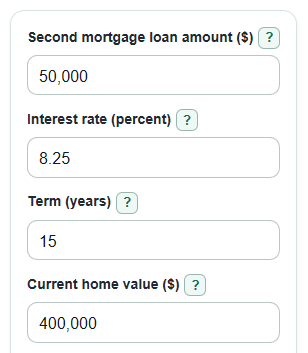
Suppose Second mortgage loan amount ($) is $50,000, Interest rate (percent) is 8.25, Term (years) is 15, Current home value ($) is $400,000, First mortgage balance ($) is $250,000, and Chosen CLTV limit (percent) is 80. With no financed costs, the payment balance is $50,000, the monthly rate is 0.006875, and the number of payments is 180. The estimated monthly payment is about $485.13. Combined loan-to-value is ($250,000 + $50,000) / $400,000 * 100 = 75 percent. The chosen 80 percent CLTV limit equals $320,000 of total mortgage debt, so the room before the limit is $20,000.
Rounding
Dollar outputs are rounded to the nearest cent. Percent outputs are rounded for display, but the pass or over-limit CLTV check uses the unrounded calculation.
Sources
- What is a second mortgage loan or "junior-lien"? | Consumer Financial Protection Bureau - Consumerfinance
- What is the difference between a Home Equity Loan and a Home Equity Line of Credit (HELOC)? | Consumer Financial Protection Bureau - Consumerfinance
- What does "amount financed" mean when getting a mortgage loan? | Consumer Financial Protection Bureau - Consumerfinance
- What is the Total Interest Percentage (TIP) on a mortgage? | Consumer Financial Protection Bureau - Consumerfinance