
Estimate how much home equity cash you may be able to borrow and whether your planned amount fits a lender limit.
Table of contents
How to use our Home Equity Borrowing Limit Calculator
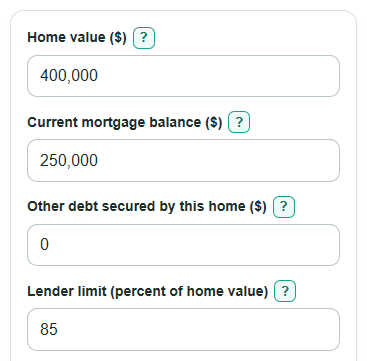
- Enter Home value ($) using your best current estimate, such as a recent appraisal, online estimate, or comparable-sale estimate.
- Enter Current mortgage balance ($) and Other debt secured by this home ($), using unpaid balances rather than original loan amounts.
- Enter Lender limit (percent of home value) and Amount you want to borrow ($); open Advanced options if costs will be added to the new loan or you want to test a changed home value.
- Select Calculate, then read Estimated cash you could borrow first and Does your planned amount fit? next.
- Sanity-check the output by comparing Combined debt after planned borrow with Lender limit (percent of home value); if they are very close, a lower appraisal or added costs could change the answer.
Definitions
Home equity: The home value minus debt secured by the home. A HELOC lets you borrow against available home equity, and a home equity loan is usually a set lump sum borrowed against that equity [1][2].
Current combined debt: Your Current mortgage balance ($) plus Other debt secured by this home ($), before adding the new borrowing.
Combined loan-to-value (CLTV): All debt secured by the home divided by Home value ($), shown as a percent.
Lender limit: The highest CLTV percent you choose to test. A lender may use a different cap.
Financed closing costs: Costs added to the new loan or line balance instead of paid out of pocket.
Home value cushion: The estimated dollar or percent drop in home value that would make your planned debt exactly hit the chosen lender limit.
Common mistakes and quick fixes
Mistake: Using the purchase price instead of a current Home value ($).
Fix: Enter a current value estimate in Home value ($), because the limit is based on today's home value, not what you paid.
Mistake: Entering the original loan amount in Current mortgage balance ($).
Fix: Use the unpaid principal balance from your latest statement for Current mortgage balance ($).
Mistake: Leaving an existing second mortgage or HELOC out of Other debt secured by this home ($).
Fix: Add all debt secured by the same home in Other debt secured by this home ($), because it counts toward combined debt.
Mistake: Comparing Amount you want to borrow ($) only with Estimated cash you could borrow and ignoring financed fees.
Fix: Put fees added to the balance in Costs added to the new loan or line ($), then check Room left after your planned borrow.
Mistake: Treating Home value cushion before hitting the limit as guaranteed approval room.
Fix: Use Home value cushion before hitting the limit as a sensitivity check, then confirm the lender's appraisal and Lender limit (percent of home value).
Limitations & Key Assumptions / Boundary Conditions
- This is an estimate, not an approval decision. Lenders can also check credit score, income, debt-to-income ratio, property type, lien position, occupancy, and loan program rules.
- The calculator uses the Home value ($) you enter. A lender's appraisal or automated valuation may be higher or lower.
- The calculator only measures borrowing room under a selected CLTV cap. It does not estimate interest rate, payment, draw-period rules, repayment terms, taxes, insurance, or closing requirements.
- Other debt secured by this home ($) should include only liens tied to the same property. Do not include unsecured credit cards, car loans, or personal loans.
- Negative dollar outputs are intentional. A negative Estimated cash you could borrow or Room left after your planned borrow means the entered debts are over the selected cap by that amount.
- The value-change test applies one simple percent change to Home value ($). It does not predict market value or appraisal adjustments.
Methodology
Core calculation
The calculator first adds the debts already secured by the home. It then applies the selected lender limit to the entered home value and subtracts current home debt plus any financed costs.
current_home_debt = mortgage_balance + other_home_debt
current_home_equity = home_value - current_home_debt
current_cltv_percent = (current_home_debt / home_value) * 100
max_total_debt = home_value * (max_cltv_percent / 100)
max_cash_to_you = max_total_debt - current_home_debt - financed_closing_costs
Planned borrowing check
The planned check treats the cash you want plus financed costs as new debt secured by the home. This is why financed costs reduce the cash room available to you.
planned_total_debt = current_home_debt + planned_borrow_amount + financed_closing_costs
planned_room_left = max_total_debt - planned_total_debt
planned_feasible_flag = 1 if planned_room_left >= 0, else 0
after_plan_cltv_percent = (planned_total_debt / home_value) * 100
equity_left_after_plan = home_value - planned_total_debt
Home value cushion and stress test
The cushion finds the home value needed for the planned debt to equal the selected lender limit. A positive cushion means the value could fall by that amount before the plan hits the cap. A negative cushion means the plan is already over the cap.
home_value_needed = planned_total_debt / (max_cltv_percent / 100)
home_value_drop_buffer = home_value - home_value_needed
home_value_drop_buffer_percent = (home_value_drop_buffer / home_value) * 100
stressed_home_value = home_value * (1 + value_change_percent / 100)
stressed_max_cash_to_you = stressed_home_value * (max_cltv_percent / 100) - current_home_debt - financed_closing_costs
Mini example
For a $400,000 home, a $250,000 current mortgage, no other secured debt, an 85 percent lender limit, and $0 financed costs, the maximum total home debt is $340,000. The estimated cash borrowing limit is $340,000 - $250,000 = $90,000. If the planned borrow is $50,000, planned total debt is $300,000, combined debt after planned borrow is 75 percent, and room left after the planned borrow is $40,000.
Calculation choices
Money fields keep signed results where the formula creates them. The calculator does not floor negative borrowing room to $0, because the negative amount shows how far the entered numbers are above the selected limit. Percent outputs are based on the entered home value, and the value-change test is blocked if the tested home value would be $0 or less.