
Compare your current personal loan with a refinance offer to estimate the new payment, fee-aware savings, and payoff timing.
Advanced options
Table of contents
How to use our Personal Loan Refinance Calculator
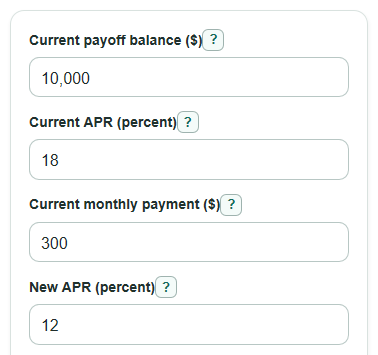
- Enter your Current payoff balance ($), Current APR (percent), and Current monthly payment ($) from your latest statement or payoff quote.
- Enter the New APR (percent) and New loan term (months) from the refinance offer you want to test.
- Open Advanced options if the new loan has New loan fees ($), the old loan has an Old loan payoff fee ($), or you need to choose How will you pay the new loan fees?
- Click Calculate and read New monthly payment first, then Monthly payment change and Estimated total savings after fees.
- Sanity-check the result: a lower New monthly payment can still have negative Estimated total savings after fees if the term is longer or fees are high.
Definitions
APR: Annual percentage rate, the yearly borrowing cost shown as a percent. APR can differ from the interest rate when certain loan costs are included [1].
Current payoff balance ($): The amount needed to pay off the old loan now.
New loan term (months): The number of monthly payments in the refinance loan.
New loan fees ($): Required costs for the new personal loan, such as an origination or processing fee.
Old loan payoff fee ($): A fee charged by the old lender for paying off the loan early.
Monthly payment change: Current monthly payment minus New monthly payment. Positive means the new payment is lower; negative means it is higher.
Estimated total savings after fees: The estimated cost of keeping the current loan minus the estimated cost of refinancing, including cash fees.
Break-even months: The number of months of lower payments needed to recover upfront cash fees.
Common mistakes and quick fixes
Mistake: Using your last statement balance for Current payoff balance ($) when your lender gives a different payoff quote.
Fix: Use the payoff amount when you have it, because it is the amount the new loan must cover.
Mistake: Entering an interest rate in New APR (percent) when the offer lists a different APR after required fees.
Fix: Use the APR from the offer so the New monthly payment comparison is closer to the lender's disclosure.
Mistake: Leaving New loan fees ($) at 0 when the refinance has an origination fee.
Fix: Add required new-loan fees and choose the correct How will you pay the new loan fees? option.
Mistake: Treating a positive Monthly payment change as automatic savings.
Fix: Check Estimated total savings after fees because a longer New loan term (months) can lower the payment but raise total cost.
Mistake: Ignoring Payoff time if you keep paying the old amount after refinancing.
Fix: Use that output to see whether keeping your old payment could shorten the loan and increase Extra interest saved by keeping the old payment.
Limitations & Key Assumptions / Boundary Conditions
- The calculator estimates a fixed-rate personal loan with monthly payments. It does not model variable rates, skipped payments, late fees, or changing payment dates.
- APR is converted to a monthly rate by dividing by 12. Actual lender disclosures may use rules and rounding methods that differ from this estimate.
- The current loan payoff estimate assumes you keep paying the entered Current monthly payment ($) until the balance is gone, with a smaller final payment if needed.
- If your current payment does not cover the first month's interest, the calculation stops because the balance would not go down.
- Cash fees affect Estimated total savings after fees and Months to earn back cash fees. Financed new-loan fees raise the new principal and the New monthly payment.
- Taxes, credit score effects, insurance products, and lender-specific underwriting rules are not included.
Methodology
How the calculator compares the two paths
The calculator first converts each APR to a monthly rate. APR is a consumer-credit disclosure term, and the exact disclosed APR can depend on regulatory rules and lender calculations [2].
monthly_rate = apr_percent / 100 / 12
For the refinance path, the new principal is the current payoff balance plus New loan fees ($) only when you choose to add those fees to the new loan.
new_principal = current_balance + financed_new_loan_fees
The New monthly payment is the standard fixed-payment amount for the new principal, monthly rate, and New loan term (months). If the monthly rate is 0, the payment is the principal divided by the number of months.
payment = principal * monthly_rate / (1 - (1 + monthly_rate)^(-months))
if monthly_rate = 0, payment = principal / months
The current loan is not forced into a new fixed term. Instead, the calculator pays it down month by month using the Current monthly payment ($). The final month can be smaller than the usual payment.
interest_this_month = balance * monthly_rate
payment_this_month = min(scheduled_payment, balance + interest_this_month)
new_balance = balance + interest_this_month - payment_this_month
The keep-current-loan cost is the current payoff balance plus Interest left on current loan. The refinance cost is all scheduled new loan payments plus any fees paid in cash.
current_total_remaining_payments = current_balance + current_remaining_interest
new_total_paid_plus_cash = new_monthly_payment * new_term_months + cash_fees
net_lifetime_savings = current_total_remaining_payments - new_total_paid_plus_cash
Monthly payment change keeps its sign so the result is easy to read.
monthly_payment_change = current_monthly_payment - new_monthly_payment
Positive Monthly payment change means the refinance payment is lower. Negative Monthly payment change means the refinance payment is higher. Positive Estimated total savings after fees means the refinance path costs less from now forward.
Fee break-even and same-payment check
When cash fees are greater than 0 and the new payment is lower, the calculator divides cash fees by the monthly payment savings and rounds up to a whole month.
break_even_months = ceil(cash_fees / monthly_payment_change)
If the old payment is higher than the new required payment, the calculator also tests the new loan with the old payment amount. That gives Payoff time if you keep paying the old amount and Extra interest saved by keeping the old payment.
Mini-example
With a Current payoff balance ($) of $10,000, Current APR (percent) of 18, Current monthly payment ($) of $300, New APR (percent) of 12, New loan term (months) of 48, and no fees, the estimated New monthly payment is about $263.34. Monthly payment change is about $36.66 lower. The current loan has about $3,967.21 of interest left, while the new loan has about $2,640.24 of interest, so Estimated total savings after fees is about $1,326.97. If you keep paying $300 on the new loan, the payoff estimate drops to 41 months and saves about $415.29 more interest than paying the new minimum.
Rounding and validation choices
Dollar outputs are displayed to cents, but the payoff loop does not round inside each month. Payoff months are rounded up because any partial final month still requires a final payment. The loop stops at 1200 months as a safety cap, and the calculator rejects negative balances, negative APRs, negative fees, and a New loan term (months) below 1.