
Estimate the cash you may need at mortgage closing after down payment, costs, deposits, credits, and adjustments.
Advanced options
Table of contents
How to use our Mortgage Cash to Close Calculator
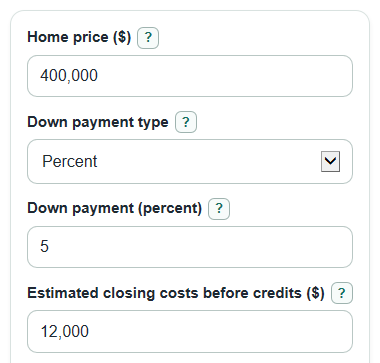
- Enter Home price ($), then choose Down payment type as Percent or Dollars.
- Fill in the matching Down payment row, Estimated closing costs before credits ($), and Earnest money already paid ($).
- Open Advanced options if you have Seller credits ($), Lender credits ($), Costs already paid before closing ($), Closing costs added to the loan ($), Other buyer adjustment ($), or Cash you have for closing ($).
- Click Calculate and read Estimated cash to close first, then Amount to bring if nothing changes.
- Sanity-check the result: Down payment used should match your plan, Credits not used should make sense, and Cash left or short should not surprise you if you entered cash available.
Definitions
Estimated cash to close: The signed estimate of what you may need to bring to closing. A negative number means the estimate points to money back to you before final review.
Amount to bring if nothing changes: The practical planning amount. It floors a negative Estimated cash to close at $0.
Down payment used: The down payment amount from the Percent or Dollars choice.
Closing costs left before credits: Estimated closing costs after subtracting costs already paid before closing and closing costs added to the loan.
Credits used in this estimate: Seller credits plus lender credits that fit inside the remaining closing-cost bucket.
Credits not used: Credits above the remaining closing costs they can cover. Ask your lender or closing team how extra credit will be handled.
Other buyer adjustment: A signed adjustment. Positive adds to what you owe, and negative lowers what you owe.
Common mistakes and quick fixes
Mistake: Reading Estimated cash to close as only the closing costs.
Fix: Check Down payment used and Estimated closing costs before credits ($) separately because cash to close can include both.
Mistake: Entering Earnest money already paid ($) as 0 even though you already paid a deposit.
Fix: Enter the deposit you already paid so the calculator subtracts it from the amount still needed.
Mistake: Expecting Seller credits ($) or Lender credits ($) to reduce the down payment.
Fix: Review Credits used in this estimate and Credits not used; this calculator applies credits only to closing costs left before credits.
Mistake: Counting the same appraisal fee in both Estimated closing costs before credits ($) and Costs already paid before closing ($) without knowing why.
Fix: Use Costs already paid before closing ($) only when that paid item is already included in the closing-cost total.
Mistake: Typing a negative number in Closing costs added to the loan ($) or Cash you have for closing ($).
Fix: Use 0 or a positive number for those rows; use Other buyer adjustment ($) for signed increases or reductions.
Limitations & Key Assumptions / Boundary Conditions
- This is a planning estimate, not the official amount from your lender, settlement agent, or Closing Disclosure.
- Seller credits and lender credits are limited here to remaining closing costs. The calculator does not use those credits to reduce the down payment.
- The calculator does not check loan-program credit caps, minimum borrower contribution rules, seller concession rules, or cash-back limits.
- Estimated closing costs before credits ($) must already include the cost categories you want counted, such as lender fees, title charges, prepaid items, taxes, insurance, and escrow setup.
- Closing costs added to the loan ($) lowers cash needed at closing, but it may increase the loan amount in real lender documents. This calculator keeps Estimated loan amount as Home price minus Down payment used.
- Money outputs are rounded to the nearest dollar for planning, so final cents can differ.
Methodology
How the estimate is built
The calculator separates the down payment from closing costs, then subtracts deposits and allowable credits. The final Closing Disclosure is the document to use for official cash-to-close details [2].
down_payment_amount = purchase_price * down_payment_percent / 100
down_payment_amount = down_payment_dollars
The first formula is used when Down payment type is Percent. The second formula is used when Down payment type is Dollars.
loan_amount = purchase_price - down_payment_amount
remaining_closing_costs_before_credits = closing_costs - costs_paid_before_closing - financed_closing_costs
If Costs already paid before closing ($) plus Closing costs added to the loan ($) is greater than Estimated closing costs before credits ($), the calculator stops and asks you to fix those inputs.
How credits are limited
Seller credits and lender credits are added together, but they are applied only up to Closing costs left before credits. This keeps credits from reducing Down payment used.
total_credits = seller_credits + lender_credits
applied_credits = min(total_credits, remaining_closing_costs_before_credits)
unused_credits = total_credits - applied_credits
Main cash-to-close math
estimated_cash_to_close = down_payment_amount + remaining_closing_costs_before_credits - applied_credits - earnest_deposit + other_adjustments
amount_to_bring = max(0, estimated_cash_to_close)
buyer_money_back = max(0, -estimated_cash_to_close)
cash_left_or_short = cash_available - amount_to_bring
Estimated cash to close is signed, so it can be negative. Amount to bring if nothing changes is floored at $0 because you would not bring a negative cashier's check or wire.
Mini-example
For a $400,000 home with 5% down, the down payment is $20,000. If closing costs are $12,000 and earnest money already paid is $5,000, with no credits or adjustments, the estimate is $20,000 + $12,000 - $0 - $5,000 + $0 = $27,000. Amount to bring if nothing changes is also $27,000.