
Compare two loan offers by monthly payment, full-term cost, and cost by the month you may pay off or refinance.
Table of contents
How to use our Loan Comparison Calculator
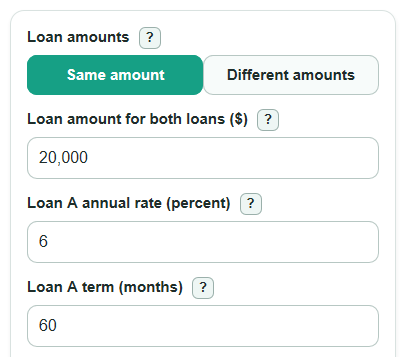
- Choose Loan amounts. Use Same amount if both offers are for the same borrowed amount, or Different amounts if the principal is not the same.
- Enter Loan A annual rate, Loan A term, Loan B annual rate, and Loan B term from the loan offers. Use 0 only for a true 0% loan.
- Open Advanced options if you have Loan A upfront fee, Loan B upfront fee, a planned Compare cost after this many months, or a Max monthly payment you can handle.
- Click Calculate, then compare Lower full-term borrowing cost with Lower cost by your chosen month. They can point to different loans when fees or early payoff timing matter.
- Sanity-check the output: a shorter term often has a higher monthly payment but lower total interest, and a lower rate can lose if its upfront fee is high.
Definitions
Loan amount: The principal, or amount borrowed before any upfront fee entered in the calculator.
Annual rate: The yearly interest rate used to calculate the fixed monthly payment. If you only have APR and no separate interest rate, enter the APR and leave fees at 0.
APR: Annual percentage rate, a yearly cost measure that can include interest and certain fees, so it can be higher than the interest rate [1].
Upfront fee: A fee paid to get the loan, such as an origination fee. In this calculator, it is treated as paid separately at the start.
Full-term borrowing cost: Total interest over the whole loan term plus upfront fees. It does not include repayment of the principal.
Cost by your chosen month: Interest paid through that month plus upfront fees, with the remaining balance added back so principal repayment is not counted as a cost.
Cost per $1,000 borrowed: Full-term borrowing cost divided by the loan amount, then scaled to $1,000. It helps compare loans with different sizes.
Monthly payment gap: Loan B minus Loan A: A positive number means Loan B costs more per month. A negative number means Loan B costs less per month.
Common mistakes and quick fixes
Mistake: Using Loan amount for both loans when the offers have different principal amounts.
Fix: Change Loan amounts to Different amounts, then enter Loan A amount and Loan B amount separately.
Mistake: Typing an APR into Loan A annual rate and also entering Loan A upfront fee.
Fix: If the rate is already an APR, leave Loan A upfront fee blank or 0 to avoid counting fees twice.
Mistake: Comparing only Loan A monthly payment and Loan B monthly payment.
Fix: Also check Lower full-term borrowing cost and Lower cost by your chosen month because the lowest payment is not always the cheapest loan.
Mistake: Leaving Compare cost after this many months at 36 when you expect to refinance or pay off much sooner.
Fix: Enter the month when you realistically expect to replace, refinance, or pay off the loan.
Mistake: Ignoring Max monthly payment you can handle when one loan has a shorter term.
Fix: Enter your payment limit so Budget check can flag a loan that saves interest but strains your monthly budget.
Limitations & Key Assumptions / Boundary Conditions
- The calculator is for fixed-rate installment loans with regular monthly payments, such as many personal loans, auto loans, and student loan offers.
- It does not model variable rates, skipped payments, late fees, prepayment penalties, balloon payments, taxes, insurance, or lender-specific rounding rules.
- Upfront fees are treated as paid separately at the start. If a lender rolls fees into the balance, include those financed fees in the loan amount instead.
- Estimated APR with fees is a side-by-side estimate, not an official lender disclosure. Official APR rules can include or exclude fees based on loan type and regulation.
- Compare cost after this many months is capped at each loan's term. If the chosen month is past a loan's payoff month, that loan is treated as fully paid off.
- When loan amounts differ, total dollar savings and cost per $1,000 borrowed can tell different stories. Use both before choosing a loan.
Methodology
Monthly payment
The calculator first finds the fixed monthly payment for each loan. The monthly rate is the entered annual rate divided by 100 and then by 12.
monthly_rate = annual_rate_percent / 100 / 12
payment = principal * monthly_rate / (1 - (1 + monthly_rate)^(-term_months))
if monthly_rate = 0, payment = principal / term_months
Full-term cost
Principal is not counted as a borrowing cost because it is the money borrowed and paid back. The full-term borrowing cost is interest plus any upfront fee entered.
total_interest = payment * term_months - principal
total_interest_and_fees = total_interest + upfront_fee
cost_per_1000 = total_interest_and_fees / principal * 1000
Chosen-month cost
For the planned payoff or refinance comparison, the calculator uses the smaller of Compare cost after this many months and that loan's term. It estimates the remaining balance after that many payments, then removes principal repayment from the cost figure.
k = min(compare_month, term_months)
if monthly_rate = 0, balance_after_k = principal - payment * k
otherwise balance_after_k = principal * (1 + monthly_rate)^k - payment * (((1 + monthly_rate)^k - 1) / monthly_rate)
cost_by_month = payment * k + balance_after_k + upfront_fee - principal
Estimated APR with fees
If an upfront fee is entered, the calculator estimates the APR by solving for the monthly rate that makes the payment fit the net amount received, which is principal minus upfront fee. APR can include interest and certain fees, so it can differ from the interest rate [1].
principal - upfront_fee = payment * (1 - (1 + monthly_apr_rate)^(-term_months)) / monthly_apr_rate
estimated_apr_percent = monthly_apr_rate * 12 * 100
A bisection solve is used for this APR estimate. If the upfront fee is 0, the estimated APR equals the entered annual rate. If an upfront fee is greater than or equal to the loan amount, the APR estimate is blocked because the net amount received would be $0 or less.
Comparison choices
The calculator compares Loan A and Loan B by full-term borrowing cost, chosen-month cost, and monthly payment gap. A tie is shown when two cost values differ by less than half a cent.
monthly_payment_gap_b_minus_a = loan_b_payment - loan_a_payment
full_term_cost_gap_b_minus_a = loan_b_total_interest_and_fees - loan_a_total_interest_and_fees
compare_month_cost_gap_b_minus_a = loan_b_cost_by_month - loan_a_cost_by_month
Mini-example
Suppose both loans are for $20,000 over 60 months. Loan A has a 6% rate and no upfront fee, while Loan B has a 5.5% rate and a $300 upfront fee. Loan B has the lower payment by about $4.63 per month, but its full-term interest plus fee is about $22.03 higher. By month 36, Loan A is also about $72.66 cheaper because Loan B's fee has not been offset enough by the lower rate.