
Estimate how a one-time mortgage lump sum changes interest saved, payoff time, and a possible recast payment.
Advanced options
Table of contents
How to use our Mortgage Lump Sum Payment Calculator
- Choose After the lump sum: keep the same payment to pay off sooner, or choose recast if you want an estimated lower principal and interest payment.
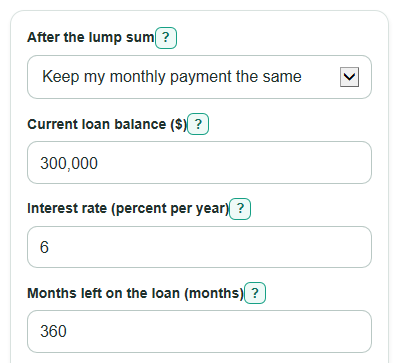
- Enter Current loan balance ($), Interest rate (percent per year), Months left on the loan (months), and Lump sum payment ($).
- Open Advanced options only if the lump sum happens later, you will also pay Extra principal after lump sum ($ per month), or you want to include a Recast fee ($).
- Click Calculate, then compare Interest saved compared with no lump sum, Months paid off early, Payoff time with this plan, and any recast payment results shown.
- Sanity-check the result: a larger earlier Lump sum payment ($) should usually raise interest saved, while a recast with no extra monthly principal usually lowers the payment but keeps the same payoff month.
Definitions
Current loan balance ($): The unpaid principal you still owe, before interest for the next payment period.
Principal: The part of the loan balance that you borrowed and still owe. Paying extra principal lowers the balance used to calculate future interest [1].
Interest rate (percent per year): The yearly rate used by the loan payment formula. The calculator divides it by 12 to estimate monthly interest.
Lump sum payment ($): A one-time extra amount applied to principal. Servicers may call this an additional principal payment or principal curtailment [2].
Recast: A servicer-approved recalculation of the principal and interest payment after a principal reduction, usually over the remaining term.
Interest saved compared with no lump sum: The estimated interest difference between the selected plan and making only the regular payment.
Months paid off early: How many fewer monthly payment periods the selected plan takes compared with the no-extra-payment baseline.
Common mistakes and quick fixes
Mistake: Entering the original loan amount in Current loan balance ($).
Fix: Use your current unpaid principal balance from your mortgage statement.
Mistake: Putting APR fees into Interest rate (percent per year).
Fix: Use the loan interest rate used to calculate principal and interest, not a fee-loaded APR.
Mistake: Entering years in Months left on the loan (months).
Fix: Multiply years by 12, so 25 years is 300 months.
Mistake: Choosing Recast and lower my monthly payment under After the lump sum when you only plan to send extra principal.
Fix: Choose Keep my monthly payment the same unless your servicer approves a recast.
Mistake: Leaving Make lump sum after (months) at 0 when the payment will happen later.
Fix: Enter the number of normal payments made before the lump sum, such as 12 for one year from now.
Mistake: Treating Net savings after recast fee as the same thing as monthly cash flow.
Fix: Use Monthly payment cut after recast for the monthly drop, and use Net savings after recast fee for interest savings after the fee.
Limitations & Key Assumptions / Boundary Conditions
- The payment estimates cover principal and interest only. They do not include property taxes, homeowners insurance, mortgage insurance, HOA dues, escrow changes, late fees, or servicing fees except the optional Recast fee ($).
- A recast is not automatic. Your servicer must allow it, and its rules may set a minimum lump sum, fee, timing rule, or loan eligibility rule.
- The calculator assumes a fixed interest rate for the remaining term. Adjustable-rate loans, interest-only periods, balloon payments, and loan modifications can produce different results.
- Extra principal after lump sum ($ per month) starts after the lump sum month. It does not reduce the balance before that point.
- If Make lump sum after (months) is at or beyond the remaining term, the loan is treated as already paid off before the lump sum month.
- Some loans can have prepayment limits or prepayment penalty terms. Check your note, loan estimate, or servicer instructions before sending a large principal payment.
- Displayed money is rounded to cents, but the payoff loop keeps full precision internally. Small differences from a servicer statement can happen because servicers may use exact payment dates, per-diem interest, rounding rules, or escrow accounting.
Methodology
Payment formula
The calculator first estimates the current monthly principal and interest payment from the current balance, annual interest rate, and months left. The annual percent rate is converted to a monthly decimal rate by dividing by 100 and then by 12.
If monthly_rate > 0: payment = balance * monthly_rate * (1 + monthly_rate)^months_left / ((1 + monthly_rate)^months_left - 1)
If monthly_rate = 0: payment = balance / months_left
No-extra-payment baseline
The baseline is the same loan with no lump sum and no extra monthly principal. This is the comparison used for interest savings.
baseline_total_interest = baseline_payment * remaining_term_months - current_balance
Balance at the lump sum month
The lump sum is applied after the chosen number of normal monthly payments. If the lump sum is immediate, that month count is 0.
If monthly_rate > 0: balance_before_lump = current_balance * (1 + monthly_rate)^m - baseline_payment * (((1 + monthly_rate)^m - 1) / monthly_rate)
If monthly_rate = 0: balance_before_lump = current_balance - baseline_payment * m
principal_after_lump = balance_before_lump - lump_sum_payment
Keep-payment path
If After the lump sum is Keep my monthly payment the same, the calculator keeps the original principal and interest payment and adds any Extra principal after lump sum ($ per month). Each month, interest is charged first, then the planned payment is applied. The final payment can be smaller than the planned payment.
monthly_interest = balance * monthly_rate
planned_payment = baseline_payment + extra_monthly_principal
actual_payment = min(balance + monthly_interest, planned_payment)
principal_paid = actual_payment - monthly_interest
new_balance = balance - principal_paid
Recast path
If After the lump sum is Recast and lower my monthly payment, the calculator recalculates the payment on the balance after the lump sum using the remaining months after that date. Any extra monthly principal is then added on top of the recast payment.
remaining_months_after_lump = remaining_term_months - m
recast_payment = payment(principal_after_lump, monthly_rate, remaining_months_after_lump)
Savings outputs
Total interest with this plan is the interest charged from now until payoff under the selected path. Interest saved is the baseline interest minus that plan interest.
interest_saved = baseline_total_interest - total_interest_with_plan
months_paid_off_early = remaining_term_months - payoff_months_with_plan
monthly_payment_cut = baseline_payment - recast_payment
recast_fee_payback_months = recast_fee / monthly_payment_cut, when monthly_payment_cut > 0
net_cash_saved_after_fee = interest_saved - recast_fee
Mini-example
For a $300,000 balance, 6% interest rate, 360 months left, and an immediate $20,000 lump sum, the baseline principal and interest payment is about $1,798.65 and baseline interest is about $347,514.57. If the homeowner keeps the same payment, the balance right after the lump sum is $280,000, the loan pays off in about 303 months, and estimated interest saved is about $84,152.92. If the homeowner recasts instead with a $250 fee and no extra monthly principal, the new principal and interest payment is about $1,678.74, the monthly payment cut is about $119.91, and net savings after the recast fee is about $22,917.64.