
Estimate battery internal resistance from a load test, then check voltage sag, heat, efficiency, and a planned load.
Advanced options
Table of contents
How to use our Battery Internal Resistance Calculator
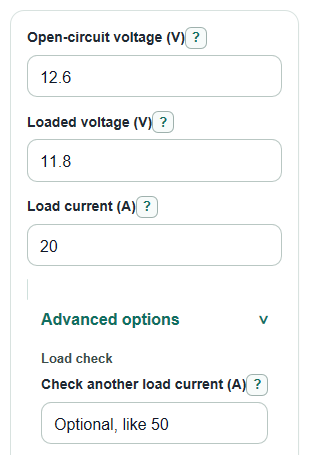
- Enter Open-circuit voltage (V), measured with the battery resting and no load connected.
- Enter Loaded voltage (V) and Load current (A) from the same load test, while current is flowing.
- Open Advanced options if you want to enter Check another load current (A), Minimum usable voltage (V), or Cells in series.
- Click Calculate, then sanity-check the results: Loaded voltage (V) should be lower than Open-circuit voltage (V), and Theoretical short-circuit current is only a model estimate, not a safe test.
- Use Estimated voltage at the checked load and Estimated heat at the checked load to judge whether the battery may sag too low or heat more at your planned current.
Definitions
Open-circuit voltage (V): The battery voltage with no outside load connected.
Loaded voltage (V): The battery terminal voltage while a known load is drawing current.
Load current (A): The current flowing during the loaded voltage measurement.
Internal resistance: The hidden resistance inside a battery that makes voltage drop and heat when current flows.
Voltage sag during your test: The drop from Open-circuit voltage (V) to Loaded voltage (V).
Milliohm: One thousandth of an ohm; battery resistance is often shown this way because it can be small.
Cells in series: Cells connected end-to-end so their voltages add; the calculator divides total resistance by this count for a rough per-cell estimate.
Minimum usable voltage (V): The lowest terminal voltage your device, controller, or battery system can accept before it may shut down or misbehave.
Common mistakes and quick fixes
Mistake: Measuring Open-circuit voltage (V) while a charger or load is still connected.
Fix: Disconnect the battery, let the reading settle, then enter the no-load voltage.
Mistake: Using Loaded voltage (V) from one test and Load current (A) from a different test.
Fix: Enter readings taken at the same time under the same load.
Mistake: Entering a Loaded voltage (V) that is equal to or higher than Open-circuit voltage (V) for a discharge test.
Fix: Recheck meter leads, charger status, and load connection so the loaded reading is lower.
Mistake: Treating Theoretical short-circuit current as a safe current rating.
Fix: Use it only as a rough model output and never short a battery to test it.
Mistake: Leaving Cells in series at 1 for a multi-cell series pack when you want Estimated resistance per series cell.
Fix: Enter the number of similar cells connected in series.
Mistake: Using Minimum usable voltage (V) as a battery health score.
Fix: Use it only as a cutoff check for Estimated voltage at the checked load.
Limitations & Key Assumptions / Boundary Conditions
- This is a DC load-test estimate using one no-load reading, one loaded reading, and one current reading. It does not measure battery capacity, state of charge, or full battery health.
- The method assumes the battery acts like an ideal voltage source with one series internal resistance over the tested current range.
- Temperature, state of charge, battery age, rest time, meter accuracy, wire resistance, and load stability can change the result.
- Loaded voltage must be lower than open-circuit voltage for a normal discharge test. If it is not, the readings do not fit this calculator.
- The planned-load check uses the same resistance found from the first test. Real batteries may sag differently at much higher or lower current.
- Theoretical short-circuit current is not a safe current rating and should not be tested by shorting a battery.
- Estimated resistance per series cell is only meaningful when the series cells are similar and at a similar charge level.
Methodology
Load-test model
The calculator uses the common load-test idea: compare the battery voltage with no load to the voltage while a known load is drawing current [1]. The voltage difference is treated as the drop across the battery's internal resistance.
V_drop = V_open - V_loaded
R_internal = (V_open - V_loaded) / I_load
R_milliohm = R_internal * 1000
In this simple battery model, the battery is handled like a voltage source with a series resistance, so more current creates more voltage sag [2]. The calculator requires positive voltage and current values, and it requires loaded voltage to be lower than open-circuit voltage for a discharge test.
Power and efficiency
The heat made inside the battery is based on current squared times internal resistance. Delivered power is the terminal voltage under load times the load current.
P_loss = I_load^2 * R_internal
P_delivered = V_loaded * I_load
efficiency_percent = (V_loaded / V_open) * 100
The theoretical short-circuit current uses the same straight-line model. It is shown for context only and is not a safe test to perform.
I_short = V_open / R_internal
Optional load check
If Check another load current (A) is entered, the calculator estimates the terminal voltage and internal heat at that planned current.
V_predicted = V_open - I_check * R_internal
P_loss_check = I_check^2 * R_internal
If Minimum usable voltage (V) is entered and it is below the open-circuit voltage, the calculator estimates the current where the simple model reaches that voltage.
I_limit = (V_open - V_min) / R_internal
If Cells in series is greater than 1, the per-cell estimate divides the total pack resistance by the number of similar series cells.
R_cell_milliohm = R_milliohm / series_cells
Mini-example
For Open-circuit voltage (V) = 12.6, Loaded voltage (V) = 11.8, and Load current (A) = 20, the voltage sag is 0.8 V. Internal resistance is 0.8 / 20 = 0.04 ohm, which is 40 milliohm. Heat made inside the battery during the test is 20^2 * 0.04 = 16 W, and power delivered to the load is 11.8 * 20 = 236 W.