
Estimate the charger amps or charge time for a battery using its Ah rating, charge level, efficiency, and safe C-rate limit.
Advanced options
Table of contents
How to use our Battery Charger Size Calculator
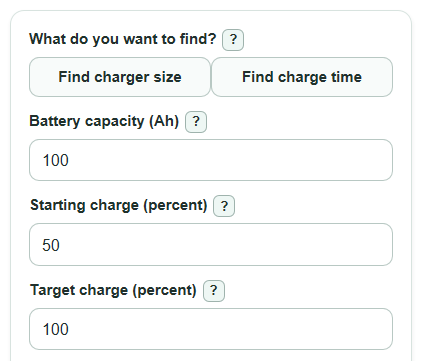
- Choose What do you want to find?: Find charger size if you are buying a charger, or Find charge time if you already know the charger output.
- Enter Battery capacity (Ah), Starting charge (percent), and Target charge (percent) from the battery label, monitor, or your best estimate.
- Fill in Time you have (hours) or Charger output (amps), whichever is shown for the mode you picked.
- Open Advanced options if you want to change Charging efficiency (percent), add Extra time for top-off (percent), or check a Max safe charge rate (C) from the battery manual.
- Sanity-check the result: Needed charger size, Nearest common charger size, and Charge speed compared with battery size should all stay within the battery and charger manuals.
Definitions
Battery capacity (Ah): The battery's amp-hour rating. A 100 Ah battery can be treated as 100 amp-hours for this estimate.
Starting charge (percent): How full the battery is now, from 0 to 100 percent.
Target charge (percent): How full you want the battery to be when charging stops.
Charge to put back: The amp-hours the battery needs to gain between the starting charge and target charge.
Charging efficiency (percent): The part of charger output that effectively becomes stored charge. Lower efficiency means a larger charger or more time.
Extra time for top-off (percent): Added time for the slower finish near full charge.
C-rate: Charger amps divided by battery Ah. For example, 10 A on a 100 Ah battery is 0.1C.
Nearest common charger size: The first size in the calculator's common charger list that is at least the needed amps and, when entered, within the C limit.
Common mistakes and quick fixes
Mistake: Entering Battery capacity (Ah) in mAh, such as typing 5000 for a 5000 mAh battery.
Fix: Convert mAh to Ah first, so 5000 mAh becomes 5 in Battery capacity (Ah).
Mistake: Setting Target charge (percent) equal to or below Starting charge (percent).
Fix: Make Target charge (percent) higher than Starting charge (percent), such as 80 after starting at 40.
Mistake: Using wall outlet amps for Charger output (amps).
Fix: Use the charger's battery-side output current, which is printed on the charger label or manual.
Mistake: Leaving Charging efficiency (percent) at 100 when you want a real-world estimate.
Fix: Use a lower Charging efficiency (percent), such as the manual value, or keep the default 85 if you only need an estimate.
Mistake: Ignoring Max safe charge rate (C) when a fast Needed charger size looks convenient.
Fix: Enter the battery manual's Max safe charge rate (C) so the calculator can show Max size from your C limit and Fastest time at your C limit.
Mistake: Treating Nearest common charger size as safe for every battery type.
Fix: Confirm the charger voltage, battery chemistry setting, and safe current before buying or charging.
Limitations & Key Assumptions / Boundary Conditions
- This calculator estimates charge size and time from amp-hours, current, efficiency, and optional top-off extra time. It does not model a full charger voltage curve.
- The battery label or manual sets the safe charging current, voltage, and chemistry setting. Do not use a result that exceeds those limits.
- Cold batteries, old batteries, battery management systems, and temperature-based charger controls can make real charging slower than the estimate.
- The common charger sizes are a practical shopping list, not a universal standard. A real product may use a different rating.
- The Max safe charge rate (C) check only works if you enter a correct C limit from the battery manual.
- The estimate assumes the charger can actually hold its rated Charger output (amps) during the useful part of the charge.
Methodology
Core calculation
The calculator first finds how many amp-hours must be replaced. It requires Target charge (percent) to be higher than Starting charge (percent).
amp_hours_to_add = battery_capacity_ah * (target_charge_percent - start_charge_percent) / 100
In Find charger size mode, it divides that needed charge by the available time and by Charging efficiency (percent). Extra time for top-off (percent) increases the required charger size because the same charge must fit into the time window.
needed_charger_a = amp_hours_to_add * (1 + top_off_extra_percent / 100) / (desired_charge_hours * charging_efficiency_percent / 100)
In Find charge time mode, it uses the charger amps you entered instead of the desired time.
charge_time_hours = amp_hours_to_add * (1 + top_off_extra_percent / 100) / (charger_current_a * charging_efficiency_percent / 100)
Speed and safe-limit checks
The charge speed compared with battery size is the charger current divided by battery capacity. This is the C-rate, a current normalized to battery capacity [1].
charger_c_rate = charger_current_a_used / battery_capacity_ah
If Max safe charge rate (C) is entered, the calculator converts it to the largest charger current allowed by that entered limit.
max_allowed_charger_a = battery_capacity_ah * max_charge_rate_c
If the requested charger size is above that limit, the calculator keeps the math result visible, shows the maximum allowed size, and estimates the fastest time at that limit.
fastest_time_at_limit_hours = amp_hours_to_add * (1 + top_off_extra_percent / 100) / (max_allowed_charger_a * charging_efficiency_percent / 100)
Common charger size
For shopping help, the calculator checks this ordered list of common amp ratings: 0.75, 1, 1.5, 2, 3, 4, 5, 6, 8, 10, 12, 15, 20, 25, 30, 40, 50, 60, 75, and 100 A. It picks the first value that is at least the Needed charger size. If a C limit is entered, the picked size must also be no higher than Max size from your C limit.
suggested_common_charger_a = first common charger amps value >= needed_charger_a and, if a C limit is entered, <= max_allowed_charger_a
Mini-example
Suppose Battery capacity (Ah) is 100, Starting charge (percent) is 50, Target charge (percent) is 100, Time you have (hours) is 10, Charging efficiency (percent) is 85, and Extra time for top-off (percent) is 0. The charge to put back is 100 * (100 - 50) / 100 = 50 Ah. The needed charger size is 50 / (10 * 0.85) = 5.88 A, so the nearest common size is 6 A. With a 6 A charger, the estimated time is 50 / (6 * 0.85) = 9.8 hours.