
Enter your RV battery bank, charge levels, and charger amps to estimate the hours and minutes needed to reach your target charge.
Table of contents
How to use our RV Battery Charge Time Calculator
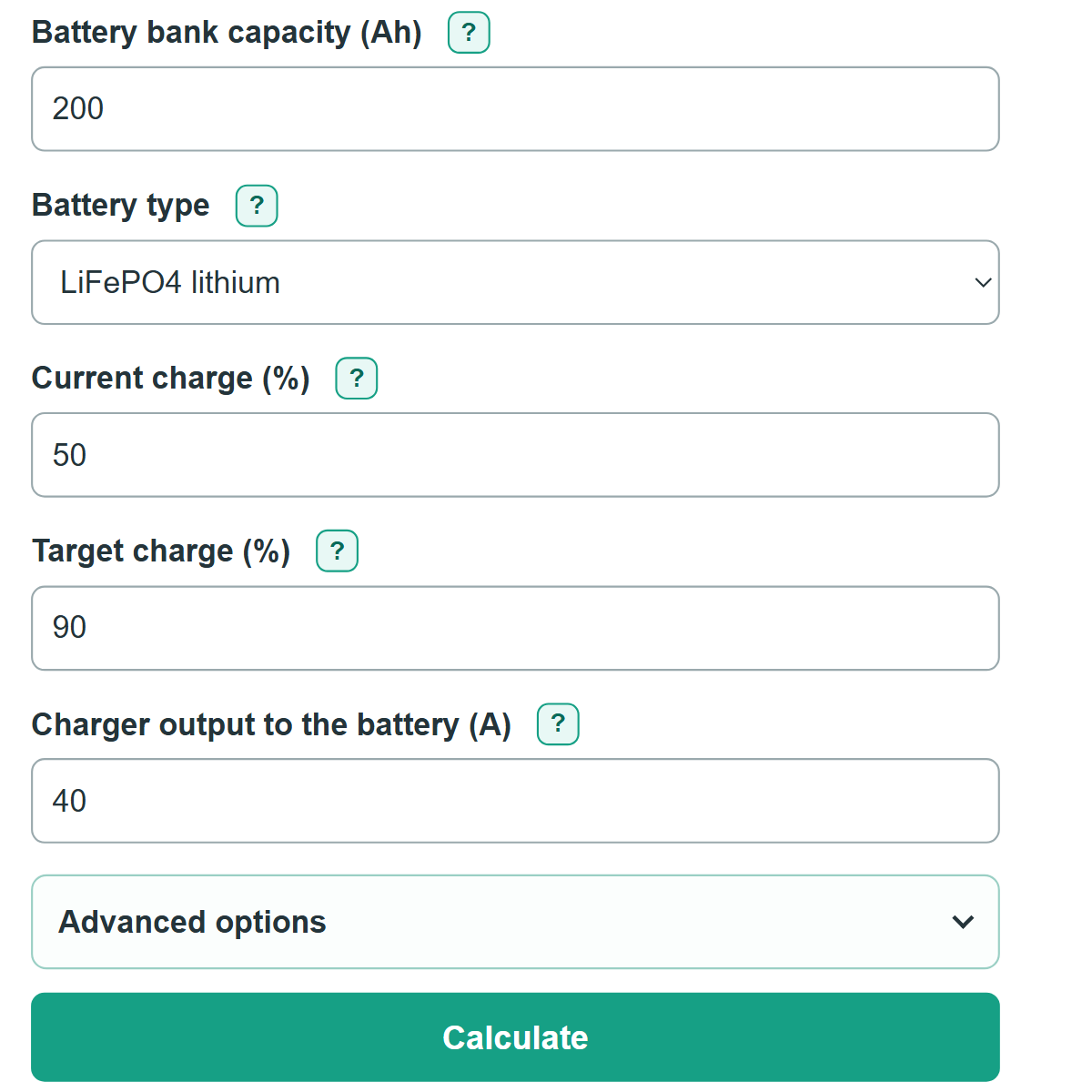
- Enter the total rated capacity of the whole bank in "Battery bank capacity (Ah)." Add Ah ratings for parallel strings, but batteries connected only in series keep the Ah rating of one string.
- Choose "Battery type" from the battery label, manual, or data sheet.
- Enter the starting reading in "Current charge (%)" and your goal in "Target charge (%)." The target must be higher than the current charge.
- Enter the charging device's DC rating in "Charger output to the battery (A)." Do not enter shore-power amps, AC input amps, or generator watts.
- Open "Advanced options" if you know the battery or BMS current limit, want to include RV power use during charging, or have documented efficiency or finishing information.
- Select "Calculate." Read "Estimated time to target charge" first, then check "Net current charging the battery" to confirm how much current remains after limits and RV use.
- Compare the estimate with your battery monitor while charging. A falling charging current or a changing RV load can make the actual finish time different.
Definitions
Ah (amp-hour): A unit of battery capacity. A 200 Ah bank is rated to hold more charge than a 100 Ah bank.
State of charge: The estimated percentage of charge stored in the battery, from 0% to 100%.
BMS: Battery management system. A lithium battery's BMS may limit or stop charging to protect the battery.
Charge efficiency: The share of charging current that this planning model treats as stored charge. The calculator uses a battery-type preset unless you enter an override.
Finishing stage: The upper part of charging where this model adds time. Its starting point and slowdown multiplier depend on the selected battery type.
Net charging current: Current left for the battery after the lower of charger output and battery limit is reduced by included RV power use.
Common mistakes and quick fixes
Mistake: Entering the Ah rating of one battery instead of the full bank.
Fix: Add Ah ratings only for parallel strings. Batteries connected only in series keep the Ah rating of one string.
Mistake: Using a 30 A shore-power connection as charger output.
Fix: Enter the charger's DC output in amps from its label or manual, such as 40 A. Shore-power amps describe AC supply capacity, not battery charging current.
Mistake: Ignoring equipment that stays on while charging.
Fix: In "Advanced options," enter average 12 V use in "RV power used while charging (A)." The calculator subtracts this current from the current available to the battery.
Mistake: Treating a voltage reading during active charging as an exact charge percentage.
Fix: Use a battery monitor reading when possible. Voltage changes with charging, loads, temperature, and resting time.
Mistake: Treating the estimate as a guaranteed finish time.
Fix: Check the battery monitor during charging and follow the battery, BMS, and charger manuals, especially for temperature and current limits.
Limitations & Key Assumptions / Boundary Conditions
- This is a planning estimate, not a manufacturer-certified charging-time rating.
- The model uses disclosed presets: LiFePO4 uses 95% efficiency, a 90% finishing threshold, and a 1.2 finishing multiplier; AGM uses 85%, 80%, and 1.5; flooded lead-acid uses 80%, 80%, and 1.7; gel uses 85%, 80%, and 1.6. Documented values can replace the efficiency and multiplier presets.
- Actual charging time can change with battery temperature, battery age and condition, wire voltage drop, charger settings, solar output, and RV equipment that cycles on and off.
- Enter the configured total bank capacity used by your battery monitor or system documentation. Series and parallel wiring affect the bank Ah rating differently.
- The calculator subtracts one average RV load. It cannot predict changing loads such as a furnace fan, water pump, inverter use, or refrigerator cycling.
- Follow the battery, BMS, and charger manuals for charge-current, voltage, temperature, and safety limits. Do not assume LiFePO4 charging is permitted at every temperature.
Methodology
Current available to the battery
The calculator subtracts RV load current from the charger's DC output first, then caps the remaining battery current at the battery or BMS charge limit. Net battery current must be greater than zero.
current available to battery = charger output - RV power used while charging
net charging current = lower of current available to battery and battery or BMS charge limit (if entered)
Charge needed
The required charge is total bank capacity multiplied by the requested increase in state of charge.
amp-hours to replace = battery bank capacity x (target charge - current charge) / 100
Time estimate
The calculator splits the requested charge at the selected battery type's finishing threshold. Charge below that point uses the selected efficiency. Charge above it also uses the finishing slowdown multiplier. Real battery chargers can use different charging stages, so simple amp-hours divided by amps can be too short near a full battery. [1]
bulk time in hours = bulk charge in Ah / (net charging current in A x efficiency)
finishing time in hours = finishing charge in Ah x finishing multiplier / (net charging current in A x efficiency)
total time = bulk time + finishing time
Worked example
A 200 Ah LiFePO4 bank charging from 50% to 90% needs 80 Ah. With 40 A of net charging current and the 95% LiFePO4 planning efficiency, the modeled time is 80 / (40 x 0.95) = 2.1053 hours. Rounded to the nearest minute, that is 2 hr 6 min. The 90% target adds no finishing-stage time because this model applies that portion only above 90%.