
Estimate the inverter watts, surge rating, battery current, and runtime for RV appliances you plan to run together.
Advanced options
Table of contents
How to use our RV Inverter Size Calculator
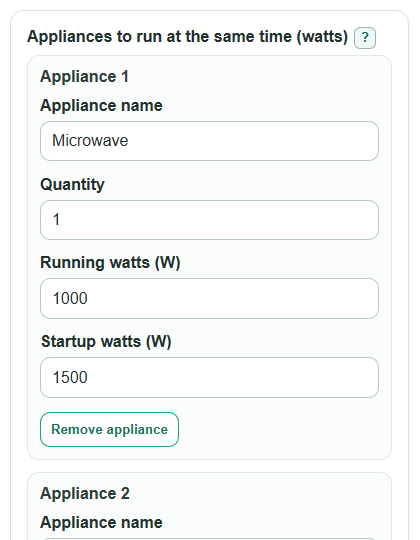
- In Appliances to run at the same time, enter each item you may use together, then add quantity, running watts, and startup watts.
- Choose Battery bank voltage and enter Battery bank size in Ah for the battery bank that will power the inverter.
- Open Advanced options if you want to change Extra room above running load, Inverter efficiency, How to count startup bursts, Inverter size style, or Usable battery amount.
- Select Calculate and read Recommended continuous inverter size first, then check Startup surge rating to look for before shopping.
- Sanity-check the result: if Estimated battery current while running is very high or Estimated runtime from the battery bank is very short, reduce the simultaneous loads or plan a larger battery and electrical setup.
Definitions
Running watts: The steady power an appliance uses after it is already on.
Startup watts: The short burst of power some appliances need when a motor, compressor, pump, or microwave starts.
Recommended continuous inverter size: The steady AC power rating to shop for after adding your running load and extra room.
Startup surge rating to look for: The short peak power rating the inverter should handle when startup loads turn on.
Ah: Amp-hours, a battery capacity rating. At the same Battery bank voltage, more Ah means more stored energy.
Inverter efficiency: The percent of battery power that becomes usable AC power. The rest is lost mostly as heat.
Usable battery amount: The percent of the battery bank you plan to use before recharging.
Battery current: The DC amps drawn from the battery bank while the inverter powers the AC loads.
Common mistakes and quick fixes
Mistake: Putting every RV device into Appliances to run at the same time, even if they will not run together.
Fix: Include only items that can be on together so Total running load is not oversized.
Mistake: Using startup watts in the running watts column of Appliances to run at the same time.
Fix: Put steady watt use in running watts and the short starting burst in startup watts so Startup surge rating to look for is not double-counted.
Mistake: Choosing the wrong Battery bank voltage for a 24 V or 48 V system.
Fix: Match Battery bank voltage to the actual battery bank because Estimated battery current while running changes a lot with voltage.
Mistake: Entering Battery bank size for one battery when the bank has several batteries connected together.
Fix: Enter the total Battery bank size in Ah at the selected Battery bank voltage before trusting Estimated runtime from the battery bank.
Mistake: Leaving Inverter efficiency at a value that does not match your inverter model.
Fix: If your manual lists efficiency, enter it under Inverter efficiency so Estimated battery current while running and Estimated runtime from the battery bank are closer.
Mistake: Looking only at Recommended continuous inverter size and ignoring Startup surge rating to look for.
Fix: Pick an inverter model whose continuous rating and surge rating both meet or beat the calculator results.
Limitations & Key Assumptions / Boundary Conditions
- This calculator sizes the inverter from entered appliance watts. If a label, manual, or meter reading is wrong, the result will be wrong too.
- It does not size battery cables, fuses, breakers, transfer switches, shore power wiring, or alternator charging. High battery current needs proper electrical design.
- Startup surge is an estimate. Real surge can vary by appliance, inverter model, battery voltage sag, soft starters, and whether several devices start at the same moment.
- Estimated runtime assumes the entered Battery bank size, Usable battery amount, and Inverter efficiency. Battery age, cold temperature, lead-acid voltage drop, inverter standby use, and other RV loads can shorten runtime.
- The common-size rounding list is a shopping aid, not a guarantee that a specific inverter has enough surge rating or battery input capability.
- For very large loads, especially air conditioners or multiple heating appliances, verify the full system with the inverter, battery, and RV equipment manuals before buying parts.
Methodology
How loads are added
The calculator includes each row in Appliances to run at the same time after checking that quantity is a whole number of 1 or more and running watts is greater than 0. If startup watts is blank, it is treated as equal to running watts. If startup watts is lower than running watts, the row is allowed and the extra startup burst for that row is treated as zero.
total_running_watts = sum(quantity_i * running_watts_i)
How startup surge is counted
The normal method assumes the largest extra startup burst starts while the other listed loads are already running. The all-at-once method is more conservative and uses the larger of startup watts or running watts for every listed item.
normal_surge_watts = total_running_watts + max(quantity_i * max(startup_watts_i - running_watts_i, 0))
all_at_once_surge_watts = sum(quantity_i * max(startup_watts_i, running_watts_i))
How continuous inverter size is found
The continuous inverter recommendation is based on the steady running load plus Extra room above running load. If Inverter size style is set to common sizes, the calculator rounds up to the first size in this list: 300, 600, 1000, 1500, 2000, 3000, 4000, and 5000 W. If the minimum is above 5000 W, it rounds up to the next 100 W.
minimum_continuous_watts = total_running_watts * (1 + safety_headroom_percent / 100)
recommended_continuous_inverter_watts = first common size >= minimum_continuous_watts, or minimum_continuous_watts when exact_only is selected
How battery current and runtime are estimated
Battery current uses the watt power relationship with an efficiency adjustment: the inverter must draw more DC power from the battery than it delivers as AC power to the appliances.
estimated_battery_draw_amps = total_running_watts / (battery_voltage * (inverter_efficiency_percent / 100))
estimated_runtime_hours = (battery_voltage * battery_capacity_ah * (battery_usable_percent / 100) * (inverter_efficiency_percent / 100)) / total_running_watts
Mini example
Using the default example of a 1000 W microwave with 1500 W startup, a 60 W laptop charger, and a 900 W coffee maker, the running load is 1960 W. With 20 percent extra room, the minimum continuous size is 2352 W, which rounds to a 3000 W inverter. The normal startup surge is 2460 W. On a 12 V, 200 Ah battery bank at 90 percent inverter efficiency and 80 percent usable battery amount, estimated battery current is about 181.5 A and estimated runtime is about 0.88 hours.
Sources
- Help me choose the right inverter/charger | Victron Energy - Victronenergy
- PowerInverter.com - Your Complete Power Inverter Resource - Powerinverter
- Inverter Size for RV: How to Choose the Right One - Anker SOLIX US - Ankersolix
- RV Inverter Sizing Guide: Choosing the Right Inverter for Your Rig | Arvee Blog - Arvee