
Estimate whether your electrical panel has room for a Level 2 EV charger and see the fastest lower setting that may fit.
Table of contents
How to use our EV Charger Panel Load Calculator
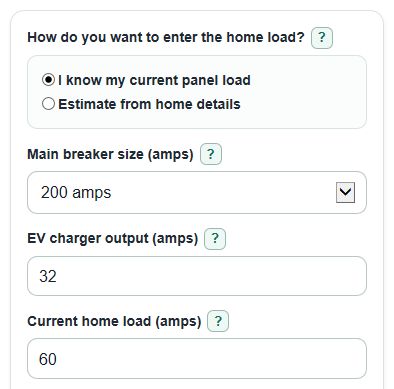
- Choose how to enter the home load: use Current home load if you already have a load calculation, or use the home-detail fields for a rough estimate.
- Select Main breaker size, then enter EV charger output using the charger setting in amps, not the EV circuit breaker size.
- If you use home details, fill in Home size, Kitchen small-appliance circuits, Laundry circuits, Fixed appliance total, and Larger heating or cooling load.
- Open Advanced options only if you need a different Charging voltage, want to leave extra panel room unused, or want the Time to add daily miles estimate.
- After you calculate, sanity-check the Panel fit result against Panel room left after charger and Fastest charger output that fits; a negative room-left number means the requested charger is over the selected limit.
Definitions
Main breaker size: The amp rating printed on the main breaker, such as 100, 150, or 200 amps.
EV charger output: The charging current sent to the car in amps. This is usually lower than the breaker size because EV charging is treated as a continuous load.
Current home load: The calculated demand load for the home before adding the EV charger. It is not the sum of breaker handles.
VA: Volt-amps, a power-like unit used in electrical load calculations. For this planning estimate, appliance watts and VA are treated the same.
Charger load counted on panel: EV charger output multiplied by 1.25 for the continuous-load check.
Panel room left after charger: The selected panel limit minus the total panel load after adding the charger. A negative value means the requested charger is over the selected limit.
Fastest charger output that fits: The highest charger output, in amps, that fits the selected panel limit using the same 1.25 rule.
Common mistakes and quick fixes
Mistake: Entering the EV circuit breaker size as EV charger output.
Fix: Use EV charger output, such as 32 amps on many 40 amp EV circuits.
Mistake: Adding up breaker handles and typing that total into Current home load.
Fix: Use a calculated Current home load from an electrician, permit worksheet, or panel study.
Mistake: Choosing Estimate from home details but leaving Fixed appliance total out because the appliance breakers are already in the panel.
Fix: Enter the nameplate watts or VA in Fixed appliance total for fixed loads such as an electric range, dryer, water heater, dishwasher, and disposal.
Mistake: Entering both electric heat and air conditioning in Larger heating or cooling load.
Fix: Enter only the larger load in Larger heating or cooling load, because the simplified estimate uses the bigger of the two.
Mistake: Treating Largest common setting that fits as a guaranteed charger setting.
Fix: Use Largest common setting that fits as a discussion point; your actual charger, wiring, breaker, and local code still control the allowed setting.
Mistake: Setting Extra panel room to leave unused near 100 percent and expecting a normal result.
Fix: Keep Extra panel room to leave unused below 100 percent; use 0 percent for a straight comparison with the Main breaker size.
Limitations & Key Assumptions / Boundary Conditions
- This is a planning estimate for a US home, not a permit-ready load calculation.
- Local code, utility rules, service equipment ratings, conductor size, temperature ratings, charger manual requirements, and inspection practices can change the final answer.
- The quick mode is only as good as the Current home load value you enter. Do not use total breaker handle counts.
- The home-details mode is simplified. It uses a dwelling load pattern with 3 VA per sq ft, 1500 VA small-appliance and laundry allowances, and a first-8000-VA plus 40 percent remainder method.
- Fixed appliance total treats watts as VA. That is reasonable for a rough planning screen, but exact load calculations may handle some appliances differently.
- Largest common setting that fits uses a short list of common charger outputs: 12, 16, 24, 32, 40, 48, 64, and 80 amps. Your charger may not support the listed value.
- Load management equipment, utility-controlled chargers, or a service upgrade can change whether a charger is allowed even when the simple panel comparison says it is over the limit.
Methodology
How the calculator counts the EV charger
Level 2 EV charging is treated as a continuous load, so the charger output is multiplied by 1.25 for the panel load check [2]. Use the charger output setting, not the breaker size.
Charger load counted on panel = EV charger output * 1.25
How the home load is chosen
In quick mode, the calculator uses the Current home load value directly.
Home load used = Current home load
In home-details mode, it builds a simplified existing-home estimate from the entered home details. The pattern uses 3 VA per sq ft, 1500 VA for each kitchen small-appliance circuit, 1500 VA for each laundry circuit, then counts the first 8000 VA at 100 percent and the rest at 40 percent before adding the larger heating or cooling load [1].
Base connected VA = 3 * Home size + 1500 * Kitchen small-appliance circuits + 1500 * Laundry circuits + Fixed appliance total
Base demand VA = min(Base connected VA, 8000) + 0.40 * max(Base connected VA - 8000, 0) + Larger heating or cooling load
Home load used = Base demand VA / Charging voltage
How panel fit is decided
The panel limit is the Main breaker size reduced by any Extra panel room to leave unused. Use 0 percent for a straight main-breaker comparison.
Panel limit = Main breaker size * (1 - Extra panel room to leave unused / 100)
Total panel load after charger = Home load used + Charger load counted on panel
Panel room left after charger = Panel limit - Total panel load after charger
Panel rating used = 100 * Total panel load after charger / Main breaker size
If Panel room left after charger is zero or positive, Panel fit result is Fits. If it is negative, Panel fit result is Over limit.
Fit-finder and breaker outputs
The fastest theoretical charger output that fits is based on the remaining panel room before adding the EV charger, divided by the same 1.25 continuous-load multiplier.
Fastest charger output that fits = max(0, (Panel limit - Home load used) / 1.25)
Largest common setting that fits is the highest value from 12, 16, 24, 32, 40, 48, 64, and 80 amps that is no higher than that theoretical limit. Typical EV circuit breaker size is the smallest listed breaker size at or above Charger load counted on panel. The tool list is 15, 20, 25, 30, 35, 40, 45, 50, 60, 70, 80, 90, 100, 110, and 125 amps.
Charging time estimate
Charging power uses EV charger output and Charging voltage. The daily time estimate converts Miles to add per day into wall energy using Vehicle efficiency and Charging efficiency.
Charging power = EV charger output * Charging voltage / 1000
Daily wall kWh = Miles to add per day / Vehicle efficiency / (Charging efficiency / 100)
Time to add daily miles = Daily wall kWh / Charging power
Mini-example
For a 200 amp panel, 60 amps of Current home load, and a 32 amp EV charger output, the EV counts as 32 * 1.25 = 40 amps. Total panel load after charger is 60 + 40 = 100 amps, so Panel room left after charger is 200 - 100 = 100 amps and the result is Fits. The fastest theoretical charger output that fits is (200 - 60) / 1.25 = 112 amps, so the largest common setting in the tool list is 80 amps.