
Estimate an EV charger breaker, charger amp setting, wire size, power, and long-run voltage drop for a home circuit.
Table of contents
How to use our EV Charger Circuit Size Calculator
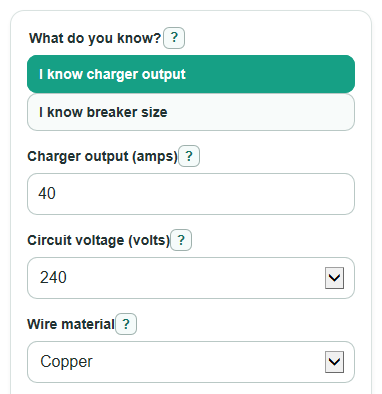
- Choose What do you know?: use Charger output when planning a new circuit, or Breaker size when checking an existing breaker.
- Enter Charger output or Breaker size, then choose Circuit voltage and Wire material.
- Open Advanced options if you need to change Terminal temperature column, Wire sizing style, One-way wire run, or Voltage drop limit.
- Select Calculate and read the main result first, then check Minimum wire size from ampacity check and Long-run wire suggestion.
- Sanity-check the answer: a 40 amp charger on 240 volts should be about 9.6 kW, and a 50 amp breaker should allow about a 40 amp charger setting.
Definitions
Charger output: The charging current, in amps, that the EV charger is set to deliver to the car.
Breaker size: The amp rating printed on the switch in the electrical panel.
Continuous load: A load expected to run for 3 hours or more. EV charging is handled this way for circuit sizing.
Circuit voltage: The voltage used by the branch circuit, usually 120 volts for Level 1 or 240 volts for many home Level 2 chargers.
Wire material: The conductor metal. Copper carries more current than aluminum at the same size.
Terminal temperature column: The ampacity table column used for the equipment terminals and conductor type, shown as 60 C or 75 C.
Wire sizing style: The choice between matching the wire ampacity to the breaker rating or checking only the continuous-load target before other code checks.
Voltage drop: The voltage lost in the wires while current flows. Long runs and smaller conductors have more drop.
AWG: American Wire Gauge, a wire size scale where a smaller number means a larger wire, such as 6 AWG being larger than 8 AWG.
kcmil: A large conductor size unit equal to 1,000 circular mils.
Common mistakes and quick fixes
Mistake: Using the car battery size for Charger output.
Fix: Enter the charger's maximum output amps in Charger output, such as 32, 40, or 48 amps.
Mistake: Treating Breaker size as the same number as the charger setting.
Fix: Use Largest charger setting for this breaker; EV charging uses a lower setting because it is a long, steady load.
Mistake: Entering round-trip distance in One-way wire run.
Fix: Enter the one-way path from the panel to the charger; the voltage drop formula doubles it.
Mistake: Ignoring Wire material when comparing wire sizes.
Fix: Choose Copper or Aluminum or copper-clad aluminum in Wire material before trusting Minimum wire size from ampacity check.
Mistake: Using a very loose Voltage drop limit to make a long run look okay.
Fix: Keep Voltage drop limit at your planning target, then compare Voltage drop for this run with Long-run wire suggestion.
Mistake: Reading Long-run wire suggestion as final permission to install that wire.
Fix: Use Important note and have an electrician verify terminals, insulation type, conduit fill, local rules, and inspection needs.
Limitations & Key Assumptions / Boundary Conditions
- This is a planning estimate for a dedicated Level 1 or Level 2 EV charger branch circuit, not a permit drawing or an installation approval.
- The calculator uses a loaded set of standard breaker sizes, ampacity values, and wire areas. It may not cover every conductor type, insulation marking, cable assembly, conduit condition, or local rule.
- Terminal temperature column matters. Using 75 C when the equipment only allows 60 C can make the wire look too small.
- Voltage drop is estimated with a simple single-phase formula using one-way run length. Real installations can differ because of actual conductor temperature, splices, terminals, route length, and shared raceways.
- The tool does not check panel capacity, service load calculations, GFCI rules, permits, manufacturer instructions, conduit fill, derating, neutral needs, grounding conductor size, or disconnect requirements.
- If Minimum load check shows a smaller conductor than Wire matches breaker, final overcurrent protection still needs a licensed electrician's review.
- Outputs above the loaded breaker or wire table are unsupported, so a larger design needs a full electrical calculation.
Methodology
How the main circuit answer is found
In Charger output mode, the charger amps are treated as a continuous load. The circuit sizing target is 125 percent of the charger output, then the calculator chooses the first loaded standard breaker size that is at least that large [1].
required_circuit_amps = charger_output_amps * 1.25
recommended_breaker_amp = first_standard_breaker_at_or_above(required_circuit_amps)
In Breaker size mode, the calculator reverses the same idea and uses 80 percent of the breaker rating as the largest charger setting.
max_safe_charger_output_amp = breaker_amps * 0.8
How power is estimated
The calculator uses the charger output amps for the selected mode and multiplies by Circuit voltage. It divides watts by 1,000 to show kilowatts.
estimated_charging_power_kw = circuit_voltage * charger_output_amps / 1000
How wire size is selected
For ampacity, the calculator picks the first loaded wire size whose ampacity is at least the target for the selected Wire material, Terminal temperature column, and Wire sizing style.
wire_ampacity_target = recommended_breaker_amp when wire_sizing_style = match_breaker
wire_ampacity_target = required_circuit_amps when wire_sizing_style = match_load
minimum_wire_size = first_wire_size_with_ampacity_at_or_above(wire_material, terminal_temperature_column, wire_ampacity_target)
How voltage drop is checked
The calculator estimates single-phase voltage drop from conductor material, charger amps, one-way run length, and conductor area. The factor 2 accounts for the out-and-back current path.
voltage_drop_volts = 2 * conductor_k * charger_output_amps * one_way_run_ft / conductor_cmil
voltage_drop_percent = voltage_drop_volts / circuit_voltage * 100
It then scans larger loaded wire sizes and returns the first one that meets both the ampacity target and the entered Voltage drop limit.
long_run_wire_size = first_wire_size_where(ampacity >= wire_ampacity_target and voltage_drop_percent <= voltage_drop_limit_percent)
Mini-example
For a 40 amp charger on a 240 volt circuit, the circuit target is 40 * 1.25 = 50 amps, so the recommended breaker is 50 amps. Estimated charging power is 240 * 40 / 1000 = 9.6 kW. With copper, 75 C, Wire matches breaker, and a 50 foot one-way run, the minimum ampacity wire from the loaded table is 8 AWG, and the estimated drop is about 3.13 volts, or about 1.30 percent.