
Use the mini split nameplate MCA and max breaker values to plan breaker size, breaker poles, copper wire size, and voltage drop.
Advanced options
Table of contents
How to use our Mini Split Breaker Size Calculator
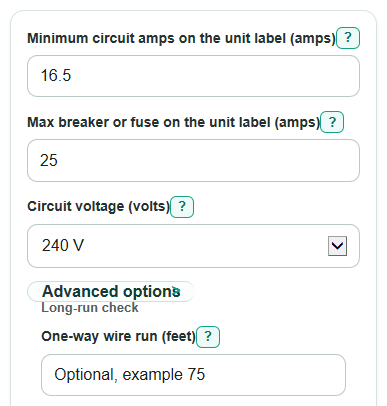
- Enter Minimum circuit amps on the unit label (amps) from the outdoor unit nameplate, often marked MCA.
- Enter Max breaker or fuse on the unit label (amps), often marked MOCP, MOP, max fuse, or max breaker.
- Choose Circuit voltage (volts) so the calculator can show the usual breaker pole count for that voltage.
- Open Advanced options only if you want the long-run check, then enter One-way wire run (feet), adjust Max voltage drop to allow (percent), and enter Load to use for long-run check (amps) if you have a better running-load value.
- Sanity-check the results: Recommended breaker size must not be above the unit label max breaker, and Minimum copper wire size by amps should be based on MCA, not BTU size.
Definitions
Minimum circuit amps on the unit label (amps): The minimum circuit amp rating printed on the outdoor unit label. It is often marked MCA and is used to choose the minimum branch-circuit wire amp rating.
Max breaker or fuse on the unit label (amps): The largest breaker or fuse the maker allows for that equipment. It is often marked MOCP, MOP, max fuse, or max breaker.
Circuit voltage (volts): The voltage of the branch circuit feeding the mini split, such as 120 V, 208 V, or 240 V.
Breaker poles: The number of breaker switches tied together. A 120 V mini split usually uses 1 pole, while a 208 V or 240 V mini split usually uses 2 poles.
AWG: American Wire Gauge. For AWG sizes, a smaller number means a larger copper wire, so 10 AWG is larger than 12 AWG.
Voltage drop: The voltage lost as current travels through the wire. Long runs, higher amps, and smaller wire raise voltage drop.
Common mistakes and quick fixes
Mistake: Using BTU size instead of Minimum circuit amps on the unit label (amps) .
Fix: Find the outdoor unit label or installation manual and enter the MCA value printed there.
Mistake: Entering the breaker you want in Max breaker or fuse on the unit label (amps) .
Fix: Enter the label limit marked MOCP, MOP, max fuse, or max breaker, because Recommended breaker size cannot exceed it.
Mistake: Picking the wrong Circuit voltage (volts) because the unit says 208/230 V or 208/240 V.
Fix: Choose the circuit voltage that matches the branch circuit being installed and confirm it with the unit wiring diagram.
Mistake: Measuring One-way wire run (feet) as straight-line distance across the yard.
Fix: Use the actual wire path from the panel to the outdoor unit; leave it blank if you do not want the voltage drop check.
Mistake: Treating Copper wire size after long-run check as permission to use any cable type or terminal rating.
Fix: Use the result as a planning size only, then confirm wire type, insulation rating, terminals, conduit fill, and local code.
Limitations & Key Assumptions / Boundary Conditions
- This is a planning tool. The outdoor unit label, installation manual, local electrical code, permit rules, and a licensed electrician take priority.
- The calculator uses copper wire only. It does not size aluminum conductors.
- The built-in wire table is limited to 14, 12, 10, 8, 6, and 4 AWG copper with conservative 60 C planning amp ratings.
- The long-run voltage drop check uses approximate copper resistance values and a single-phase round-trip formula. Real results can change with conductor temperature, wiring method, splices, and actual running current.
- The breaker pole result is a typical planning guide: 120 V is shown as 1 pole, while 208 V and 240 V are shown as 2 poles. The unit wiring diagram and panel type still matter.
- The calculator does not size by BTU, indoor head count, plug type, or guesswork. If you do not have MCA and max breaker values, find the nameplate or manual first.
- If the entered MCA and max breaker values conflict, or the needed wire is beyond the built-in table, the calculator should stop instead of inventing a result.
Methodology
Nameplate-first method
The calculator uses the equipment nameplate values first. For mini split and other HVAC equipment, the manufacturer nameplate values for MCA and MOCP are the key limits used for branch-circuit planning [4]. MCA sets the minimum wire amp rating. MOCP, MOP, max fuse, or max breaker sets the largest overcurrent device allowed by the unit label.
Breaker size
The calculator scans the built-in standard breaker list: 15, 20, 25, 30, 35, 40, 45, 50, 60, 70, 80, 90, and 100 amps. It chooses the largest standard size that is not above Max breaker or fuse on the unit label (amps).
breaker_amps = max(S) where S is in STANDARD_BREAKERS and S <= max_breaker_amps
After that, it checks that the selected breaker is at least the MCA. If no standard size fits between MCA and the max breaker value, the calculator reports an unsupported state instead of guessing.
Breaker poles
The pole count is based only on Circuit voltage (volts).
breaker_poles = 1 if circuit_voltage == 120, else 2
Wire size by amps
The amp-only wire result scans the copper table from smaller physical wire to larger physical wire: 14 AWG = 15 A, 12 AWG = 20 A, 10 AWG = 30 A, 8 AWG = 40 A, 6 AWG = 55 A, and 4 AWG = 70 A. The first size with an amp rating at least as high as MCA becomes Minimum copper wire size by amps.
minimum_wire_awg = first AWG where ampacity_60c_copper >= mca_amps
Long-run voltage drop check
If One-way wire run (feet) is blank, the calculator skips voltage drop upsizing and makes Copper wire size after long-run check match the amp-only wire size. If a run length is entered, the load is Load to use for long-run check (amps) when provided, otherwise MCA. The wire resistance values used are 14 AWG = 3.07, 12 AWG = 1.93, 10 AWG = 1.21, 8 AWG = 0.764, 6 AWG = 0.491, and 4 AWG = 0.308 ohms per 1000 feet.
voltage_drop_volts = 2 * one_way_run_ft * load_amps * wire_ohms_per_1000ft / 1000
voltage_drop_percent = 100 * voltage_drop_volts / circuit_voltage
max_allowed_drop_volts = circuit_voltage * max_voltage_drop_percent / 100
The calculator starts with the amp-only wire size and tests larger physical wire sizes until the estimated voltage drop is at or below Max voltage drop to allow (percent). If none of the built-in copper sizes works, it reports unsupported.
long_run_wire_awg = first AWG at or larger than minimum_wire_awg where voltage_drop_percent <= max_voltage_drop_percent
Mini-example
Suppose the label MCA is 22 A, the max breaker is 35 A, and the circuit is 240 V. The breaker result is 35 A because 35 is the largest built-in standard breaker that does not exceed the label max. The amp-only copper wire is 10 AWG because 10 AWG is rated 30 A in the built-in table, which covers 22 A. If the one-way run is 150 feet and the long-run load is 22 A, 10 AWG gives about 3.33% voltage drop, which is above a 3% limit. The next larger size, 8 AWG, gives about 2.10%, so the long-run result is 8 AWG.