
Estimate capacitor RMS ripple current and see the minimum per-capacitor datasheet rating needed for your safety margin.
Advanced options
Table of contents
How to use our Capacitor Ripple Current Calculator
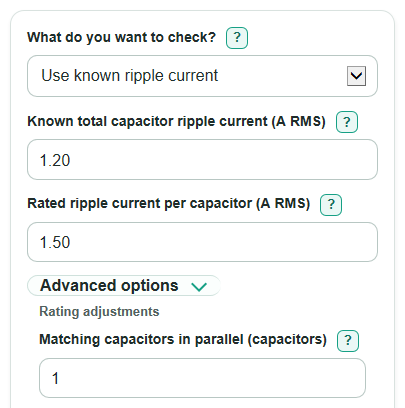
- Choose What do you want to check? based on the numbers you already have: known ripple current, buck input, buck output, or measured AC and DC current.
- Fill in only the visible circuit inputs, then enter Rated ripple current per capacitor (A RMS) from the capacitor datasheet.
- Open Advanced options if you need Matching capacitors in parallel, Datasheet frequency multiplier, Datasheet temperature multiplier, Extra safety margin, or ESR per capacitor.
- Click Calculate and read Rating result first, then compare Minimum rating per capacitor with the datasheet rating of each capacitor.
- Sanity-check the result: Ripple current per capacitor should fall when Matching capacitors in parallel increases, and Headroom after safety margin should rise when the datasheet multipliers or rated current increase.
Definitions
Ripple current: The AC part of capacitor current. It heats the capacitor even when the average current is zero.
RMS current: A steady-current value that would make about the same heat as the changing current waveform.
Rated ripple current per capacitor: The datasheet ripple-current rating for one capacitor at the datasheet's stated test conditions.
Datasheet frequency multiplier: A correction factor used when your ripple frequency is different from the datasheet rating frequency.
Datasheet temperature multiplier: A correction factor used when the capacitor's local temperature differs from the datasheet rating condition.
ESR per capacitor: Equivalent series resistance, a small internal resistance that turns ripple current into heat.
Headroom after safety margin: The extra usable rating left after the calculator adds your Extra safety margin. Negative headroom means the setup fails the check.
Common mistakes and quick fixes
Mistake: Using peak current in Known total capacitor ripple current (A RMS).
Fix: Enter the RMS ripple current, because RMS is the heating-equivalent value used for capacitor ratings.
Mistake: Entering Output voltage (V) that is equal to or higher than Input voltage (V) in buck input mode.
Fix: Use buck input mode only when Output voltage (V) is lower than Input voltage (V).
Mistake: Copying a ripple voltage number into Inductor ripple current (A peak-to-peak).
Fix: Enter the peak-to-peak inductor current ripple in amps, not volts.
Mistake: Leaving Datasheet frequency multiplier or Datasheet temperature multiplier at 1.00 when the datasheet gives correction factors for your conditions.
Fix: Use the exact multiplier values from the capacitor datasheet when available.
Mistake: Counting unlike parts in Matching capacitors in parallel.
Fix: Use this input for identical capacitors that are expected to share current evenly.
Mistake: Treating Estimated heat in all capacitors (W) as the final temperature rise.
Fix: Use ESR per capacitor for a heat estimate only; case temperature also depends on airflow, board copper, spacing, and the capacitor package.
Limitations & Key Assumptions / Boundary Conditions
- The rating check is only as good as the capacitor datasheet values you enter. Ripple-current ratings are usually tied to a reference frequency and temperature, so correction factors matter [1].
- Matching capacitors in parallel assumes identical capacitors, similar ESR, similar temperature, and a layout that shares current evenly.
- Buck input capacitor mode uses an ideal continuous-conduction estimate. Converter losses, duty-cycle limits, diode or synchronous behavior, and detailed ripple shape can change the real RMS current.
- Buck output capacitor mode assumes the capacitor current is a zero-average triangular wave based on Inductor ripple current (A peak-to-peak).
- Measured AC and DC current mode uses a simplified square-difference estimate. It is not a replacement for measuring capacitor current directly with safe, suitable equipment.
- Estimated heat in all capacitors (W) is only ESR heating. It does not calculate final core temperature, case temperature, lifetime, voltage derating, or capacitance needs.
- Minimum matching capacitors needed checks ripple-current rating only. Voltage rating, capacitance, surge current, physical size, lifetime, and safety approvals still need separate checks.
Methodology
How the calculator chooses total ripple current
The calculator first estimates Total capacitor ripple current from the selected mode. In known-current mode, it uses your entered RMS value directly.
I_total = I_known
For a simplified buck input capacitor, the calculator estimates ideal duty ratio from output voltage divided by input voltage, then uses the common RMS input-capacitor estimate.
D = Vout / Vin
I_total = I_load * sqrt(D * (1 - D))
For a simplified buck output capacitor with triangular ripple, the RMS value is peak-to-peak inductor ripple current divided by sqrt(12).
I_total = Delta_I_pp / sqrt(12)
For measured AC and DC current mode, the calculator estimates the ripple part by subtracting the DC current contribution in RMS-squared terms.
I_total = sqrt(I_ac_rms^2 - I_dc^2)
How the rating check is done
With matching parallel capacitors, the estimated current per capacitor is the total ripple current divided by the capacitor count.
I_per_cap = I_total / N
The adjusted usable rating per capacitor is the entered datasheet rating multiplied by the entered frequency and temperature multipliers.
I_usable = I_rated * K_frequency * K_temperature
The minimum datasheet rating per capacitor works backward from the estimated current, the selected safety margin, and the same correction multipliers.
I_needed_rated = I_per_cap * (1 + margin_percent / 100) / (K_frequency * K_temperature)
Headroom compares the usable rating with the ripple current after the safety margin is added. Positive headroom passes. Negative headroom shows how far the setup is short.
headroom_percent = (I_usable - I_per_cap * (1 + margin_percent / 100)) / (I_per_cap * (1 + margin_percent / 100)) * 100
The minimum parallel count rounds up because you cannot install a fraction of a capacitor.
N_min = ceil(I_total * (1 + margin_percent / 100) / (I_rated * K_frequency * K_temperature))
ESR heat check
If ESR per capacitor is entered, the calculator estimates internal ripple-current heat for the whole capacitor bank.
P_total = I_per_cap^2 * ESR * N
Mini-example
If Known total capacitor ripple current is 1.20 A RMS, Rated ripple current per capacitor is 1.50 A RMS, Matching capacitors in parallel is 1, both datasheet multipliers are 1.00, and Extra safety margin is 20 percent, the needed rating is 1.20 * 1.20 / 1.00 = 1.44 A RMS. The usable rating is 1.50 A RMS, so the setup passes with about 4.17 percent headroom after the safety margin.