
Estimate op amp bandwidth from GBW, circuit type, gain, and your signal frequency, with optional slew-rate checking.
Advanced options
Table of contents
How to use our Op Amp Bandwidth Calculator
- Choose the Circuit type that matches your feedback setup so the calculator uses the right noise gain.
- Enter Signal gain magnitude or Noise gain, then enter the Gain-bandwidth product from the op amp datasheet.
- Enter the Signal frequency to check, using the highest frequency your circuit must pass well.
- Open Advanced options if you want to include Slew rate, Output signal size, Wanted safety room, or change Number display.
- After you click Calculate, sanity-check the output: Room above your signal frequency should be at least your Wanted safety room, and Slew-rate bandwidth limit should not be lower than the needed signal frequency.
Definitions
Gain-bandwidth product: The datasheet frequency-gain tradeoff for many voltage-feedback op amps. In this calculator it is entered in MHz and converted to Hz.
Signal gain magnitude: The size of the signal gain in V/V, written as a positive number. An inverting gain of -10 has a magnitude of 10.
Noise gain: The gain that sets closed-loop bandwidth. It equals signal gain for a non-inverting amplifier, equals 1 plus signal gain magnitude for an inverting amplifier, and equals 1 for a voltage follower.
Small-signal -3 dB bandwidth: The estimated frequency where the closed-loop gain is about 3 dB lower for small output signals.
Slew rate: The fastest output voltage change the op amp can make, entered in V/us. A low slew rate can limit large sine waves before the small-signal bandwidth does.
Room above your signal frequency: The ratio between estimated usable bandwidth and your checked signal frequency, shown in dB. Higher room means more margin.
Common mistakes and quick fixes
Mistake: Choosing Circuit type as Non-inverting amplifier for an inverting gain stage.
Fix: Choose Circuit type as Inverting amplifier so Noise gain used becomes 1 plus Signal gain magnitude.
Mistake: Entering a negative value in Signal gain magnitude for an inverting amplifier.
Fix: Enter the positive gain size only; for a gain of -10 V/V, type 10 in Signal gain magnitude.
Mistake: Reading the datasheet value in Hz but typing it into Gain-bandwidth product as if it were MHz.
Fix: Convert the value first; 1000000 Hz should be entered as 1 in Gain-bandwidth product.
Mistake: Filling only Slew rate or only Output signal size.
Fix: Enter both Slew rate and Output signal size to run the slew-rate check, or leave both blank.
Mistake: Using peak-to-peak voltage in Output signal size.
Fix: Use V peak; a 4 V peak-to-peak sine wave is 2 V peak in Output signal size.
Mistake: Treating a small positive Room above your signal frequency as plenty of margin.
Fix: Compare Room above your signal frequency with Wanted safety room, and use a faster op amp or lower gain if it is too small.
Limitations & Key Assumptions / Boundary Conditions
- The GBW method is a first-order estimate for voltage-feedback op amps with single-pole-like open-loop rolloff. It may be poor for current-feedback op amps, decompensated parts, or parts with unusual frequency response.
- Layout, capacitive loads, feedback resistor values, input capacitance, and output loading can reduce real bandwidth or cause peaking and ringing.
- The inverting mode assumes a simple feedback network where noise gain is 1 plus the signal gain magnitude. Use Noise gain mode for other feedback networks.
- The slew-rate check assumes a sine wave and uses Output signal size in V peak. Square waves, pulses, and distorted waveforms can need faster slew rate.
- The calculator does not check input common-mode range, output voltage swing limits, distortion, phase margin, stability, or power supply headroom.
- Wanted safety room is a design margin, not a guarantee. A higher value gives more cushion for tolerance, temperature, and datasheet variation.
Methodology
How the bandwidth is estimated
The calculator first chooses the noise gain from Circuit type. Noise gain is used because closed-loop bandwidth is set by the gain seen by the op amp error signal, not always by the signal gain.
NG = 1 for follower
NG = G for non_inverting
NG = 1 + G for inverting
NG = user entered noise gain for custom_noise_gain
Next, Gain-bandwidth product is converted from MHz to Hz and divided by noise gain. This gives the estimated small-signal -3 dB bandwidth.
GBW_hz = GBW_mhz * 1000000
BW_small_hz = GBW_hz / NG
If both Slew rate and Output signal size are entered, the calculator also finds the full-power sine-wave bandwidth from slew rate. Slew rate is converted from V/us to V/s.
BW_slew_hz = (SR_v_per_us * 1000000) / (2 * pi * V_peak)
The primary result, Estimated usable bandwidth, is the smaller of the small-signal bandwidth and the slew-rate bandwidth when the slew-rate check is complete. If the slew-rate fields are blank, Estimated usable bandwidth equals the small-signal bandwidth.
BW_usable_hz = min(BW_small_hz, BW_slew_hz)
room_db = 20 * log10(BW_usable_hz / f_test_hz)
The calculator also converts signal gain to dB when signal gain is known.
signal_gain_db = 20 * log10(G_signal)
For Highest gain at your signal frequency, the calculator divides GBW by the checked frequency. In inverting mode it subtracts 1 because inverting noise gain is 1 plus signal gain magnitude.
max_noise_gain = GBW_hz / f_test_hz
max_inverting_signal_gain = max_noise_gain - 1
Mini example
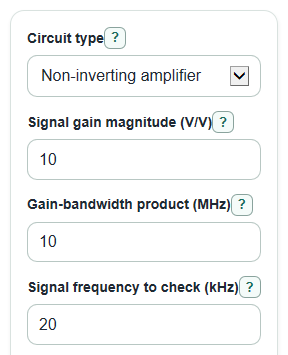
For a non-inverting amplifier with Signal gain magnitude = 10 V/V, Gain-bandwidth product = 10 MHz, and Signal frequency to check = 20 kHz, the noise gain is 10. The small-signal bandwidth is 10000000 Hz / 10 = 1000000 Hz, or 1 MHz. The room is 20 * log10(1000000 / 20000) = 33.98 dB. If Slew rate = 2 V/us and Output signal size = 2 V peak, the slew-rate bandwidth is about 159155 Hz, so Estimated usable bandwidth becomes 159155 Hz and the room falls to about 18.02 dB.