
Check a simple zener shunt regulator for resistor size, zener power, resistor power, and safety margins.
Advanced options
Table of contents
How to use our Zener Diode Power Calculator
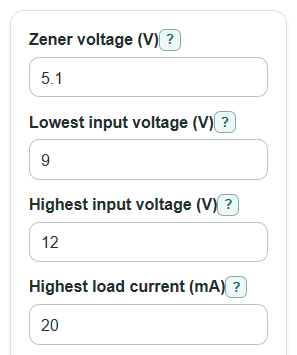
- Enter Zener voltage (V), Lowest input voltage (V), and Highest input voltage (V) using the real supply range your circuit may see.
- Enter Highest load current (mA) and Minimum zener current (mA); the calculator uses these to choose the largest resistor that should still keep the zener regulating.
- Open Advanced options if you want to check Lowest load current (mA), choose a standard Series resistor choice, or apply Zener rated power (W), Resistor rated power (W), and Power safety factor.
- Click Calculate and read Highest zener diode power first, then check both power margin outputs; a negative margin means that part is undersized for the entered safety factor.
- Sanity-check the result by confirming Lowest zener current is at least your Minimum zener current (mA) and Highest zener current makes sense for the no-load or light-load case.
Definitions
Zener voltage (V): The output voltage the zener diode is meant to hold when it has enough current.
Zener current: The current through the zener diode itself, not the current used by the load.
Load current: The current taken by the circuit connected to the regulated output.
Series resistor: The resistor between the input supply and the zener output node in a simple shunt regulator.
Exact maximum series resistor: The largest calculated resistor that should still provide the entered Minimum zener current (mA) at the lowest input voltage and highest load current.
E12 and E24: Common preferred resistor value sets. The calculator rounds down to a value in the chosen set so regulation is not lost by choosing a resistor that is too large.
Power margin after safety factor: The part rating divided by the safety factor, minus the calculated power. Positive means extra room. Negative means the part is undersized.
Common mistakes and quick fixes
Mistake: Using the normal supply voltage for Lowest input voltage (V) instead of the lowest possible value.
Fix: Enter the lowest value the supply can actually reach so Lowest zener current is checked at the hardest regulation case.
Mistake: Leaving Lowest load current (mA) too high when the load can be unplugged.
Fix: Use 0 for Lowest load current (mA) if no-load operation is possible, because that usually raises Highest zener diode power.
Mistake: Treating Series resistor to use as a minimum resistor value.
Fix: It is chosen from Exact maximum series resistor; a larger resistor can reduce Lowest zener current below Minimum zener current (mA).
Mistake: Comparing Highest zener diode power directly with Zener rated power (W) and ignoring Power safety factor.
Fix: Use Zener power margin after safety factor; negative means the zener rating is too small for the safety factor you entered.
Mistake: Forgetting that Highest series resistor power can fail even when the zener is safe.
Fix: Check Resistor power margin after safety factor and raise Resistor rated power (W) or change the design if the margin is negative.
Limitations & Key Assumptions / Boundary Conditions
- This is for a simple zener shunt regulator: one series resistor feeding a zener diode and a load.
- The calculation treats Zener voltage (V) as fixed. Real zeners have voltage slope with current, tolerance, and temperature drift.
- The calculator checks steady-state heat power only. It does not check startup pulses, surge current, ripple, thermal resistance, airflow, or board copper area.
- Minimum zener current (mA) must come from a data sheet or a safe design choice. Guessing too low can make the output voltage sag.
- Power safety factor is a design rule you choose. It is not a guarantee that a part will stay cool in a tight enclosure.
- Standard resistor rounding uses ideal E12 or E24 values and does not include resistor tolerance. A high-tolerance resistor can change the actual zener current.
- If Highest input voltage (V) is far above Zener voltage (V), a shunt regulator may waste a lot of power. A different regulator may be better.
Methodology
Calculation flow
A basic zener shunt regulator uses a series resistor feeding a zener diode and the load, so resistor current splits between the load and the zener [1]. The calculator first designs for the hardest regulation case, then checks heat at the highest input voltage and lightest load.
R_exact = (Vin_min - Vz) / (IL_max + Iz_min)
Currents in milliamps are converted to amps by multiplying by 0.001 before using the formulas. R_exact is the exact maximum series resistor in ohms.
R_selected = round_down_to_series(R_exact, resistor_set)
If Exact calculated value is selected, R_selected equals R_exact. If E12 common values or E24 common values is selected, the calculator chooses the largest standard value that is less than or equal to R_exact.
Iz_actual_min = (Vin_min - Vz) / R_selected - IL_max
This is shown as Lowest zener current. It is checked at Lowest input voltage (V) and Highest load current (mA), where the zener has the least current left over.
Iz_actual_max = (Vin_max - Vz) / R_selected - IL_min
This is shown as Highest zener current. It is checked at Highest input voltage (V) and Lowest load current (mA), where the zener usually runs hottest.
Pz_max = Vz * Iz_actual_max
Pr_max = (Vin_max - Vz)^2 / R_selected
These give Highest zener diode power and Highest series resistor power in watts.
margin = rated_power / power_safety_factor - calculated_power
The same margin formula is used for the zener and the resistor. The calculator keeps negative margins because a negative value tells you how far the part is undersized.
Mini example
With Zener voltage (V) = 5.1, Lowest input voltage (V) = 9, Highest input voltage (V) = 12, Highest load current (mA) = 20, Minimum zener current (mA) = 5, Lowest load current (mA) = 0, and E24 rounding, the exact maximum resistor is (9 - 5.1) / (0.020 + 0.005) = 156 ohms. E24 rounds down to 150 ohms. At the hottest diode case, zener current is (12 - 5.1) / 150 - 0 = 0.046 A, so zener power is 5.1 * 0.046 = 0.2346 W. The resistor power is (12 - 5.1)^2 / 150 = 0.3174 W.