
Enter resistors connected end-to-end to find their equivalent series resistance, with optional supply voltage for current, voltage drops, and power.
Table of contents
How to use our Series Resistor Calculator
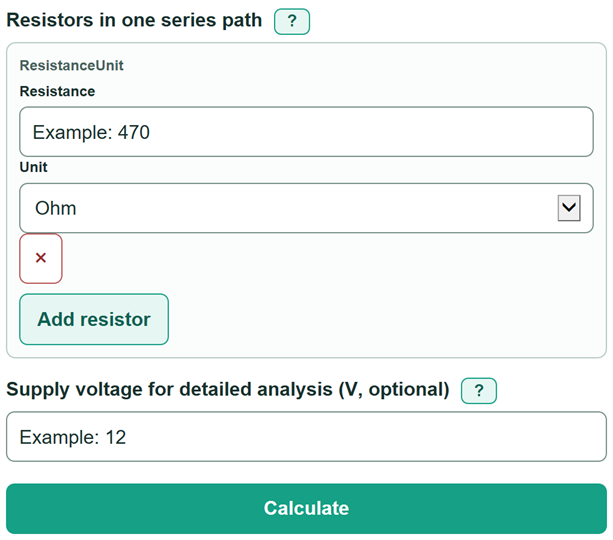
- Add one row for each physical resistor connected end-to-end with no branch between them.
- Enter each resistance and choose the unit printed on the resistor, schematic, parts list, or meter reading.
- Leave supply voltage blank if you only need equivalent resistance, or enter the circuit voltage to calculate current, voltage drops, and power.
- Click Calculate and check that the equivalent resistance is greater than every individual positive resistor value.
- If you entered a supply voltage, check that the displayed voltage drops add to the supply voltage, allowing for display rounding.
Definitions
Series path: A single route where components connect end-to-end and no current branch splits off between them.
Equivalent series resistance: One resistance value that has the same total resistance as all entered resistors in the series path.
Ohm: The unit of electrical resistance.
mOhm, kOhm, MOhm, and GOhm: Resistance units using SI prefixes. Milli means one-thousandth, kilo means one thousand, mega means one million, and giga means one billion. [1]
Common circuit current: The same current that flows through every resistor in a pure series path.
Voltage drop: The part of the supply voltage across one resistor.
Power: Electrical energy converted per second by a resistor, measured in watts (W).
Common mistakes and quick fixes
Mistake: Including a section of circuit that has a branch or parallel path.
Fix: Use this calculator only for resistors connected in one unbranched, end-to-end path. Work out any parallel section separately first.
Mistake: Entering 1.5 Ohm for a resistor labeled 1.5 kOhm.
Fix: Choose kOhm for that row, or enter 1,500 and choose Ohm.
Mistake: Using the reciprocal formula for parallel resistors.
Fix: In a pure series path, convert every resistor to Ohm and add the values directly.
Mistake: Entering 0 or a negative resistance.
Fix: Enter a finite resistance greater than 0 for every row. Zero and negative values are outside this ordinary resistor model.
Mistake: Treating a blank supply-voltage field as 0 V.
Fix: Leave it blank when you only need equivalent resistance. Enter 0 only when the actual supply voltage is zero.
Limitations & Key Assumptions / Boundary Conditions
- This calculation applies only to a pure, unbranched series path of ordinary positive resistors.
- It does not solve mixed series-parallel circuits, circuits with branches, capacitors, inductors, diodes, LEDs, transistors, or other nonlinear parts.
- Entered values are treated as ideal resistance values. Resistor tolerance, temperature, lead resistance, and meter accuracy can change a real measurement.
- Voltage-drop and power results assume an ideal DC supply and do not include source internal resistance or changing load behavior.
- Compare calculated resistor power with each resistor's rated power before building or powering a circuit.
Methodology
Series resistance
The calculator converts each entered resistance to Ohm, then adds the values. This works because a pure series circuit has only one current path.
R_total (total resistance) = R1 + R2 +... + Rn
For example, 150 Ohm plus 1.35 kOhm becomes 150 Ohm plus 1,350 Ohm, which equals 1,500 Ohm.
Optional voltage analysis
When you enter supply voltage, the calculator applies Ohm's law to the complete series path. The calculated current is the current through each resistor.
I (current in A) = V_supply (supply voltage in V) / R_total (total resistance in Ohm)
For each resistor, voltage drop equals current times resistance. Power equals current squared times resistance.
V_resistor (voltage drop in V) = I * R_resistor
P_resistor (power in W) = I * I * R_resistor
With 12 V across 1,500 Ohm, the current is 0.008 A, or 8 mA. A 150 Ohm resistor drops 1.2 V and dissipates 9.6 mW. A 1,350 Ohm resistor drops 10.8 V and dissipates 86.4 mW, so the drops add to 12 V.