
Calculate thermistor beta from two resistance and temperature measurements, then check the nominal resistance and optional third point.
Table of contents
How to use our Thermistor Beta Calculator
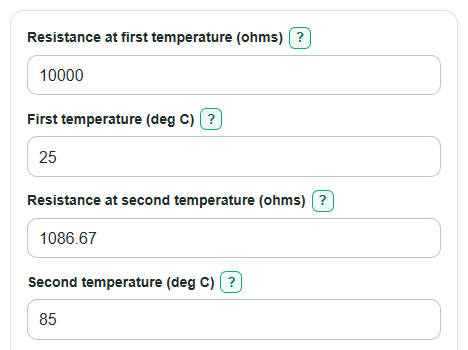
- Enter Resistance at first temperature (ohms) and First temperature (deg C) from one measured thermistor point.
- Enter Resistance at second temperature (ohms) and Second temperature (deg C) from a second point that is clearly at a different temperature.
- Open Advanced options if you want a different Reference temperature for nominal resistance (deg C), or if you have a third measured point for Check resistance (ohms) and Check temperature (deg C).
- Click Calculate and read Thermistor beta first, then check What the sign means to see whether the points look like a normal NTC thermistor pattern.
- Sanity-check the result: Nominal resistance at the reference temperature should be close to a known datasheet value, and a small Check resistance error means the two-point beta model fits your third point better.
Definitions
Thermistor beta: The number, in kelvin, that describes how sharply an NTC thermistor's resistance changes with temperature. It is also called the beta value or B value.
NTC thermistor: A temperature-sensitive resistor whose resistance normally goes down as temperature goes up.
PTC thermistor: A temperature-sensitive resistor whose resistance goes up as temperature goes up.
Kelvin: An absolute temperature scale used inside the beta equation. The calculator converts deg C to kelvin by adding 273.15.
Natural log, ln: A logarithm used in the beta formula. You do not need to calculate it by hand.
Nominal resistance at the reference temperature: The resistance predicted by the beta model at the chosen reference temperature, often 25 deg C for parts sold as 10k NTC or 100k NTC.
Check resistance error: The percent difference between your measured check resistance and the resistance predicted by the beta model.
Common mistakes and quick fixes
Mistake: Entering the fixed divider resistor instead of the thermistor value in Resistance at first temperature (ohms).
Fix: Use only the measured thermistor resistance for Resistance at first temperature (ohms) and Resistance at second temperature (ohms).
Mistake: Typing Fahrenheit values into First temperature (deg C) or Second temperature (deg C).
Fix: Convert the temperatures to deg C before entering them.
Mistake: Using the same number for First temperature (deg C) and Second temperature (deg C).
Fix: Use two different temperatures, because Thermistor beta would require division by zero if the temperatures match.
Mistake: Filling in Check resistance (ohms) but leaving Check temperature (deg C) blank.
Fix: Enter both check fields together, or clear both fields if you do not want the third-point check.
Mistake: Treating a negative Thermistor beta as a formatting problem.
Fix: Read What the sign means; a negative value usually means the points act like a PTC thermistor, or one resistance-temperature pair was entered wrong.
Mistake: Comparing Nominal resistance at the reference temperature to a datasheet that uses a different reference temperature.
Fix: Set Reference temperature for nominal resistance (deg C) to the same reference temperature used by the datasheet.
Limitations & Key Assumptions / Boundary Conditions
- The beta model is a two-point approximation. A full resistance table or Steinhart-Hart coefficients can fit a real thermistor better over a wide temperature span.
- Resistance values must be greater than 0 ohms because the natural log part of the formula cannot use zero or negative resistance.
- Temperatures must be above -273.15 deg C so the kelvin temperature is positive.
- First temperature (deg C) and Second temperature (deg C) cannot be the same, because the beta formula would divide by zero.
- A negative Thermistor beta is not blocked. It means the entered points do not follow the usual NTC pattern.
- If the two resistance values are the same but the temperatures differ, Thermistor beta is 0 K. That does not match normal NTC behavior, and the temperature-from-resistance check is not possible because it would divide by beta.
- The optional third-point check only tests one extra point. A small error at that point does not prove the model is accurate at every temperature.
- Measurement errors from self-heating, poor thermometer contact, wiring resistance, or an unstable bath can change the calculated beta.
Methodology
Core beta calculation
The calculator uses the two measured resistance-temperature points to solve for the thermistor beta value. Beta is commonly calculated from resistance measurements at two temperature points [2].
T_K = T_C + 273.15
B = ln(R1 / R2) / ((1 / T1_K) - (1 / T2_K))
In this formula, B is Thermistor beta in K, R1 and R2 are the two resistances in ohms, T1_K and T2_K are the two temperatures in kelvin, and ln means natural log.
Nominal resistance
After beta is found, the calculator estimates the resistance at the selected reference temperature.
R_ref = R1 / exp(B * ((1 / T1_K) - (1 / T_ref_K)))
R_ref is the Nominal resistance at the reference temperature. If the reference is 25 deg C, this is the value often compared with a part label such as 10k NTC.
Optional check point
If Check temperature (deg C) is entered, the calculator predicts the resistance at that temperature.
R_pred = R_ref * exp(B * ((1 / T_check_K) - (1 / T_ref_K)))
If both Check resistance (ohms) and Check temperature (deg C) are entered, it keeps the sign of the resistance error.
error_percent = ((R_check - R_pred) / R_pred) * 100
Positive Check resistance error means the measured check resistance is higher than the model prediction. Negative means it is lower.
The calculator can also estimate temperature from the check resistance when beta is not 0.
T_from_R_K = 1 / ((1 / T_ref_K) + (ln(R_check / R_ref) / B))
T_from_R_C = T_from_R_K - 273.15
temp_error_C = T_from_R_C - T_check_C
Positive Check temperature error means the model reads warmer than the entered check temperature. Negative means it reads cooler.
Mini example
Using Resistance at first temperature (ohms) = 10000 at First temperature (deg C) = 25, and Resistance at second temperature (ohms) = 1086.67 at Second temperature (deg C) = 85, the temperatures are 298.15 K and 358.15 K.
B = ln(10000 / 1086.67) / ((1 / 298.15) - (1 / 358.15)) = 3949.95 K
With Reference temperature for nominal resistance (deg C) = 25, Nominal resistance at the reference temperature is 10000 ohms. If Check resistance (ohms) = 3600 and Check temperature (deg C) = 50, the model predicts about 3584.68 ohms, so Check resistance error is about 0.43 percent and Check temperature error is about -0.08 deg C.