
Calculate stored energy in an inductor, or solve for needed inductance or current with optional RL discharge estimates.
Advanced options
Table of contents
How to use our Inductor Energy Calculator
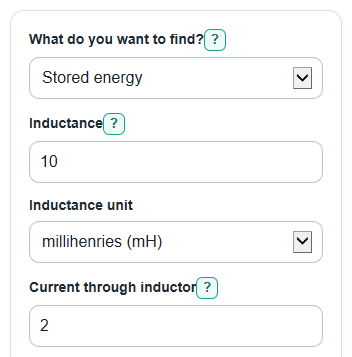
- Choose What do you want to find?: Stored energy, Needed inductance, or Needed current.
- Enter the visible known values, then pick the correct Inductance unit, Current unit, or Energy unit for those values.
- If you know the discharge path, open Advanced options and enter Discharge path resistance (ohms) and Current left after discharge (percent).
- Click Calculate and read Main answer first, then check the supporting cards such as Stored energy, RL time constant, or Time to chosen current left.
- Sanity-check the result: doubling Current through inductor should make Stored energy four times larger, because current is squared.
Definitions
Inductor: A coil-like part that stores energy in a magnetic field when current flows through it and resists quick changes in current [1].
Inductance: How strongly the inductor stores magnetic energy for a given current. The calculator converts uH and mH to henries (H).
Current through inductor: The current in the coil at the moment being checked. The stored-energy formula uses this instant current, in amps (A).
Stored energy: Magnetic energy held by an ideal linear inductor at the entered current. The calculator can show it in joules (J) and millijoules (mJ).
Discharge path resistance: The total resistance, in ohms, that the inductor current flows through after switching.
RL time constant: The time scale for current decay in a resistor-inductor path. After one time constant, current is about 36.8 percent of its starting value.
Current left after discharge: The target remaining current percent used to estimate Time to chosen current left.
Common mistakes and quick fixes
Mistake: Entering 10 in Inductance but leaving Inductance unit on H when the part is 10 mH.
Fix: Match Inductance unit to the part marking, such as millihenries (mH) for 10 mH.
Mistake: Using average AC current in Current through inductor for a moment-by-moment energy question.
Fix: Use the instant Current through inductor at the moment you want to analyze.
Mistake: Trying to find Needed inductance with Current through inductor set to 0.
Fix: Enter a nonzero Current through inductor, because the Needed inductance formula divides by current squared.
Mistake: Entering a negative Stored energy when finding Needed current or Needed inductance.
Fix: Use 0 or a positive Stored energy value; magnetic stored energy cannot be negative in this model.
Mistake: Treating Starting voltage across discharge resistance as the worst possible switch voltage.
Fix: Use it only as the simple resistor-path estimate from Discharge path resistance (ohms); real switching can create higher spikes.
Mistake: Setting Current left after discharge (percent) to 0 or 100.
Fix: Enter a value greater than 0 and less than 100, such as 1 for nearly off.
Limitations & Key Assumptions / Boundary Conditions
- The stored-energy formula assumes an ideal linear inductor, so inductance stays constant as current changes.
- Real inductors can saturate, heat up, and have winding resistance. Those effects can change energy storage and discharge behavior.
- The discharge check assumes the inductor discharges through one simple resistor path. It does not model diodes, sparks, switches, capacitors, snubbers, or changing resistance.
- Starting voltage across discharge resistance is only the resistor-path estimate. It is not a safety rating and not a guaranteed switch-voltage limit.
- For AC, ripple, or pulsed current, use the current at the exact moment you want to check. Average current can give the wrong stored energy.
- The calculator reports current magnitude for Needed current. Current in the opposite direction stores the same energy because the current is squared.
Methodology
Core energy calculation
The calculator first converts all active inputs to base units: henries for inductance, amps for current, and joules for energy. It then uses the standard ideal-inductor energy relationship [2].
E = 0.5 * L * I^2
In this formula, E is stored energy in joules, L is inductance in henries, and I is current in amps.
Solving backward
When you choose Needed inductance, the calculator rearranges the same equation:
L = 2 * E / I^2
When you choose Needed current, it solves for current magnitude:
I = sqrt(2 * E / L)
Current is shown as a positive magnitude because the energy is the same for positive or negative current.
Optional discharge check
If Discharge path resistance (ohms) is entered, the calculator estimates simple RL discharge values from the same inductance and starting current.
τ = L / R
V0 = abs(I) * R
P0 = I^2 * R
t = -τ * ln(p / 100)
Here, τ is the RL time constant in seconds, R is discharge resistance in ohms, V0 is starting discharge voltage in volts, P0 is starting heat rate in watts, and p is Current left after discharge (percent).
Mini-example
For 10 mH and 2 A, the calculator converts 10 mH to 0.010 H, then calculates E = 0.5 * 0.010 * 2^2 = 0.020 J, which is 20 mJ. With a 5 ohm discharge path, τ = 0.010 / 5 = 0.002 s, V0 = 2 * 5 = 10 V, P0 = 2^2 * 5 = 20 W, and time to 1 percent current left is -0.002 * ln(0.01) = 0.00921 s.