
Choose your air-core coil shape, enter its dimensions and turns, and calculate its estimated inductance in microhenries (uH).
Winding measurements
This is a geometry-based air-core estimate. Wire spacing, nearby objects, self-capacitance, frequency, and measurement method can change a real coil's value.
Table of contents
How to use our Coil Inductance Calculator
- Choose "Coil shape" to match the winding: a single-layer solenoid, multilayer solenoid, or flat spiral.
- Set "Coil dimension unit" to match the ruler, caliper, or drawing you are copying from.
- Enter each requested measurement and the counted whole number of turns. Only measurements used by the selected shape appear.
- Select "Calculate" to see the estimated coil inductance in uH and a note explaining the selected measurement model.
- Sanity-check the result by confirming that solenoid length includes only the wound section, and that a flat spiral's outer diameter is greater than its inner diameter.
Definitions
Inductance: A coil property that opposes a change in electric current by storing energy in a magnetic field.
Microhenry (uH): One millionth of a henry. The calculator reports estimated inductance in this unit.
Air-core coil: A coil wound on air, plastic, paper, or another nonmagnetic form instead of a magnetic core.
Mean turn diameter: The diameter of the wire path through the centers of opposite turns.
Winding length: The first-turn-to-last-turn distance along a solenoid's axis.
Winding depth: The radial thickness of stacked wire layers in a multilayer solenoid.
Flat spiral: A coil with turns mostly in one plane, measured at its inner and outer winding edges.
Common mistakes and quick fixes
Mistake: Using the former diameter instead of the mean turn diameter.
Fix: Measure through the centers of opposite wire turns. For a multilayer coil, use the diameter halfway through the winding depth.
Mistake: Entering the full former length as winding length.
Fix: Measure only from the first turn to the last turn along the coil axis.
Mistake: Treating winding depth as an added diameter.
Fix: Enter the radial thickness from the inner wire layer to the outer wire layer. It is half the difference between winding outer and inner diameters.
Mistake: Reversing a flat spiral's inner and outer diameters.
Fix: Measure the empty center opening for the inner diameter and the complete winding for the outer diameter. The outer diameter must be larger.
Mistake: Applying this air-core estimate to a ferrite, iron, powder-core, or toroidal coil.
Fix: Use a design method for that core material because the magnetic core and its path change inductance.
Limitations & Key Assumptions / Boundary Conditions
- The formulas estimate self-inductance for the listed air-core shapes only; they do not apply to ferrite, iron, powder-core, or toroidal coils.
- Wire diameter, insulation thickness, turn spacing, and uneven winding placement can make a measured coil differ from the estimate.
- Nearby metal, other coils, circuit boards, and enclosures can change measured inductance.
- The estimate does not include self-capacitance, self-resonant frequency, resistance, Q, or frequency-dependent losses.
- For a flat spiral, measure at winding edges. For a solenoid, use only the length occupied by turns, not unused former length.
Methodology
Geometry estimate
The calculator uses a simplified Wheeler-style air-core estimate matched to the selected winding shape. Dimensions are converted to inches before calculation, and the result is in microhenries (uH). [1]
One inch equals exactly 25.4 mm. In the formulas, D is mean turn diameter in inches, l is winding length in inches, b is radial winding depth in inches, and N is the whole number of turns.
Single-layer: L (uH) = D^2 x N^2 / (18 x D + 40 x l)
Multilayer: L (uH) = 0.2 x D^2 x N^2 / (3 x D + 9 x l + 10 x b)
For a flat spiral, r is mean radius in inches and w is radial winding width in inches.
Flat spiral: r = (outer diameter + inner diameter) / 4
Flat spiral: w = (outer diameter - inner diameter) / 2
Flat spiral: L (uH) = r^2 x N^2 / (8 x r + 11 x w)
Worked mini-example
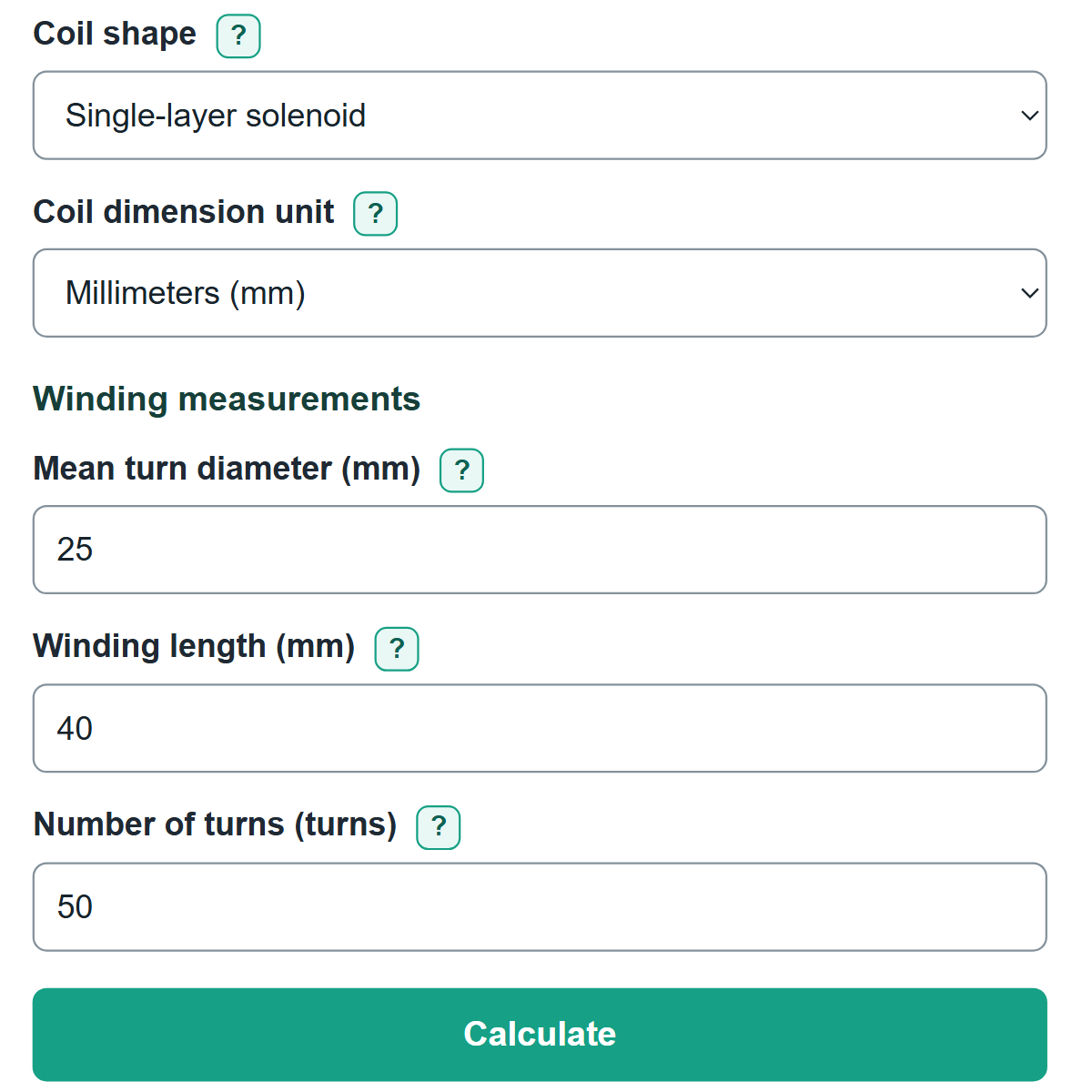
A single-layer coil with a 25 mm mean diameter, 40 mm winding length, and 50 turns has D = 0.9843 in and l = 1.5748 in. The single-layer formula gives about 30.01 uH.
Measurement rules
For a single-layer solenoid, measure through wire centers and from the first turn to the last turn. For a multilayer solenoid, also measure radial depth from the inner layer to the outer layer. For a flat spiral, measure the inner and outer winding edges; the calculator derives radius and width.
Calculation details
Only dimensions used by the selected shape are calculated. Active dimensions must be greater than zero, turns must be a positive whole number, and a flat spiral must have an outer diameter greater than its inner diameter.