
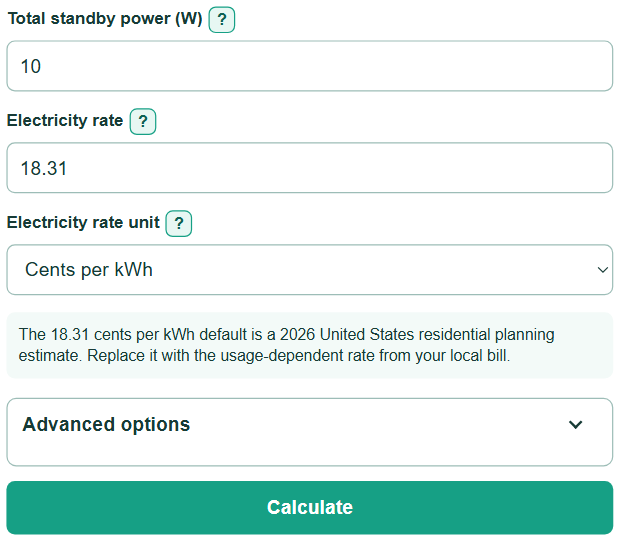
Enter standby watts and your electricity rate to estimate the annual and monthly cost of idle devices on your electric bill.
The 18.31 cents per kWh default is a 2026 United States residential planning estimate. Replace it with the usage-dependent rate from your local bill.
Advanced options
Standby schedule
Cutoff plan
Table of contents
How to use our Standby Power Cost Calculator
- Measure the combined idle power of the devices with a plug-in power meter or energy-monitoring smart plug, then enter it in "Total standby power (W)".
- Choose the unit shown on your bill in "Electricity rate unit" before entering a new rate. If you later switch units, the calculator converts a valid rate to keep the same price.
- Enter the usage-dependent electricity rate from your bill. Include energy-related supply and delivery charges, but not a fixed monthly customer or service charge.
- Select "Calculate". The first result is the estimated annual standby cost, followed by the average monthly cost and annual energy use.
- For seasonal equipment or devices that are fully off part of the time, open "Advanced options" and adjust "Standby time (hours per day)" and "Standby days per year".
- To check a switched strip, smart plug, timer, setting change, or unplugging plan, choose "Yes" for "Check a power cutoff plan". Enter the watts it turns off, the controller's own power, and its purchase price.
- Sanity-check the energy result against the schedule. For example, 10 W left in standby for 24 hours per day over 365 days uses 87.6 kWh per year.
Definitions
Standby power: Electricity a device uses while idle, waiting for a command, or maintaining a ready state.
Watt (W): A unit of power. It tells how fast a device is using electricity at a given moment.
Kilowatt-hour (kWh): A unit of energy used on electric bills. One kWh is equal to 1,000 W used for one hour.
Usage-dependent electricity rate: The part of an electric bill that changes when kWh use changes. This calculator uses that rate, not fixed monthly charges.
Simple payback time: The time for modeled energy savings to equal a one-time purchase price. It does not include financing, repairs, or the changing value of money over time.
Common mistakes and quick fixes
Mistake: Using the watt number on a product label as the standby reading.
Fix: Measure the device while it is idle or in standby. A label often gives maximum or active power instead.
Mistake: Entering cents per kWh while "Electricity rate unit" is set to dollars per kWh.
Fix: Choose the bill's unit first. For example, 18.31 cents per kWh equals $0.1831 per kWh.
Mistake: Including a fixed monthly customer or service charge in the rate.
Fix: Use only charges that rise with kWh use. Lower standby use normally does not remove fixed account charges.
Mistake: Counting all device power as removable in a cutoff plan.
Fix: Enter only standby watts the plan truly turns off, and enter the control device's own draw in "Control device power (W)".
Mistake: Disconnecting equipment that needs continuous power.
Fix: Keep power connected when it is needed for safety, security, networking, recording, updates, or normal appliance operation.
Limitations & Key Assumptions / Boundary Conditions
- This is a flat-rate estimate. It excludes fixed service charges, taxes, tiered prices, demand charges, and time-of-use prices.
- Results depend on the standby watt reading and schedule. Standby draw can change with settings, network activity, charging, and connected equipment.
- The default electricity rate is a US residential planning estimate for 2026. Replace it with the usage-dependent rate from your own bill.
- The cutoff-plan calculation applies the same daily and yearly schedule to both the watts removed and the controller's own power use.
- Do not treat a positive cutoff result as permission to disconnect equipment that needs continuous power for safety, security, recording, networking, updates, or appliance operation.
- Five-year net savings subtracts the purchase price once. It does not include replacement costs, equipment failure, rebates, or future electricity-rate changes.
Methodology
Cost calculation
The calculator converts the entered electricity rate to dollars per kWh when needed, then calculates energy from power and time.
annual standby energy (kWh) = standby power (W) / 1000 * standby time (hours per day) * standby days per year
annual standby cost ($) = annual standby energy (kWh) * electricity rate ($ per kWh)
monthly standby cost ($) = annual standby cost ($) / 12
Example: A 10 W load in standby for 24 hours per day over 365 days uses 87.6 kWh per year. At $0.20 per kWh, it costs $17.52 per year, or $1.46 per average month.
Cutoff-plan calculation
When "Check a power cutoff plan" is set to "Yes", the calculator subtracts the control device's own power from the standby power it turns off. Negative savings stay negative.
net annual cutoff savings ($) = (watts turned off - controller watts) / 1000 * hours per day * days per year * rate ($ per kWh)
simple payback (months) = purchase price ($) / net annual savings ($ per year) * 12
five-year net cutoff savings ($) = net annual savings ($ per year) * 5 - purchase price ($)
Simple payback appears only when net annual savings are positive. A zero-price cutoff method with positive savings pays back immediately. The 18.31 cents per kWh starting rate is a 2026 US residential planning estimate from the U.S. Energy Information Administration [1].