
Find the heat power in one resistor and pick a safer wattage rating from the parts you can actually use.
Table of contents
How to use our Resistor Wattage Calculator
- Choose What do you know? so the calculator uses the two values you have: voltage and current, voltage and resistance, or current and resistance.
- Enter the visible values using the matching unit selectors, such as Current unit or Resistance unit.
- Open Advanced options if you want to change Extra safety headroom or edit Available wattage ratings to match your parts bin.
- Click Calculate, then read Recommended resistor rating first, followed by Power the resistor turns into heat and Target power after headroom.
- Sanity-check the result: a resistor rating below Power the resistor turns into heat is too small, and a result near the part's limit needs extra datasheet and temperature checking.
Definitions
Voltage across the resistor: The voltage drop from one end of the resistor to the other, measured in volts (V).
Current through the resistor: The electric current flowing through that one resistor, measured in amperes (A), milliamperes (mA), or microamperes (uA).
Resistance amount: How strongly the resistor limits current, measured in ohms, kilo-ohms, or mega-ohms.
Power the resistor turns into heat: The electrical power changed into heat inside the resistor, measured in watts (W).
Extra safety headroom: The percent added above calculated power before choosing a wattage rating. For example, 100% means twice the calculated power.
Recommended resistor rating: The first value in Available wattage ratings that is at least as large as Target power after headroom.
RMS: For AC circuits, root mean square is the steady-power equivalent voltage or current to enter instead of the peak value.
Common mistakes and quick fixes
Mistake: Using the power supply voltage for Voltage across the resistor when another part also drops voltage.
Fix: Enter only the voltage drop across that resistor in Voltage across the resistor.
Mistake: Typing 20 in Current amount but leaving Current unit set to A when you meant 20 milliamps.
Fix: Set Current unit to mA, or enter 0.02 with Current unit set to A.
Mistake: Entering 1 in Resistance amount and forgetting Resistance unit is set to ohms instead of kilo-ohms.
Fix: Set Resistance unit to kilo-ohms for 1 k ohm, or enter 1000 with Resistance unit set to ohms.
Mistake: Setting Extra safety headroom to a negative number to force a smaller Recommended resistor rating.
Fix: Use 0 or more for Extra safety headroom; a common starting point is 100% for double the calculated power.
Mistake: Leaving Available wattage ratings with values that do not match the resistors you can buy or already have.
Fix: Edit Available wattage ratings so Recommended resistor rating is chosen from your real options.
Mistake: Treating Rating note as a pass when it says no listed rating is high enough.
Fix: Add a larger value to Available wattage ratings or choose a resistor with a higher wattage rating.
Limitations & Key Assumptions / Boundary Conditions
- This calculator is for one resistor at a time, not a full series-parallel network.
- Use RMS voltage or RMS current for AC circuits. Do not enter peak AC values unless you first convert them to RMS.
- The Recommended resistor rating is a starting point, not a guarantee that the part will stay cool in every setup.
- Real resistor temperature depends on part type, package size, mounting, airflow, nearby heat, pulse load, and ambient temperature.
- The Available wattage ratings list is editable and may not include every rating sold by every manufacturer.
- Very small or very large values can be valid math, but wiring, tolerance, measurement error, and datasheet limits can matter more in real circuits.
Methodology
How the calculator chooses a rating
The calculator first converts the entered current to amperes and resistance to ohms. It then uses the selected pair of known values with Ohm's law and resistor power equations [1].
current_a = current_value * current_multiplier
resistance_ohm = resistance_value * resistance_multiplier
If What do you know? is Voltage and current, power and the implied resistance are:
power_w = voltage_v * current_a
calculated_resistance_ohm = voltage_v / current_a
If What do you know? is Voltage and resistance, current and power are:
calculated_current_a = voltage_v / resistance_ohm
power_w = voltage_v * voltage_v / resistance_ohm
If What do you know? is Current and resistance, voltage and power are:
calculated_voltage_v = current_a * resistance_ohm
power_w = current_a * current_a * resistance_ohm
Next, the calculator applies Extra safety headroom. Choosing a resistor power rating above expected power is a common way to add margin [2].
target_power_w = power_w * (1 + headroom_percent / 100)
The Available wattage ratings values are cleaned, sorted from smallest to largest, and scanned until the first rating meets or beats the target.
recommended_rating_w = first rating_w where rating_w >= target_power_w
Mini example
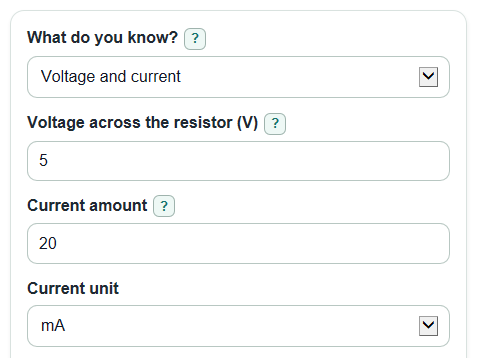
With 5 V across the resistor and 20 mA through it, the current is 0.02 A. The power is 5 * 0.02 = 0.1 W, and the implied resistance is 5 / 0.02 = 250 ohms. With 100% headroom, the target is 0.1 * 2 = 0.2 W. From the default ratings list, the first rating at or above 0.2 W is 0.25 W.
Validation choices
The calculator reads only the visible inputs needed for the selected known pair. Voltage and current must be nonnegative, resistance must be greater than 0 when used, current must be greater than 0 in voltage and current mode, Extra safety headroom must be 0 or more, and Available wattage ratings must include at least one positive finite number.