
Check a solar panel string's cold voltage limit and optional hot MPPT range using your panel and inverter specs.
Table of contents
How to use our Solar String Voltage Calculator
- Enter Panels in one string, counting only panels wired in series, where string voltage adds up.
- Copy Panel Voc and Voc temperature change from the panel datasheet, then enter the coldest expected site temperature in Lowest expected outdoor temperature.
- Enter Max allowed string voltage from the inverter, charge controller, or other rule that sets the lowest allowed limit.
- Use Advanced options only if you also want the hot MPPT check: enter Panel Vmp, Vmp temperature change, Hottest expected cell temperature, and the MPPT voltage range.
- Sanity-check the result: Cold string Voc should be below the limit, and Most panels allowed by cold Voc should be a whole-panel count that makes sense for your planned string.
Definitions
Voc: Open-circuit voltage. It is the panel voltage when no load is connected, and it is used for the cold safety check.
Vmp: Voltage at maximum power. It is the working voltage near the panel's best power point.
MPPT: Maximum power point tracking. It is the inverter or charge controller voltage range where it can turn solar power into useful output.
Series string: Panels wired positive to negative so their voltages add together.
Temperature change: The datasheet voltage coefficient in percent per deg C. A negative value means voltage rises when temperature falls below 25 deg C.
Cold voltage room left: Max allowed string voltage minus Cold string Voc. Positive means room remains; negative means the string is over the entered limit.
Common mistakes and quick fixes
Mistake: Entering the total number of panels on the roof in Panels in one string .
Fix: Count only the panels wired in series in that one string.
Mistake: Using Panel Vmp where Panel Voc is requested.
Fix: Use open-circuit voltage for Panel Voc ; save working voltage for Panel Vmp in Advanced options.
Mistake: Typing a positive value in Voc temperature change because the minus sign was missed.
Fix: Recheck the datasheet. PV voltage temperature changes are usually negative percent per deg C.
Mistake: Using average winter weather for Lowest expected outdoor temperature .
Fix: Use the coldest expected site temperature because cold weather raises Cold string Voc .
Mistake: Treating MPPT maximum voltage as the same as Max allowed string voltage .
Fix: Use the absolute PV input limit for Max allowed string voltage and the working MPPT range for the Advanced options.
Mistake: Reading a negative Cold voltage room left as harmless spare room.
Fix: Negative means the calculated string is over the entered limit by that many volts.
Limitations & Key Assumptions / Boundary Conditions
- This is a voltage planning check, not a full solar design. It does not size wire, fuses, current limits, roof layout, rapid shutdown equipment, grounding, or code paperwork.
- The cold check uses the entered outdoor temperature as the temperature for the Voc correction. Real equipment instructions or local code may require a different method.
- The hot MPPT check uses the entered cell temperature, not outdoor air temperature. Cell temperature can be much hotter than air temperature in full sun.
- Datasheet values can vary by module model, power bin, and manufacturer instructions. Use the exact panel and inverter or charge controller specs for the system.
- The suggested panel-count range is based only on voltage. It can still fail other design limits such as maximum input current, maximum input power, string count, or local rules.
- If the temperature coefficient or voltage values are copied incorrectly, every calculated voltage and panel-count result will be wrong.
Methodology
Core cold voltage check
The calculator first converts the entered temperature from deg F to deg C because PV voltage temperature coefficients are stated per deg C.
temp_c = (temp_f - 32) * 5 / 9
It then adjusts one panel's datasheet voltage from the 25 deg C reference condition to the selected temperature.
voltage_at_temp = voltage_stc * (1 + (temp_coeff_pct_c / 100) * (temp_c - 25))
For the cold safety check, voltage_stc is Panel Voc, temp_coeff_pct_c is Voc temperature change, and temp_c comes from Lowest expected outdoor temperature.
cold_string_voc = panels_in_series * cold_voc_per_panel
voltage_headroom = max_allowed_voltage - cold_string_voc
max_safe_panels = floor(max_allowed_voltage / cold_voc_per_panel)
Cold voltage check passes when Cold string Voc is less than or equal to Max allowed string voltage. A negative Cold voltage room left is kept as a negative number so you can see how far over the limit the string is.
Optional hot MPPT check
When the Advanced options are used, the same temperature-correction formula is applied to Panel Vmp at Hottest expected cell temperature.
hot_string_vmp = panels_in_series * hot_vmp_per_panel
mppt_low_headroom = hot_string_vmp - mppt_min_voltage
mppt_high_headroom = mppt_max_voltage - hot_string_vmp
suggested_min_panels_for_mppt = ceil(mppt_min_voltage / hot_vmp_per_panel)
max_panels_by_mppt = floor(mppt_max_voltage / hot_vmp_per_panel)
suggested_max_panels_overall = min(max_safe_panels, max_panels_by_mppt)
If Fewest panels for hot MPPT is greater than Most panels after cold and MPPT checks, the entered values do not leave a working whole-panel string length under these voltage checks.
Mini-example
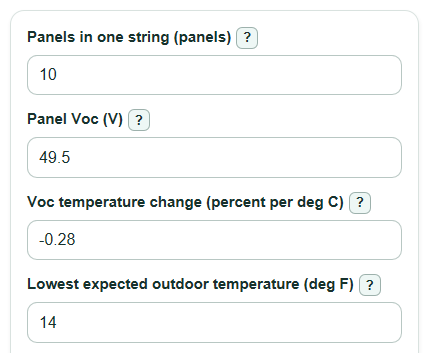
With 10 panels, Panel Voc of 49.5 V, Voc temperature change of -0.28 percent per deg C, Lowest expected outdoor temperature of 14 deg F, and a 600 V limit, 14 deg F converts to -10 deg C. The per-panel cold Voc is 49.5 * (1 + (-0.28 / 100) * (-10 - 25)) = 54.351 V.
cold_string_voc = 10 * 54.351 = 543.51 V
voltage_headroom = 600 - 543.51 = 56.49 V
max_safe_panels = floor(600 / 54.351) = 11 panels
So that 10-panel string passes the 600 V cold check in this example, with room for one more panel by voltage only.