
Enter wall measurements and product-label details to find how many insulation packages to buy and whether the product fits the wall cavity.
Wall size
Insulation product
Advanced options
Table of contents
How to use our Wall Insulation Calculator
- Choose whether you already know the total wall area or need to calculate it from wall length and wall height.
- Enter the gross wall size before deductions, then enter the combined area of windows, doors, and other spaces that will not receive insulation.
- Copy the coverage per package, product thickness, and R-value from the exact insulation package or product data sheet.
- Measure the clear wall cavity depth, then enter extra material or price per package in Advanced options only if needed.
- Check that the package count is rounded up, the net wall area matches your measurements, and the product thickness is no greater than the cavity depth.
Definitions
Gross wall area: The full wall area before windows, doors, and other openings are subtracted.
Net wall area: Gross wall area minus spaces that will not receive insulation.
Coverage per package: The square feet covered by the selected package at its labeled thickness.
R-value: A measure of resistance to heat flow. This calculator uses it to identify the selected product and does not use it to guess thickness.
Cavity depth: The clear inside depth available for insulation in the wall.
Cavity clearance: Cavity depth minus product thickness. A negative value means the product is thicker than the cavity.
Common mistakes and quick fixes
Mistake: Entering net wall area, then subtracting openings again.
Fix: Enter gross wall area before deductions. If your area is already net, enter 0 for openings.
Mistake: Using coverage from a different insulation product.
Fix: Copy the square-foot coverage from the exact bag, bundle, or roll you plan to buy.
Mistake: Entering a nominal stud size instead of the clear cavity depth.
Fix: Measure the open space available for insulation in inches.
Mistake: Ignoring negative cavity clearance.
Fix: A negative clearance means the product is too thick to fit uncompressed. Choose a product that fits or get qualified installation advice.
Mistake: Expecting extra material to change the net wall area.
Fix: Extra material increases the coverage you buy for cuts and waste. It does not increase the wall area receiving insulation.
Mistake: Treating estimated package purchase cost as the full project cost.
Fix: Add labor, delivery, taxes, air sealing, removal, and disposal separately when they apply.
Limitations & Key Assumptions / Boundary Conditions
- The package estimate depends on the coverage printed for the selected product, and coverage can differ between products.
- Extra material is a planning allowance that cannot predict every cut, damaged package, or irregular wall section.
- The thickness check compares uncompressed product thickness with measured cavity depth. It does not confirm local code requirements, vapor control, air sealing, or installed thermal performance.
- A product that fits by thickness can still require care around wiring, pipes, blocking, and irregular framing.
- The optional cost covers whole packages at the entered price only. It excludes labor, delivery, taxes, air sealing, removal, and disposal.
- Opening area must be measured accurately and remain smaller than gross wall area.
Methodology
Area and package calculation
The calculator uses the entered total wall area, or multiplies wall length by wall height. It subtracts measured openings to find the net area to insulate.
gross_wall_area = wall_area
gross_wall_area = wall_length * wall_height
net_wall_area = gross_wall_area - opening_area
Extra material increases purchase coverage. A blank extra-material field has the same effect as 0%.
purchase_area = net_wall_area * (1 + waste_percent / 100)
Purchase area is divided by coverage per package and rounded up because insulation is sold in whole packages.
packages_needed = ceil(purchase_area / package_coverage)
Fit check and cost
The fit check compares measured cavity depth and labeled product thickness in inches. Zero clearance is an exact depth match; negative clearance means the product does not fit uncompressed.
cavity_clearance = cavity_depth - product_thickness
If a package price is entered, the material-only estimate multiplies the rounded-up package count by that price.
estimated_material_cost = packages_needed * package_price
Worked example
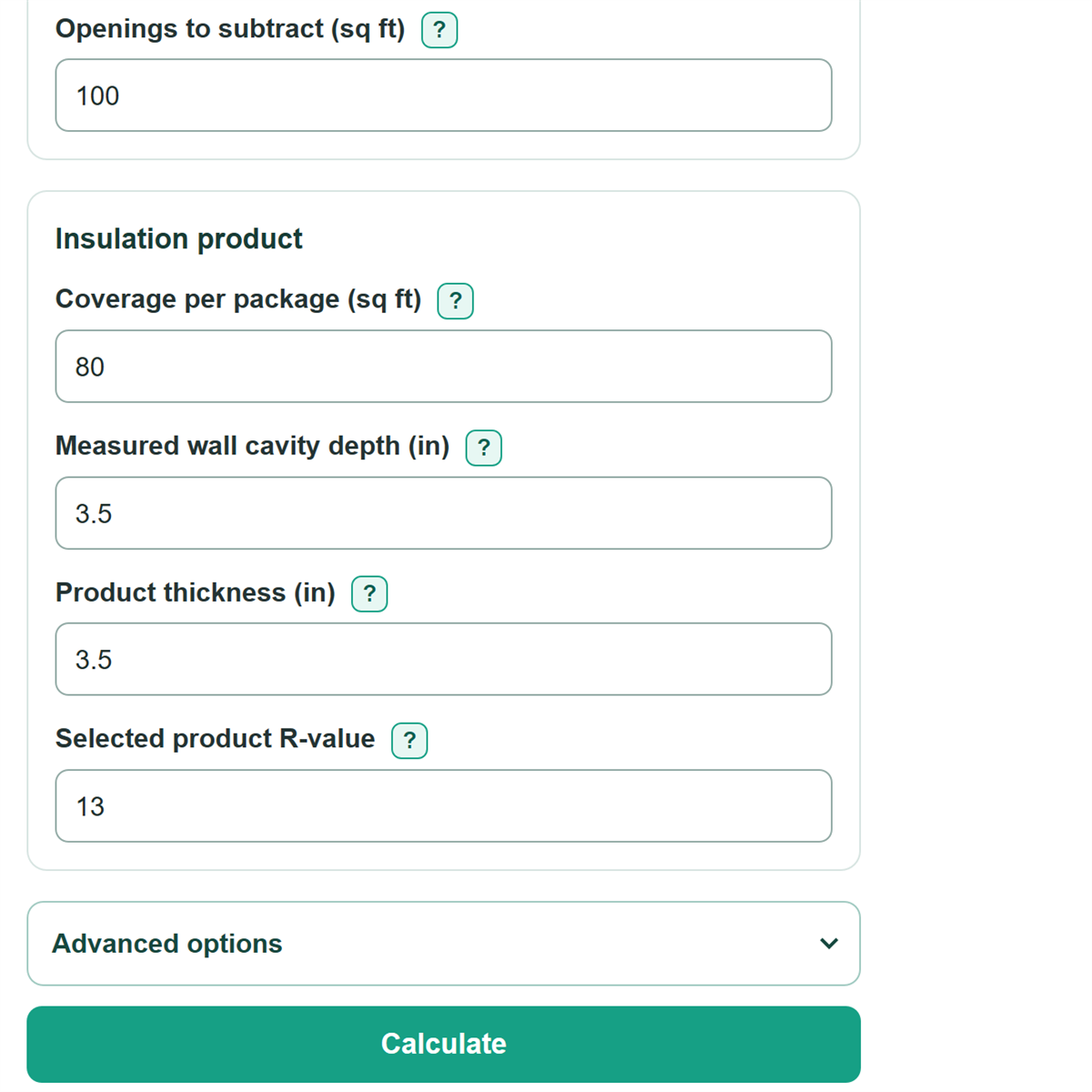
A 1,000 sq ft wall with 100 sq ft of openings has 900 sq ft of net area. Adding 10% extra material gives 990 sq ft to purchase. With 80 sq ft per package, 990 divided by 80 equals 12.375, so 13 packages are needed. At $50 per package, the estimated package cost is $650. A 3.5 in product in a 3.5 in cavity has 0 in clearance and fits by this thickness check.
Product selection
The calculator does not choose an R-value for the building. Insulation recommendations vary by climate and building conditions, so compare the selected product label with local code requirements [1].