
Calculate ACH from room size and airflow, or find the airflow needed to hit a target ACH.
Advanced options
Table of contents
How to use our Air Changes per Hour Calculator
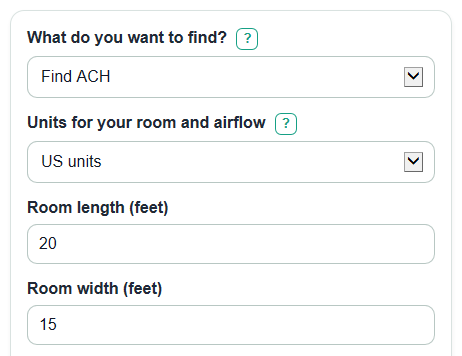
- Pick What do you want to find?: Find ACH if you know airflow, or Find needed airflow if you have a Target ACH (air changes per hour).
- Choose Units for your room and airflow, then enter the room length, width, and ceiling height in the labels shown.
- Enter Main airflow (CFM) or Main airflow (L/s), or enter Target ACH (air changes per hour) if you are working backward.
- Open Advanced options only if you need Number of same main units (units), Main airflow factor (percent), Extra airflow (CFM), Extra airflow (L/s), or Compare to target ACH (air changes per hour).
- Check whether Room volume and Effective airflow counted look reasonable before using the Air changes per hour and clearing-time estimates.
Definitions
ACH: Air changes per hour. It means how many room-size amounts of air are moved or cleaned in one hour, not that every air molecule is replaced.
CFM: Cubic feet per minute. This is a common US airflow unit for fans, vents, and air cleaners.
L/s: Liters per second. This is a common metric airflow unit.
Room volume: The room size found by multiplying length by width by ceiling height.
Effective airflow counted: The airflow used in the ACH math after counting same-size units, the main airflow factor, and any extra airflow.
Main airflow factor: A percent that reduces the main rated airflow when the device is not being used at its full rated flow.
CADR: Clean air delivery rate. It is a clean-air airflow rating often used for portable air cleaners.
Clearing time: An estimate of how long it takes to remove a chosen percent of an airborne contaminant in a well-mixed room with no new source.
Common mistakes and quick fixes
Mistake: Entering inches in Room length (feet), Room width (feet), or Ceiling height (feet).
Fix: Convert inches to feet first, or use Metric units and enter Room length (meters), Room width (meters), and Ceiling height (meters).
Mistake: Using Main airflow (CFM) from one fan but forgetting Number of same main units (units).
Fix: Put the single-unit airflow in Main airflow (CFM) and enter the matching unit count in Number of same main units (units).
Mistake: Treating Main airflow factor (percent) like a decimal, such as entering 0.8 for 80 percent.
Fix: Enter 80 in Main airflow factor (percent), not 0.8.
Mistake: Adding the same air twice in Main airflow (L/s) and Extra airflow (L/s).
Fix: Use Extra airflow (L/s) only for other known airflow that is not already included in Main airflow (L/s).
Mistake: Reading Minutes for one room-size air amount as the time to remove every air molecule.
Fix: Use Estimated time for 90% removal, Estimated time for 95% removal, and Estimated time for 99% removal for rough clearing times.
Mistake: Using Target check as proof that a room meets a building, lab, or health rule.
Fix: Treat Target check as a simple math comparison to Compare to target ACH (air changes per hour), not a compliance decision.
Limitations & Key Assumptions / Boundary Conditions
- ACH is a dilution or cleaning estimate. It does not prove that every part of the room gets the same airflow.
- The clearing-time outputs assume well-mixed air and no new contaminant source. Poor mixing, blocked vents, short-circuiting airflow, or open doors can make real clearing slower.
- Target check is only a math comparison to the entered target. It is not a code, healthcare, lab, or cleanroom compliance check.
- Main airflow factor applies only to Main airflow (CFM) or Main airflow (L/s). Extra airflow is treated as already measured effective airflow.
- If extra airflow already meets the target in Find needed airflow mode, Needed main airflow per unit is floored at 0 because negative fan airflow is not physical.
- Room shape details, furniture, supply and return locations, filter leakage, and fan performance changes under pressure are not modeled.
Methodology
Room volume
The calculator first finds the room volume from the entered dimensions.
volume_ft3 = length_ft * width_ft * height_ft
volume_m3 = length_m * width_m * height_m
Effective airflow
For a main fan, vent, or air cleaner, the calculator multiplies the rated main airflow by the number of matching main units and by the main airflow factor. Extra airflow is then added as a separate measured amount.
effective_cfm = airflow_cfm * number_of_units * (effectiveness_percent / 100) + extra_airflow_cfm
effective_lps = airflow_lps * number_of_units * (effectiveness_percent / 100) + extra_airflow_lps
Air changes per hour
In US units, CFM is cubic feet per minute, so multiplying by 60 changes it to cubic feet per hour. In metric units, 1 L/s equals 3.6 m3/hour.
ach = effective_cfm * 60 / volume_ft3
ach = effective_lps * 3.6 / volume_m3
Needed airflow
When you choose Find needed airflow, the calculator rearranges the ACH formula to find the main airflow needed per unit after extra airflow, unit count, and the main airflow factor are included.
needed_main_cfm = max(0, ((volume_ft3 * target_ach / 60) - extra_airflow_cfm) / (number_of_units * effectiveness_percent / 100))
needed_main_lps = max(0, ((volume_m3 * target_ach / 3.6) - extra_airflow_lps) / (number_of_units * effectiveness_percent / 100))
Time outputs
Minutes for one room-size air amount is 60 divided by ACH. Estimated clearing time uses exponential decay for a well-mixed room.
minutes_per_air_change = 60 / ach
time_minutes = -ln(1 - removal_fraction) * 60 / ach
The removal fractions are 0.90, 0.95, and 0.99. Their natural log factors are 2.302585093, 2.995732274, and 4.605170186.
Mini-example
A 20 ft by 15 ft by 8 ft room has volume 2400 ft3. With 200 CFM counted airflow, ACH = 200 * 60 / 2400 = 5.0. One room-size air amount takes 60 / 5 = 12 minutes. The estimated 95% removal time is 2.995732274 * 60 / 5 = 35.9 minutes.
Calculation notes
All room dimensions must be greater than 0. ACH must be greater than 0 before time outputs can be calculated. The calculator keeps very small clearing times as minutes, not as instant removal.