
Estimate transformer size, voltage loss, wire size, and split-run fixes for one low-voltage garden lighting cable run.
Table of contents
How to use our Garden Lighting Calculator
- Choose the Transformer output (volts) tap you plan to use, such as 12 V or 15 V.
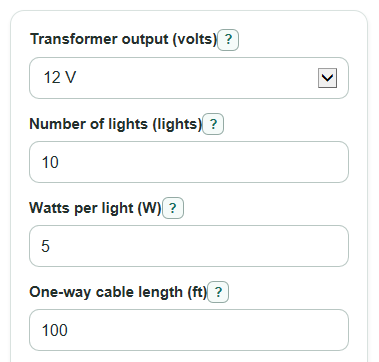
- Enter Number of lights, Watts per light, and One-way cable length for one cable run only.
- Pick the Wire size you plan to use, then adjust Allowed voltage loss or Extra transformer room if your plan uses different targets.
- If you already own a transformer, enter Existing transformer size to check its load percent; otherwise leave it blank.
- Compare Planned wire result, Voltage lost, and Estimated voltage at farthest light. If the voltage loss looks high, check the distance and watts before buying wire.
Definitions
AWG: American Wire Gauge, the wire-size system used for landscape cable. A smaller AWG number means thicker wire and less voltage loss.
Transformer output: The voltage tap on the transformer, such as 12 V, 13 V, 14 V, or 15 V.
One-way cable length: The distance from the transformer to the farthest light on the run, not the round-trip wire length.
Voltage lost: The amount of transformer voltage used up by the cable before power reaches the farthest light.
Run current: The amps flowing through the cable for this one run. More current causes more voltage loss in the same wire.
Extra transformer room: Extra wattage added above the light load so the transformer is not planned right at its rating.
Existing transformer load: The percent of an optional existing transformer rating used by the total light watts.
Common mistakes and quick fixes
Mistake: Entering the full out-and-back cable distance in One-way cable length.
Fix: Enter only the distance from the transformer to the farthest light; the calculation handles the return path.
Mistake: Using total project lights in Number of lights when some lights are on a separate run.
Fix: Count only the lights on this one run, or check each run separately.
Mistake: Guessing Watts per light from brightness or bulb shape.
Fix: Use the watt value on the fixture or bulb label, or use average watts per light if all lights on the run are similar.
Mistake: Thinking a larger AWG number in Wire size you plan to use means thicker cable.
Fix: Remember that 10 AWG is thicker than 12 AWG, and 12 AWG is thicker than 16 AWG.
Mistake: Leaving Allowed voltage loss too high just to make Planned wire result pass.
Fix: Use a voltage loss target that your fixtures can tolerate, then fix a failing run with thicker wire, fewer watts, or shorter runs.
Mistake: Comparing Total light watts directly to Existing transformer size without Extra transformer room.
Fix: Use Recommended transformer size for a planning size that includes the extra room percent.
Limitations & Key Assumptions / Boundary Conditions
- This checks one cable run at a time. Separate branches should be checked separately.
- The voltage loss estimate treats the full light load as if it is at the farthest light. This is usually conservative for evenly spaced lights.
- The wire recommendation is limited to common copper sizes: 16, 14, 12, 10, and 8 AWG.
- Loose connectors, corrosion, poor splices, high wire temperature, and damaged cable can increase voltage loss beyond the estimate.
- The transformer size uses a practical built-in list: 60, 100, 150, 200, 300, 600, 900, and 1200 W. Stores may sell different sizes.
- The calculator does not check local electrical code, burial depth, fixture voltage limits, dimmers, timers, or transformer tap rules.
- If the estimated voltage at the farthest light is zero or negative, the layout is far beyond a useful low-voltage run and should be redesigned.
Methodology
How the load is found
The calculator first finds the total light load on the run, then uses the transformer voltage to estimate current. Electric power uses the relationship power = voltage * current, rearranged here to find current.
total_watts = fixture_count * watts_per_light
current_amps = total_watts / system_voltage
How voltage loss is found
Voltage drop in landscape lighting is affected by load, wire length, and wire gauge; common causes of high drop include too many fixtures, long wire runs, and wire that is too thin for the load [1]. The calculator uses copper resistance per 1000 ft for the selected AWG size and doubles the one-way distance because current travels out and back.
voltage_drop_volts = 2 * one_way_distance_ft * current_amps * (wire_ohms_per_1000ft / 1000)
voltage_drop_percent = (voltage_drop_volts / system_voltage) * 100
voltage_at_last_light = system_voltage - voltage_drop_volts
How the wire and transformer answers are chosen
The planned wire passes when its Voltage lost percent is less than or equal to Allowed voltage loss. For Thinnest wire that meets your target, the calculator checks 16, 14, 12, 10, and 8 AWG in that order and picks the first one that passes. Transformer sizing starts with total light watts plus Extra transformer room, then rounds up to the next built-in transformer size.
minimum_transformer_watts = total_watts * (1 + spare_capacity_pct / 100)
suggested_equal_runs = max(1, ceil(voltage_drop_percent / allowed_drop_pct))
existing_transformer_load_percent = (total_watts / existing_transformer_watts) * 100
Mini-example
For 10 lights at 5 W each on a 12 V transformer, Total light watts is 50 W and Run current is 4.1667 A. With 100 ft of 12 AWG copper, Voltage lost in cable is about 1.323 V, so Voltage lost is about 11.03 percent and Estimated voltage at farthest light is about 10.677 V. With a 10 percent target, the planned 12 AWG run fails, the thinnest passing common wire is 10 AWG, and the split-run shortcut suggests at least 2 equal runs.