
Estimate how many path lights to buy and the spacing to use based on your path size, fixture lumens, and layout.
Advanced options
Table of contents
How to use our Pathway Lighting Calculator
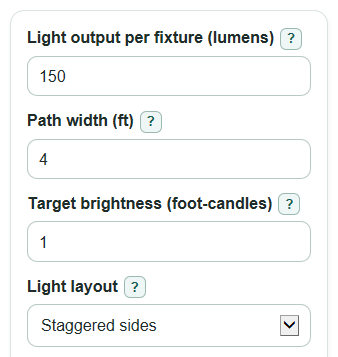
- Enter Light output per fixture (lumens) from the fixture or bulb box, then enter Path width (ft) and Path length (ft) for the area you want lit.
- Set Target brightness (foot-candles). Use a higher target for steps, uneven surfaces, or places where you need clearer footing.
- Choose Light layout: One side, Staggered sides, or Paired across the path. Paired layouts use two fixtures at each light position.
- Open Advanced options if you want to change Light reaching the path (%), Extra overlap (%), Maximum allowed spacing (ft), Power per light (W), or Number format.
- Check Set lights about this far apart and Estimated average brightness. If the spacing looks too tight or too wide for your fixture style, adjust the target, useful-light percent, or maximum spacing and calculate again.
Definitions
Lumens: The total amount of light a bulb or fixture makes. The calculator uses Light output per fixture (lumens) before estimating how much reaches the path.
Foot-candle: Light on one square foot of surface. One foot-candle means one lumen spread over one square foot [2].
Light reaching the path (%): The estimated share of fixture lumens that actually lands on the walking surface.
Extra overlap (%): A spacing reduction that helps neighboring lights overlap more, which can reduce dark gaps.
Light position: A spot along the path where a light is placed. In a paired layout, one position has two fixtures, one on each side.
On-center spacing: The distance from one light position to the next light position, measured center to center.
Common mistakes and quick fixes
Mistake: Using Light output per fixture (lumens) as if every lumen lands on the walkway.
Fix: Adjust Light reaching the path (%) to allow for shielding, beam shape, plants, and light that spills off the path.
Mistake: Entering the whole yard length instead of the area in Path length (ft).
Fix: Measure only the section you want lit, from the first planned light position to the last.
Mistake: Setting Target brightness (foot-candles) too high for a simple garden path.
Fix: Lower the target or compare Estimated average brightness with the feel you want before buying extra fixtures.
Mistake: Choosing Paired across the path without noticing that Lights to buy doubles.
Fix: Use Light layout to compare Paired across the path with Staggered sides before you shop.
Mistake: Treating Largest planned spacing as the exact tape-measure distance.
Fix: Use Set lights about this far apart because it includes whole-light rounding along your Path length (ft).
Mistake: Leaving Power per light (W) wrong when checking a transformer load.
Fix: Enter the fixture wattage from the product label so Estimated total power matches your planned lights.
Limitations & Key Assumptions / Boundary Conditions
- This is a planning estimate, not a photometric lighting design. Real results can differ because fixtures have different beam shapes, mounting heights, shields, and lenses.
- The method assumes average light over the path area. It does not model bright spots, dark patches, glare, shadows, steps, curves, walls, or plants.
- Light reaching the path (%) is an estimate. A lower value gives more lights and closer spacing; a higher value gives fewer lights and wider spacing.
- The calculator assumes a light position at each end of the lit path, then spaces the remaining positions evenly between them.
- Maximum allowed spacing (ft) is a design cap, not a code rule. Change it if your fixture maker gives a tested spacing recommendation.
- Estimated total power uses Power per light (W) times Lights to buy only. Transformer sizing can also depend on wire length, voltage drop, fixture type, and manufacturer rules.
- If the calculator shows an unusually dense layout, recheck Light output per fixture (lumens), Target brightness (foot-candles), Path width (ft), and Light reaching the path (%).
Methodology
How the estimate is calculated
The calculator starts by reducing rated fixture lumens to estimated useful lumens. This avoids assuming that all light from the fixture lands on the walkway.
useful_lumens = fixture_lumens * useful_light_pct / 100
It then decides how many fixtures are at each light position. One side and staggered layouts use one fixture per position. Paired across the path uses two fixtures per position.
fixtures_per_station = 2 if layout == paired, else 1
Because a foot-candle is lumens per square foot, spacing can be estimated by dividing useful lumens at one position by the light needed for one strip of path.
raw_spacing_ft = (useful_lumens * fixtures_per_station) / (target_fc * path_width_ft)
Extra overlap reduces that spacing, and Maximum allowed spacing (ft) caps it.
overlap_spacing_ft = raw_spacing_ft * (1 - extra_overlap_pct / 100)
planned_spacing_ft = min(overlap_spacing_ft, max_spacing_ft)
The path must use a whole number of spaces and light positions, so the calculator rounds the interval count up. It assumes a light position at both ends of the lit path.
interval_count = ceil(path_length_ft / planned_spacing_ft)
station_count = interval_count + 1
actual_spacing_ft = path_length_ft / interval_count
lights_to_buy = station_count * fixtures_per_station
After rounding, the actual average brightness may be above the target because the final spacing is often smaller than the planned maximum.
estimated_average_fc = (useful_lumens * fixtures_per_station) / (path_width_ft * actual_spacing_ft)
If Power per light (W) is entered, total power is calculated from the final fixture count.
estimated_total_watts = lights_to_buy * watts_per_light
Mini-example
With 150 lumens per fixture, 30% light reaching the path, a 4 ft wide path, a 1 foot-candle target, a staggered layout, 20% extra overlap, and a 40 ft path, useful lumens are 45. Raw spacing is 11.25 ft, overlap spacing is 9 ft, and the 10 ft cap does not reduce it. The calculator rounds 40 / 9 up to 5 intervals, giving 6 light positions, 6 fixtures, and actual spacing of 8 ft. Estimated average brightness is 1.40625 foot-candles. With 3 W per light, estimated total power is 18 W.
Number formatting
Auto format uses regular decimals for normal values. It switches to scientific notation only when the absolute value is at least 1000000 or greater than 0 and less than 0.0001.