
Estimate the bedroom lumens, number of lights, and LED watts needed from your room size and bulb package lumens.
Advanced options
Table of contents
How to use our Bedroom Lighting Calculator
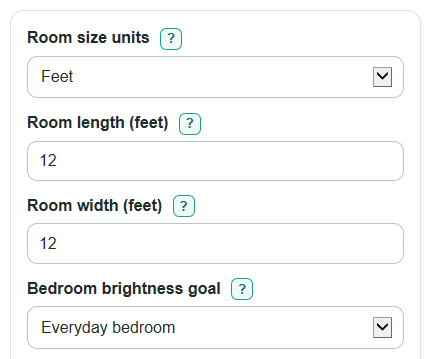
- Choose Room size units, then enter Room length and Room width using the same unit.
- Pick a Bedroom brightness goal: soft for relaxing, everyday for normal use, or bright for cleaning, dressing, or reading with lamps.
- Enter Lumens per light from one bulb box or one fixture package, not the watt number.
- Open Advanced options only if wall color, shade style, dust buffer, LED brightness per watt, or Number display should be adjusted.
- Check the result by comparing Lights needed at your chosen lumens each with real fixture locations; if the count seems crowded, use higher-lumen lights or add lamps instead of forcing all light into one ceiling fixture.
Definitions
Lumens: The amount of visible light a bulb or fixture gives off. More lumens means a brighter light [1].
Lumens per light: The lumen output for one bulb or one fixture package used to calculate how many lights are needed.
Foot-candles: A brightness unit equal to lumens spread over square feet. In this calculator, it is the bedroom brightness target used with room area.
Lux: A metric brightness unit equal to lumens spread over square meters. It is useful when a guide or light meter uses metric units.
LED brightness per watt: Lumens per watt, often written lm/W. A higher value means the LED gives more light for each watt of electricity.
Extra buffer for age and dust: Extra planned lumens added because bulbs can dim and fixtures can collect dust over time.
Common mistakes and quick fixes
Mistake: Mixing feet and meters in Room length and Room width after choosing Room size units.
Fix: Set Room size units first, then enter both room dimensions in that same unit.
Mistake: Typing watts into Lumens per light because the bulb package says 60 W equivalent.
Fix: Use the lumen number for Lumens per light; watts are energy use, not brightness.
Mistake: Choosing Bright cleaning or reading under Bedroom brightness goal and expecting one ceiling light to handle close reading.
Fix: Use the result for room light, then add a bedside or desk lamp near the reading spot.
Mistake: Leaving Wall and ceiling color at mixed when the bedroom has dark paint, dark wood, or a dark ceiling.
Fix: Change Wall and ceiling color to Mostly dark colors so the Total lumens to shop for increases for absorbed light.
Mistake: Picking Open ceiling lights for How much light spreads into the room when the fixture has a deep shade or covered globe.
Fix: Choose Deep shade or covered fixture so trapped light is included in the estimate.
Mistake: Setting LED brightness per watt to a very high guess to make Estimated LED power for all lights look lower.
Fix: Use the lm/W value from the package, or keep the default if you do not know it.
Limitations & Key Assumptions / Boundary Conditions
- This is a planning estimate for bedroom ambient light, not a full lighting design with exact beam angles, ceiling height, glare, or fixture photometry.
- The bedroom brightness presets are simple targets: 10 foot-candles for soft, 15 for everyday, and 25 for bright. Personal comfort can be higher or lower.
- Wall and ceiling color and fixture delivery are broad planning factors. Real paint finish, shade material, room shape, and furniture can change the light level.
- Lights needed at your chosen lumens each is rounded up, so the installed total may be above the Total lumens to shop for.
- Bright reading or study still needs a nearby task light. A ceiling-only layout can leave shadows on books, desks, or faces.
- Estimated LED power for all lights depends on the LED brightness per watt entered. Actual power can differ by product and driver design.
Methodology
How the room size is handled
The calculator first converts the floor area to square feet so the foot-candle method stays consistent. If the room is entered in feet, it multiplies length by width. If the room is entered in meters, it multiplies the square-meter area by 10.7639104167.
area_ft2 = room_length * room_width
area_ft2 = room_length * room_width * 10.7639104167, when Room size units is meters
Brightness target
The Bedroom brightness goal selects a target in foot-candles. The calculator uses 10 for Soft sleep space, 15 for Everyday bedroom, and 25 for Bright cleaning or reading. A foot-candle target works because one foot-candle is one lumen per square foot.
target_fc = 10, 15, or 25
Planning factors
Wall and ceiling color adjusts for reflected light. Mostly light colors use 0.90, mixed colors use 1.00, and mostly dark colors use 1.15. How much light spreads into the room adjusts for fixture delivery. Open ceiling lights use 0.90, a typical bedroom fixture uses 0.75, and a deep shade or covered fixture uses 0.60. The dust and age buffer is added as a percent.
buffer_factor = 1 + light_loss_buffer_pct / 100
total_lumens_needed = area_ft2 * target_fc * surface_factor * buffer_factor / delivery_factor
Light count and watts
The calculator divides the total lumens by Lumens per light, then rounds up because you cannot buy part of a bulb or fixture. LED watts are estimated by dividing total lumens by LED brightness per watt. Lumens are used for brightness comparisons, while watts describe power use [1].
lights_needed = ceil(total_lumens_needed / fixture_lumens)
estimated_led_watts = total_lumens_needed / led_efficacy
target_lux = target_fc * 10.7639104167
Mini example
For a 12 ft by 12 ft bedroom, the area is 144 square feet. With Everyday bedroom at 15 foot-candles, mixed colors, a typical fixture delivery factor of 0.75, and a 10 percent buffer, the total is 144 * 15 * 1.00 * 1.10 / 0.75 = 3168 lumens. With 800 lumens per light, the count is ceil(3168 / 800) = 4 lights. With 90 lm/W LEDs, the estimated power is 3168 / 90 = 35.2 watts.