
Estimate LED strip electricity cost, yearly kWh, and power supply size from strip length, watts, use time, brightness, and standby power.
Table of contents
How to use our LED Strip Cost Calculator
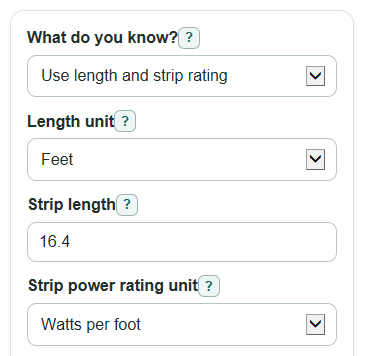
- Choose What do you know?: use length and Strip power rating, or switch to Total strip watts if the package lists the whole strip load.
- Enter Hours on per day, Days on per week, and Electricity price from your electric bill, using dollars per kWh.
- Open Advanced options if the strip is dimmed, has Off-time controller power, needs a different Power supply extra room, or uses a voltage other than 12 V.
- Click Calculate, then read Estimated yearly cost first and Recommended power supply size for buying a driver.
- Sanity-check the output: Full-power strip load should be lower than or close to the power supply rating, and Electricity used per year should rise when hours, watts, brightness, or Electricity price rises.
Definitions
Watt (W): A measure of power, or how fast the LED strip uses electricity while running.
Kilowatt-hour (kWh): A measure of energy on electric bills; 1 kWh equals 1,000 watt-hours [2].
Strip power rating: The strip load per foot or per meter, usually shown as watts per foot or watts per meter.
Full-power strip load: The maximum LED strip watts before dimming is applied.
Average brightness: The typical brightness setting as a percent of full power for the cost estimate.
Off-time controller power: Power used by a smart controller or receiver while the LEDs are off but still plugged in.
Power supply extra room: Extra watt capacity added above the strip load so the power supply is not planned right at its limit.
Current (A): Electrical flow in amps, estimated from full-power watts divided by strip voltage.
Common mistakes and quick fixes
Mistake: Entering the power supply label in Strip power rating or Total strip watts.
Fix: Use the LED strip load for Strip power rating or Total strip watts; use Recommended power supply size only after calculating.
Mistake: Mixing Length unit with Strip power rating unit without checking the package.
Fix: Set Length unit and Strip power rating unit to match what you typed, so Strip length is converted correctly.
Mistake: Leaving Electricity price blank or typing a percent instead of dollars per kWh.
Fix: Enter Electricity price as a number such as 0.17, not 17%.
Mistake: Using 100 for Average brightness when the strip is usually dimmed.
Fix: Lower Average brightness to your typical setting so Estimated power while on and Estimated yearly cost are closer to real use.
Mistake: Ignoring Off-time controller power for an always-plugged-in smart controller.
Fix: Enter Off-time controller power if you know it; it affects Electricity used per week even when the LEDs are off.
Mistake: Picking the wrong Strip voltage when checking Estimated current at full power.
Fix: Set Strip voltage to the strip voltage printed on the product, or use Other strip voltage for a custom value.
Limitations & Key Assumptions / Boundary Conditions
- Average brightness is a practical estimate. Real RGB strips may not use exactly half power at 50 percent brightness, especially when colors change.
- The cost estimate uses one repeated weekly schedule, 52 weeks per year, 12 months per year, and 365 days per year.
- Electricity price should be your effective $ per kWh. Fixed monthly fees, taxes, time-of-use rates, and tiered pricing can make the real bill different.
- Recommended power supply size is a wattage estimate only. It does not check connector limits, wire gauge, voltage drop, waterproof ratings, or local electrical code.
- Estimated current at full power uses Full-power strip load divided by Strip voltage. Long low-voltage runs may still need power injection even when the wattage looks safe.
- Hidden inputs for the inactive mode are not part of the calculation, so Total strip watts is ignored when What do you know? is set to length and rating.
Methodology
How the calculator finds strip watts
If you choose length and rating, the calculator first converts the strip length when the length unit and rating unit do not match. It uses 3.280839895 feet per meter.
length_ft = length_m * 3.280839895
length_m = length_ft / 3.280839895
The full-power strip load is then found from the matching length unit and the strip power rating. If you choose total watts, the length and rating fields are ignored.
max_strip_watts = strip_length_in_rating_unit * strip_power_rating
max_strip_watts = total_strip_watts
How energy and cost are calculated
The on-power estimate applies the Average brightness percent to the full-power strip load.
estimated_on_watts = max_strip_watts * (brightness_percent / 100)
Weekly energy includes on-time energy plus optional off-time controller energy. Electric bills commonly use kWh, and 1,000 watt-hours equals 1 kWh [2].
weekly_energy_kwh = ((estimated_on_watts * hours_per_day * days_per_week) + (standby_watts * ((24 * 7) - (hours_per_day * days_per_week)))) / 1000
Yearly energy uses a simple 52-week year. Cost uses the entered Electricity price.
annual_energy_kwh = weekly_energy_kwh * 52
annual_cost = annual_energy_kwh * electricity_rate
monthly_cost = annual_cost / 12
daily_cost = annual_cost / 365
Power supply and current
The recommended supply size adds the selected extra room to the full-power strip load, then you should round up to a power supply size that is actually sold.
recommended_power_supply_watts = max_strip_watts * (1 + power_supply_headroom_percent / 100)
Full-power current uses watts divided by volts.
estimated_current_amps = max_strip_watts / strip_voltage
Mini-example
A 16 ft strip rated at 4 W per foot has a full-power strip load of 64 W. If it runs 6 hours per day, 7 days per week, at $0.17 per kWh, the weekly energy is 2.688 kWh, the yearly energy is 139.776 kWh, and the estimated yearly cost is $23.76. With 20 percent power supply extra room, the recommended power supply size is 76.8 W, so a buyer would round up to the next available size.