
Calculate single-phase AC watts, amps, volts, or power factor from the values you know.
Table of contents
How to use our Single Phase Power Calculator
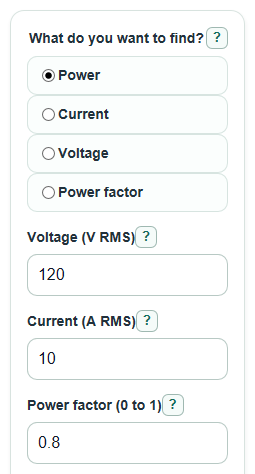
- Pick the missing value in What do you want to find?; the calculator will hide that field.
- Enter the known values, using normal meter values for Voltage (V RMS) and Current (A RMS).
- Use Power factor (0 to 1) as a decimal, such as 0.80, not 80 percent.
- Open Advanced options only if you want to change Power display unit or Number format.
- Sanity-check the results: Real power should not be greater than Apparent power, and a lower power factor should create a larger Phase angle.
Definitions
Single-phase AC: A common alternating-current power system with one voltage wave, often used in homes and small equipment.
Voltage (V RMS): Electrical push in volts, using RMS, which means the normal AC value shown by a meter.
Current (A RMS): Electrical flow in amps, using the normal AC value shown by a meter or clamp meter.
Real power (W): Useful power in watts. It becomes work, heat, light, or motion.
Power factor (0 to 1): A decimal that shows how much of the volt-amp load becomes real watts. A value of 1 means all apparent power is real power.
Apparent power: Voltage times current in VA. It describes the load size the source must carry.
Reactive power magnitude: The back-and-forth part of AC power in var, shown without a leading or lagging sign.
Phase angle: The angle in degrees between voltage and current that matches the power factor.
Common mistakes and quick fixes
Mistake: Entering 80 in Power factor (0 to 1) for 80 percent.
Fix: Enter 0.80, because this field uses a decimal from 0 to 1.
Mistake: Using peak voltage instead of the normal meter value in Voltage (V RMS) .
Fix: Use the RMS voltage shown by a meter or nameplate, such as 120 V RMS.
Mistake: Leaving Real power (W) filled in while solving for Power and expecting it to affect the answer.
Fix: In What do you want to find? , the hidden field is the one being solved, so only the visible required fields are used.
Mistake: Typing a current of 0 in Current (A RMS) when solving for Power factor .
Fix: Enter a current greater than 0, because apparent power is voltage times current.
Mistake: Reading Reactive power magnitude as a sign that the load is leading or lagging.
Fix: Treat it as size only; this calculator does not ask whether current leads or lags voltage.
Limitations & Key Assumptions / Boundary Conditions
- The calculator uses the common passive-load power factor range of 0 to 1. It does not handle negative power flow or generator backfeed cases.
- Values must be RMS values. Peak voltage or peak current will make the real power and apparent power too high.
- Reactive power is shown as a magnitude only. The calculator does not identify leading or lagging loads.
- The phase angle calculation assumes a sinusoidal AC circuit where power factor equals the cosine of the phase angle.
- It does not check wire size, breaker rating, voltage drop, motor starting current, or electrical code requirements.
- Small rounding differences can happen because displayed values are rounded, while the internal calculation uses the full entered numbers.
Methodology
Core equations
For single-phase AC, the default real power calculation multiplies RMS voltage, RMS current, and power factor [3].
P = V * I * PF
When solving for a different missing value, the same relationship is rearranged.
I = P / (V * PF)
V = P / (I * PF)
PF = P / (V * I)
Apparent power is found before applying power factor.
S = V * I
Reactive power magnitude comes from the right-triangle relationship between apparent power and real power.
Q = sqrt(S^2 - P^2)
The phase angle is calculated from the power factor.
φ (phase angle in degrees) = arccos(PF) * 180 / pi
Mini example
With 120 V RMS, 10 A RMS, and a power factor of 0.80, real power is 120 * 10 * 0.80 = 960 W. Apparent power is 120 * 10 = 1200 VA. Reactive power magnitude is sqrt(1200^2 - 960^2) = 720 var. The phase angle is arccos(0.80) * 180 / pi, which is about 36.87 degrees.
Calculation choices
Watts are converted to kilowatts by dividing by 1000, and volt-amperes are converted to kilovolt-amperes by dividing by 1000. If a tiny negative value appears inside the square root only because of rounding, it is treated as 0; otherwise, real power greater than apparent power is rejected as impossible for a power factor from 0 to 1.