
Check conduit fill for mixed wires and see whether the selected conduit size fits under the chosen NEC fill rule.
Table of contents
How to use our Conduit Fill Calculator
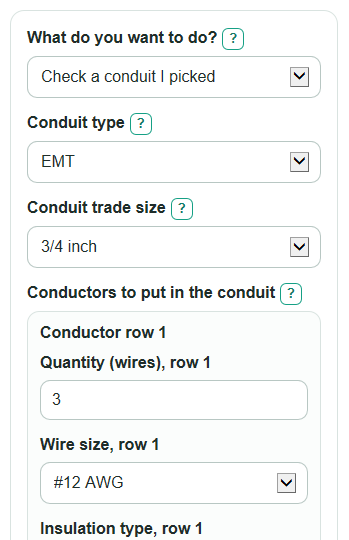
- Choose What do you want to do?: check a conduit you picked, or find the smallest supported conduit size for the same conductor list.
- Select the Conduit type and, when checking a picked conduit, the Conduit trade size shown on the raceway.
- In Conductors to put in the conduit, add one row for each wire size and insulation type, then enter the whole-number quantity for that row.
- Open Advanced options only if you need the Short nipple rule, a Planning target, or a different Number format.
- After you Calculate, sanity-check the result: Code fill result should match the rule you chose, and Room left before the limit should be positive for a pass or negative for an overfill.
Definitions
Conduit fill: The percent of the conduit inside area taken up by the listed insulated conductors.
Trade size: The named conduit size, such as 3/4 inch, not the exact inside diameter.
Conductor row: One line in Conductors to put in the conduit for wires that share the same quantity, wire size, and insulation type.
Total wire area used: The sum of the table area for every conductor row, in square inches.
Fill rule used: The maximum allowed fill percent chosen from the total conductor count and the Short nipple rule setting.
Room left before the limit: Allowed wire area minus actual wire area; a negative number means the conduit is overfilled.
Planning target: An optional percent full target for easier pulls; it does not change the code pass/fail result.
Common mistakes and quick fixes
Mistake: Using Conduit trade size as the exact inside diameter.
Fix: Pick the named Conduit trade size printed or specified for the conduit; the calculator uses the loaded inside area table.
Mistake: Putting all wires into one Conductors to put in the conduit row when they have different wire sizes or insulation types.
Fix: Add a separate Conductors to put in the conduit row for each unique size and insulation combination.
Mistake: Turning on Short nipple rule for a normal long run.
Fix: Use Short nipple rule only when the run is 24 inches or shorter and the code conditions apply.
Mistake: Treating Planning target as the code limit.
Fix: Use Code fill result for the pass/fail answer; Planning target is only a comfort check for pulling room.
Mistake: Ignoring a negative Room left before the limit because the fill percent looks close.
Fix: A negative Room left before the limit means the listed conductors are over the allowed area by that many square inches.
Limitations & Key Assumptions / Boundary Conditions
- This calculator checks conduit fill only. It does not check ampacity adjustment, temperature correction, voltage drop, box fill, bending limits, or pulling tension.
- Results depend on the loaded conduit inside areas and conductor areas. Use only supported conduit types, trade sizes, wire sizes, and insulation families.
- The Short nipple rule must be selected by the user. Confirm the run is 24 inches or shorter and meets the adopted code conditions before relying on the 60 percent limit.
- Local amendments, project specifications, and the adopted NEC edition can change what is acceptable. Verify final work with the local authority having jurisdiction.
- The conductor list is for individual conductors in supported raceways. Cable assemblies, tray cable, conduit bodies, and box fill need separate rules and data.
- Actual pulling difficulty can be affected by bends, conduit damage, lubricant, conductor stiffness, and installation conditions even when conduit fill passes.
Methodology
How the fill check is calculated
The calculator adds the area used by each conductor row, then compares that total with the allowed area for the selected conduit type, trade size, and fill rule.
total_conductor_area = sum(quantity_i * area_per_conductor_i)
For the normal rule, the fill limit is 53 percent for 1 conductor, 31 percent for 2 conductors, and 40 percent for 3 or more conductors [2]. If Short nipple rule is selected, the fill limit used is 60 percent.
max_allowed_area = conduit_inside_area * fill_limit_percent / 100
fill_percent = total_conductor_area / conduit_inside_area * 100
room_left_area = max_allowed_area - total_conductor_area
Room left is kept as a signed number. Positive means space remains before the limit. Negative means the listed conductors are over the allowed area.
Smallest supported size search
When What do you want to do? is set to Find the smallest conduit size, the calculator ignores the selected conduit size and checks supported trade sizes for the chosen conduit type from smallest to largest.
recommended_trade_size = first ascending supported size where total_conductor_area <= conduit_inside_area_size * fill_limit_percent / 100
Mini-example
For 9 #12 THHN/THWN-2 conductors in 3/4 inch EMT, using a conductor area of 0.0133 square inches each gives 0.1197 square inches total. A 3/4 inch EMT area of 0.533 square inches with the 40 percent normal fill rule allows 0.2132 square inches. The fill is 22.46 percent, and room left is 0.0935 square inches, so the fill check passes.
Rounding and display
The calculator uses the loaded table values without rounding during the calculation. It rounds only the displayed numbers, so a value that is exactly at the allowed area within normal floating-point tolerance is treated as passing.