
Enter your solar quote, expected yearly production, and electricity value to estimate when bill savings could recover your net solar cost.
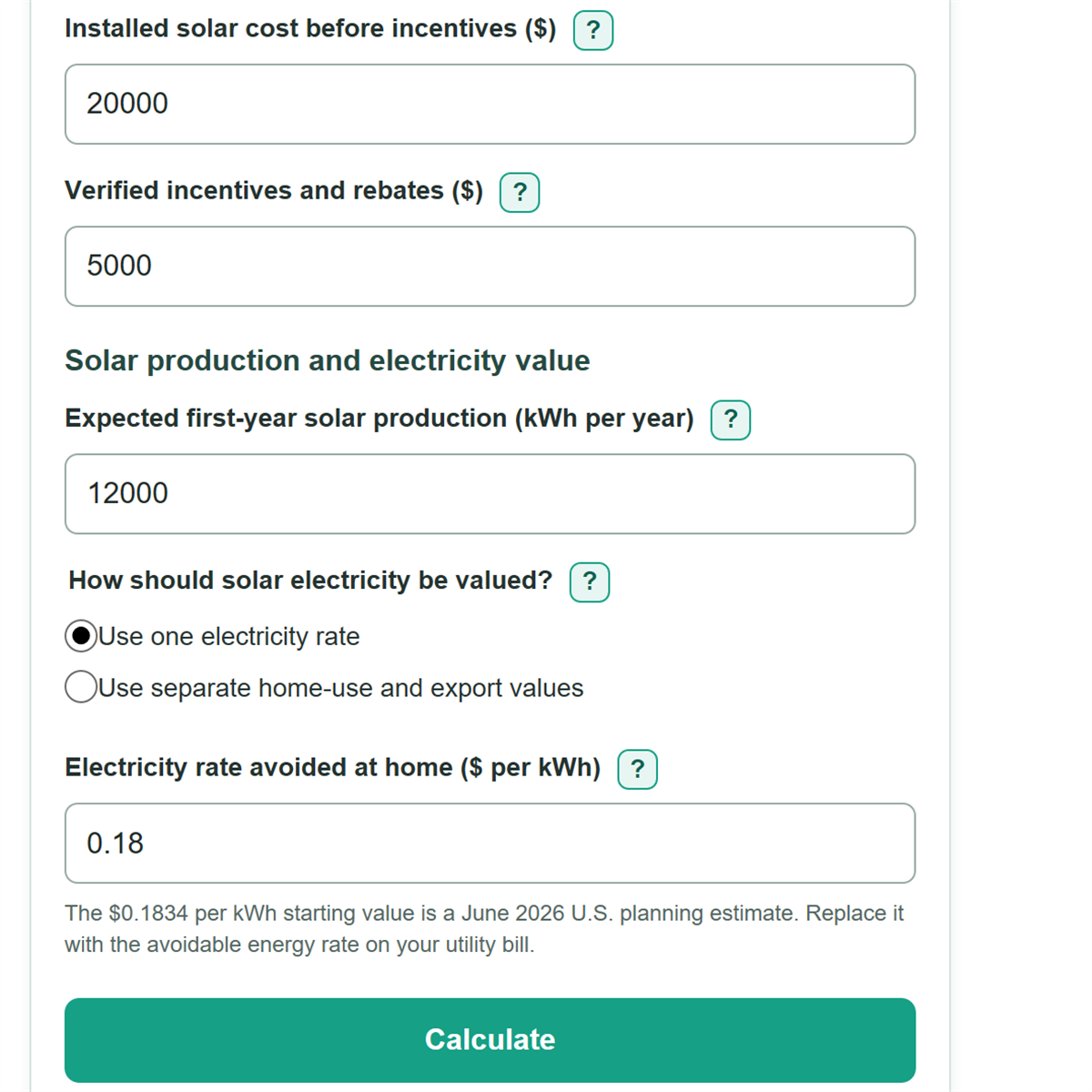
The $0.1834 per kWh starting value is a June 2026 U.S. planning estimate. Replace it with the avoidable energy rate on your utility bill.
This estimates avoidable energy charges. Fixed utility account charges are not included.
This is the installed cost minus the verified incentives you entered.
Table of contents
How to use our Solar Panel Payback Calculator
- Enter the cash purchase price from your installer quote and enter verified rebates, credits, or grants. Enter 0 for incentives if you have none.
- Copy the proposal's expected first-year production into "Expected first-year solar production (kWh per year)." Do not enter the system size in kW.
- Choose one electricity rate for a quick estimate. Choose separate home-use and export values if your utility pays a different amount for solar electricity sent to the grid.
- Enter the avoidable per-kWh electricity rate from your utility plan, then click Calculate. For separate values, also enter the share used at home and the utility export payment.
- Compare estimated first-year savings with the energy-charge part of your current yearly electric bills. If savings seem too high, check the production estimate, electricity rate, and home-use percentage.
Definitions
kWh: A kilowatt-hour is a unit of electrical energy. Solar proposals commonly show expected annual production in kWh per year.
Electricity rate avoided at home: The per-kWh value of solar electricity used in the house because it replaces electricity you would otherwise buy from the utility.
Export rate: The amount your utility pays or credits for each solar kWh sent to the grid. It may be lower than the retail electricity rate. [1]
Solar electricity used at home: The percentage of solar production used in the house as it is generated. The remaining production is treated as exported to the grid.
Net solar project cost: Installed solar cost before incentives minus verified incentives and rebates.
Simple payback: Net solar project cost divided by estimated first-year electricity savings, shown in years.
Common mistakes and quick fixes
Mistake: Entering system size in kW as expected first-year production.
Fix: Check Installed solar cost before incentives ($) and then recalculate. Enter the annual kWh estimate from the installer proposal or an address-specific production estimate.
Mistake: Using the whole monthly bill divided by kWh as the avoided electricity rate.
Fix: Check Installed solar cost before incentives ($) and then recalculate. Use the per-kWh energy charge solar can avoid. Fixed account charges may still appear on the bill.
Mistake: Subtracting a credit or rebate before checking that you qualify.
Fix: Check Installed solar cost before incentives ($) and then recalculate. Enter only incentives you expect to receive. Enter 0 if eligibility, amount, or timing is uncertain.
Mistake: Valuing every solar kWh at the retail rate when exported electricity earns less.
Fix: Check Installed solar cost before incentives ($) and then recalculate. Choose separate home-use and export values, then enter a realistic home-use percentage and your utility's export rate.
Mistake: Treating solar payback as a loan payoff date.
Fix: Check Installed solar cost before incentives ($) and then recalculate. This is a cash-purchase estimate based on electricity savings. Review loan, lease, or power purchase agreement payments separately.
Limitations & Key Assumptions / Boundary Conditions
- This is a cash-purchase screening estimate. It does not include loan interest, lease payments, power purchase agreement payments, or the time value of money.
- The 25-year estimate repeats first-year savings for 25 years. It does not include electricity-rate changes, solar production decline, maintenance, inverter replacement, roof work, or equipment failure.
- Savings use a per-kWh electricity value only. Fixed charges, demand charges, minimum bills, and detailed time-of-use pricing are excluded.
- Actual production can differ because of weather, shading, roof direction, equipment performance, curtailment, and changes to the home or grid.
- Incentives are treated as an upfront cost reduction. Check eligibility, amount, timing, tax treatment, and transferability for your project.
- The separate home-use and export method uses yearly averages. It does not match solar generation and household electricity use hour by hour.
Methodology
Calculation method
The calculator subtracts verified incentives from the quoted cash price to find net project cost. It then values the expected first-year solar production. With one electricity rate, each solar kWh uses the entered avoided rate. With separate values, the calculator combines the home-use rate and export rate based on the share of production used at home. Utility compensation for exported solar can change savings. [1]
net project cost = installed solar cost before incentives - verified incentives and rebates
home-use share = solar electricity used at home (percent) / 100
average value per solar kWh = retail rate * home-use share + export rate * (1 - home-use share)
estimated first-year electricity savings = expected first-year solar production * average value per solar kWh
estimated solar payback = net project cost / estimated first-year electricity savings
estimated 25-year net savings = estimated first-year electricity savings * 25 - net project cost
Worked example
A project with a $20,000 cash cost, $5,000 in verified incentives, 12,000 kWh of first-year production, and an avoided rate of $0.18 per kWh has a $15,000 net cost. First-year savings are $2,160.
$15,000 / $2,160 per year = 6.94 years
The estimated payback is 6.9 years. Simple 25-year net savings are $39,000. The starting electricity rate is a June 2026 U.S. residential planning estimate; replace it with your utility's avoidable per-kWh rate. [2]