
Enter your latitude to find a practical fixed solar-panel tilt, seasonal settings, and the direction panels should face.
Optional mount-angle limits
Angles are measured from horizontal. Leave both blank for the unconstrained latitude-only estimates. A limit clips the estimate; it does not establish the best energy yield or structural safety.
Table of contents
How to use our Solar Panel Tilt Calculator
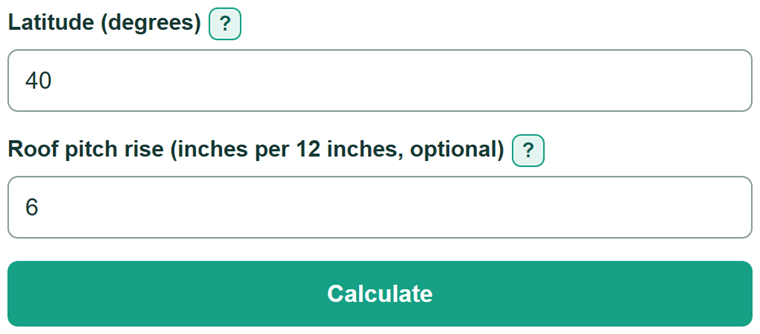
- Find your latitude in a maps app or location details. Enter a positive number north of the equator and a negative number south of it.
- To compare an existing roof, enter only the rise from its rise/12 pitch. For a 6/12 roof, enter 6.
- Click Calculate. The first card gives a fixed panel tilt in degrees from horizontal for a panel that stays at one angle all year.
- Use the summer and winter angles only if the mount can be adjusted safely. Check the facing-direction card too, because tilt and direction are separate choices.
- Sanity-check the numbers: 0 degrees is flat, 90 degrees is vertical, and a negative roof comparison means your roof is flatter than the recommended fixed tilt.
Definitions
Latitude: A location's north-south position in degrees. The equator is 0 degrees; north is positive and south is negative.
Panel tilt: Panel steepness measured from horizontal. A flat panel has a 0-degree tilt, and a vertical panel has a 90-degree tilt.
Fixed tilt: One panel angle that remains unchanged through the year.
Roof pitch rise: The vertical rise over 12 inches of horizontal run. A 6/12 roof rises 6 inches over a 12-inch run.
Equator-facing direction: The direction toward the equator: true south in the Northern Hemisphere and true north in the Southern Hemisphere. Panel direction and tilt both affect solar photovoltaic output [1].
True north: Geographic north on a map. It can differ from magnetic north shown by an uncorrected compass.
Common mistakes and quick fixes
Mistake: Entering longitude instead of latitude.
Fix: Use the north-south coordinate from -90 to 90 degrees. Latitude is positive north of the equator and negative south of it.
Mistake: Measuring panel tilt from vertical.
Fix: Measure from horizontal. A flat panel is 0 degrees, while a vertical panel is 90 degrees.
Mistake: Typing "6/12" into the roof-pitch field.
Fix: Enter only 6. The calculator already uses a 12-inch horizontal run.
Mistake: Treating roof pitch and panel tilt as the same type of number.
Fix: A roof pitch is rise per 12 inches of run. The calculator converts that value to degrees from horizontal before comparing it.
Mistake: Mixing up tilt and facing direction.
Fix: Tilt is how steep the panel is. North of the equator, panels generally face true south; south of it, they generally face true north.
Mistake: Using this estimate as a final installation plan.
Fix: Check shade, roof shape, structure, wind, snow, local horizon, setbacks, and mounting requirements before installation.
Limitations & Key Assumptions / Boundary Conditions
- This is a latitude-based starting estimate, not an address-specific energy-production forecast.
- The calculation does not include shade, trees, buildings, roof shape, weather, local horizon, panel spacing, or electrical equipment.
- Roof structure, wind, snow load, drainage, fire setbacks, and local rules can limit the tilt that is practical or permitted.
- Summer and winter settings apply only to a mount that can be adjusted safely. The calculator does not estimate whether changing the angle is worth the time or cost.
- The direction result uses true north or true south, not an uncorrected magnetic-compass heading. At the equator, a site-specific design is needed.
Methodology
Calculation method
The calculator uses the size of the entered latitude, without its north or south sign, as the fixed year-round tilt in degrees from horizontal.
fixed tilt = abs(latitude)
For an adjustable mount, it uses a summer setting 15 degrees lower and a winter setting 15 degrees higher. Summer tilt cannot be less than 0 degrees, and winter tilt cannot be greater than 90 degrees.
summer tilt = max(0, abs(latitude) - 15)
winter tilt = min(90, abs(latitude) + 15)
If you enter roof-pitch rise, the calculator converts the rise over a fixed 12-inch run into degrees from horizontal with arctangent.
roof tilt = atan(roof pitch rise / 12) * 180 / pi
The roof comparison subtracts fixed tilt from converted roof tilt. A positive value means the roof is steeper; a negative value means it is flatter.
roof difference = roof tilt - fixed tilt
Worked example
At 40 degrees north latitude, the fixed tilt is 40 degrees. The suggested summer setting is 25 degrees and the winter setting is 55 degrees. A 6/12 roof converts to about 26.6 degrees from horizontal, which is about 13.4 degrees flatter than the fixed-tilt estimate.