
Estimate battery backup time from a battery label, or find the battery size needed for a planned outage.
Table of contents
How to use our Battery Backup Calculator
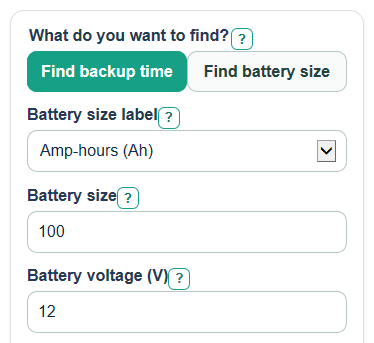
- Choose What do you want to find?: Find backup time if you know the battery, or Find battery size if you know the hours you need.
- Pick Battery size label, then enter Battery size, Battery voltage, and Total load using the running watts for everything powered at the same time.
- If you choose Find battery size, enter Backup time wanted; if you choose Find backup time, enter the battery label size instead.
- Open Advanced options if you want to adjust System efficiency, Usable battery, Number of identical batteries, or Number display.
- Check the main answer against Rated stored energy, Usable energy after settings, and Estimated battery current; if the current looks high for your battery or inverter, check the equipment manual before relying on the estimate.
Definitions
Amp-hours (Ah): A battery label number that describes capacity at a stated voltage. To turn Ah into energy, the calculator multiplies Ah by Battery voltage.
Watt-hours (Wh): Stored energy. A 1 Wh amount can supply 1 watt for 1 hour before losses and usable-battery limits are applied.
Battery voltage: The nominal direct-current battery or battery-bank voltage used for Ah conversion and current estimates.
Total load: The steady running power, in watts, for all devices powered at the same time.
System efficiency: The percent of battery energy that reaches the load after losses, often from an inverter, wiring, and heat.
Usable battery: The percent of the rated battery energy you plan to use before stopping or recharging.
Estimated battery current: The approximate amps drawn from the battery side while the load is running.
Common mistakes and quick fixes
Mistake: Entering startup surge watts in Total load.
Fix: Use the steady running watts for Total load, then check surge limits separately in your inverter manual.
Mistake: Choosing the wrong Battery size label for Battery size.
Fix: Pick Amp-hours (Ah) if the label says Ah, or Watt-hours (Wh) if the label says Wh.
Mistake: Using the charger voltage instead of Battery voltage.
Fix: Enter the nominal battery or battery-bank Battery voltage, such as 12 V, 24 V, or 48 V.
Mistake: Leaving System efficiency blank or setting it above 100.
Fix: Enter a percent greater than 0 and at most 100 for System efficiency.
Mistake: Treating Usable battery as always 100 percent.
Fix: Set Usable battery to the share you plan to use before stopping or recharging.
Mistake: Entering mixed battery sizes under Number of identical batteries.
Fix: Use Number of identical batteries only when the batteries are the same size and part of the same system.
Limitations & Key Assumptions / Boundary Conditions
- The estimate assumes a steady Total load. Motors, refrigerators, pumps, and tools can have startup surge that is higher than running watts.
- System efficiency is a planning input. Real efficiency changes with inverter size, load level, wiring, temperature, and equipment condition.
- Usable battery is not a universal battery rule. Use the battery maker's guidance for depth of discharge, low-voltage cutoff, and warranty limits.
- Number of identical batteries assumes the batteries are the same size and work as one backup system. Mixed batteries can behave differently.
- Estimated battery current is not a safety rating. Check battery, fuse, cable, and inverter limits before building or loading a system.
- Battery age, cold weather, high heat, poor connections, and repeated deep discharges can reduce real runtime.
- If Battery size label is Watt-hours (Wh), Battery voltage is still needed for Estimated battery current and Ah comparison.
Methodology
How the calculator uses the battery label
If Battery size label is Amp-hours (Ah), the calculator first converts the label to watt-hours. Watt-hours are the stored energy used for the runtime math.
rated_energy_wh = battery_capacity_ah x battery_voltage_v x battery_count
If Battery size label is Watt-hours (Wh), the label is already stored energy, so the calculator only multiplies by the battery count.
rated_energy_wh = battery_capacity_wh x battery_count
Find backup time
The calculator reduces rated energy by Usable battery and System efficiency, then divides by Total load.
usable_energy_wh = rated_energy_wh x (usable_percent / 100) x (efficiency_percent / 100)
estimated_runtime_hours = usable_energy_wh / load_watts
The friendly time display changes decimal hours into hours and minutes by multiplying the leftover hour by 60.
Find battery size
In size mode, the calculator starts with the energy the load needs, then divides by the usable-battery and efficiency factors to get the rated stored energy needed.
required_energy_wh = (load_watts x target_hours) / ((usable_percent / 100) x (efficiency_percent / 100))
It then converts that stored energy to amp-hours at the selected Battery voltage.
required_capacity_ah = required_energy_wh / battery_voltage_v
If Number of identical batteries is greater than 1, the per-battery Ah is the total Ah divided by that count.
Current estimate and display
Estimated battery current uses the load, Battery voltage, and System efficiency.
estimated_battery_current_amps = load_watts / (battery_voltage_v x (efficiency_percent / 100))
Auto Number display uses regular numbers for everyday values and scientific notation only when a nonzero value is below 0.0001 or at least 1000000.
Mini example
For a 100 Ah battery at 12 V, Number of identical batteries of 1, Usable battery of 80 percent, System efficiency of 85 percent, and Total load of 300 W:
rated_energy_wh = 100 x 12 x 1 = 1200 Wh
usable_energy_wh = 1200 x 0.80 x 0.85 = 816 Wh
estimated_runtime_hours = 816 / 300 = 2.72 hours
That is about 2 hours and 43 minutes. The current estimate is 300 / (12 x 0.85), or about 29.4 A.