
Estimate the power supply size for an LED strip and check whether long lead wires may waste too much voltage.
Advanced options
Table of contents
How to use our LED Strip Power Calculator
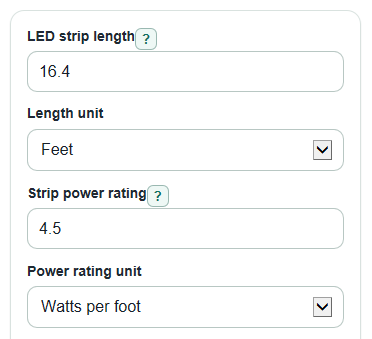
- Enter LED strip length and choose the matching Length unit.
- Enter the strip's listed Strip power rating, then choose whether that rating is in watts per foot or watts per meter.
- Choose the rated Strip voltage (V), such as 5 V, 12 V, or 24 V.
- Open Advanced options if you want to change Extra power supply capacity (%) or run the wire check with One-way wire length from supply to strip, Copper wire size (AWG), and Voltage drop limit (%).
- Click Calculate, then sanity-check the results: the recommended watts should be higher than the estimated strip watts when extra capacity is above 0%, and a high lead-wire voltage drop means you may need shorter wire, thicker wire, 24 V strip, or power injection.
Definitions
Watts (W): How fast electrical power is used. For an LED strip, more watts usually means the power supply must be larger.
Amps (A): Electric current, or electric flow. At the same voltage, more watts means more amps.
Volts (V): Electrical push. The power supply voltage must match the LED strip voltage, such as 12 V or 24 V.
Watts per foot or watts per meter: The strip's power rating for each unit of length. The calculator multiplies this by the strip length after matching units.
Extra power supply capacity (%): Added room above the estimated strip load. It helps you choose a supply that is not running at its exact calculated limit.
Voltage drop: Voltage lost in the wires before power reaches the LED strip. Too much drop can make the strip dimmer or change color, especially on long low-voltage runs.
AWG: American Wire Gauge, a wire size system. Smaller AWG numbers mean thicker wire and lower resistance.
One-way wire length: The distance from the power supply to the strip input. The calculator counts both the positive and negative wires in the voltage drop math.
Common mistakes and quick fixes
Mistake: Using the reel length for LED strip length when only part of the reel is lit.
Fix: Enter only the total lit length connected to this power supply output.
Mistake: Mixing Length unit and Power rating unit , such as feet for length but reading the strip label as watts per meter.
Fix: Set Power rating unit to the exact unit printed on the strip listing or datasheet.
Mistake: Picking the wrong Strip voltage (V) because the power supply label says a different voltage.
Fix: Use the LED strip's rated DC voltage, then choose a matching power supply at or above the calculated size.
Mistake: Entering round-trip cable length in One-way wire length from supply to strip .
Fix: Enter the one-way distance only; the calculator doubles it to count the positive and negative wires.
Mistake: Treating Copper wire size (AWG) as if a bigger AWG number means thicker wire.
Fix: Remember that smaller AWG numbers are thicker, so 14 AWG has less resistance than 20 AWG.
Mistake: Leaving Extra power supply capacity (%) at 0 for a final build with no safety margin.
Fix: Use a practical extra-capacity value, such as the default 20%, unless you are only checking the exact strip load.
Limitations & Key Assumptions / Boundary Conditions
- This calculator is for constant-voltage DC LED strips, not constant-current LED drivers.
- The power result is based on the strip's listed full-power rating. Real power can be lower when dimmed or when colors are not all on.
- The wire check covers only the lead wires from the power supply to the strip input. It does not model voltage drop along the strip's own copper traces.
- Connector resistance, controller losses, dimmer behavior, fuse sizing, heat, enclosure ratings, and electrical code rules are not included.
- The AWG check uses copper wire resistance values at about room temperature. Real cable resistance can vary by material, strand count, temperature, and manufacturer.
- A blank One-way wire length from supply to strip means no wire voltage drop check is run.
- If the estimated voltage at the strip input is very low or negative, the entered wire length, wire size, and load are not workable under this simple resistance model.
Methodology
Power supply size
The calculator first converts the entered LED strip length so it matches the selected Power rating unit. It uses 0.3048 meters per foot and 3.280839895 feet per meter for length conversion.
strip_watts = strip_length_in_rating_units * power_per_length
Watts are the rate of power use. The calculator then uses the DC power relationship between watts, volts, and amps to estimate strip current.
strip_amps = strip_watts / strip_voltage
Extra capacity is added only after the strip load is estimated.
recommended_supply_watts = strip_watts * (1 + headroom_percent / 100)
recommended_supply_amps = recommended_supply_watts / strip_voltage
Lead-wire voltage drop
If One-way wire length from supply to strip is entered, the calculator converts that length to feet, looks up the selected copper AWG resistance in ohms per 1000 ft, and estimates the voltage lost in both lead wires.
wire_voltage_drop = 2 * wire_length_ft * strip_amps * (awg_ohms_per_1000ft / 1000)
The factor 2 counts the positive and negative conductors. The drop percent and estimated strip input voltage are then calculated from the selected strip voltage.
wire_drop_percent = (wire_voltage_drop / strip_voltage) * 100
voltage_at_strip = strip_voltage - wire_voltage_drop
Worked example
For a 16.4 ft strip rated at 4.5 W per foot on 12 V, the estimated strip power is 16.4 * 4.5 = 73.8 W. The strip current is 73.8 / 12 = 6.15 A. With 20% extra capacity, the recommended supply size is 73.8 * 1.20 = 88.56 W, and the minimum supply current is 88.56 / 12 = 7.38 A.
If a wire check is entered, the calculator compares the lead-wire drop percent with Voltage drop limit (%). A result within the limit means the entered lead wires meet that planning target; a result over the limit means the strip may receive noticeably less voltage than expected.