
Convert candela or millicandela to lumens using either a beam angle or a solid angle.
Advanced options
Table of contents
How to use our Candela to Lumens Calculator
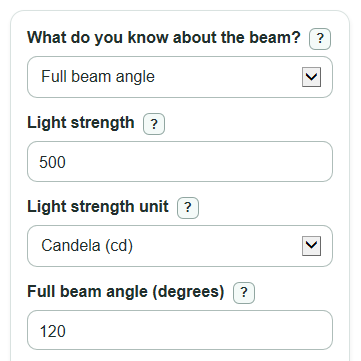
- Choose What do you know about the beam?: use Full beam angle for most light specs, or Solid angle if you already have a steradian value.
- Enter Light strength and pick Light strength unit, either Candela (cd) or Millicandela (mcd).
- If using beam angle mode, enter Full beam angle (degrees); use Advanced options only if your angle is a half angle from the center line.
- If using solid angle mode, enter Solid angle (steradians) instead, then click Calculate.
- Check Beam spread used, Full beam angle used, and Beam share of a full sphere; if these look far too small or large, recheck the angle unit and whether you entered a full angle or half angle.
Definitions
Candela (cd): A unit for light strength in one direction. In this calculator, candela is multiplied by beam spread to estimate lumens.
Millicandela (mcd): One thousandth of a candela. For example, 2000 mcd equals 2 cd.
Lumens (lm): Total visible light in the selected beam. More lumens means more total light in that beam, if the beam spread is the same.
Solid angle (steradians): A 3D angle that measures how wide a beam spreads through space. A full sphere is 4 * pi sr.
Full beam angle: The cone angle from one side of the beam to the other side. This is different from a half angle measured from the center line to one edge.
Beam share of a full sphere: The beam solid angle divided by 4 * pi, shown as a percent. It helps you spot angle or unit mistakes.
Common mistakes and quick fixes
Mistake: Entering a half angle in Full beam angle (degrees) while Angle value means is set to Full beam angle.
Fix: Change Angle value means to Half angle from center, or double the angle before entering it.
Mistake: Typing an LED mcd value into Light strength but leaving Light strength unit on Candela (cd).
Fix: Set Light strength unit to Millicandela (mcd), then use Light strength used to confirm the cd conversion.
Mistake: Choosing Solid angle but still editing Full beam angle (degrees) and expecting it to affect Light in the beam.
Fix: In solid angle mode, change Solid angle (steradians); the hidden angle field is not used.
Mistake: Entering a Solid angle (steradians) greater than a full sphere.
Fix: Use a value from 0 to about 12.5664 sr, then compare Beam share of a full sphere with 100 percent.
Mistake: Setting Digits to show too low or too high and thinking the math changed.
Fix: Use Digits to show from 2 to 8; it changes only rounding on screen, not the stored calculation.
Limitations & Key Assumptions / Boundary Conditions
- The conversion assumes a round cone beam and a uniform candela value across that beam. Real beams often have a bright center and dimmer edges.
- A product's stated beam angle may use a half-brightness cutoff, so measured total lumens can differ from this estimate.
- Full beam angle mode accepts 0 to 360 degrees. A 0 degree beam returns 0 lumens in the ideal model, but a real light cannot have exactly zero spread.
- Solid angle mode accepts 0 to 4 * pi steradians, about 12.5664 sr. Values above that are larger than a full sphere and are blocked.
- When Solid angle is selected, Full beam angle (degrees) and Angle value means are not used for the primary calculation.
- Rounding from Number display and Digits to show affects only the displayed answer, not the underlying formulas.
Methodology
Core relationship
The calculator uses the standard photometric relationship between luminous intensity, luminous flux, and solid angle: luminous intensity in candela is luminous flux per solid angle [2]. That means lumens are found by multiplying candela by the beam's solid angle.
lumens = candela * solid_angle_sr
Unit conversion
If Light strength unit is Millicandela (mcd), the entered value is divided by 1000 before the lumen calculation.
candela = millicandela / 1000
Beam angle mode
When Angle value means is Full beam angle, the entered angle is treated as the full cone angle from one side of the beam to the other.
solid_angle_sr = 2 * pi * (1 - cos((beam_angle_deg * pi / 180) / 2))
When Angle value means is Half angle from center, the entered angle is treated as the angle from the center line to one edge of the beam.
solid_angle_sr = 2 * pi * (1 - cos(half_angle_deg * pi / 180))
Solid angle mode
If you enter Solid angle (steradians) directly, that value is used for the lumen calculation. The matching full cone angle is shown as a check for a round beam.
full_beam_angle_deg = 2 * acos(1 - solid_angle_sr / (2 * pi)) * 180 / pi
Sphere share check
A full sphere has a solid angle of 4 * pi steradians, so the calculator compares the beam spread with that full-sphere value [1].
beam_share_pct = solid_angle_sr / (4 * pi) * 100
Mini example
For 500 cd with a 120 degree full beam angle, the solid angle is about 3.1416 sr. The lumen estimate is 500 * 3.1416 = 1570.8 lm, and the beam covers about 25 percent of a full sphere.