
Convert liters to cubic centimeters, or check the reverse from cm^3 back to liters.
Advanced options
Table of contents
How to use our Liters to Cubic Centimeters Converter
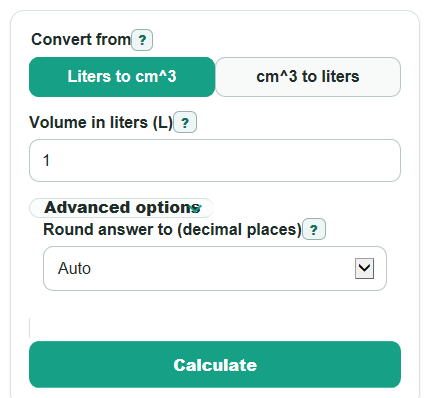
- Choose the direction in Convert from: Liters to cm^3 for the usual conversion, or cm^3 to liters for a reverse check.
- Enter the active volume only: use Volume in liters (L) or Volume in cubic centimeters (cm^3), and type numbers only.
- Pick Round answer to if your homework asks for a certain number of decimal places; otherwise leave it on Auto.
- Click Calculate, then read Converted volume first and use Conversion step to see the arithmetic.
- Sanity-check the result with Milliliter check: a cm^3 amount should match the same number of milliliters.
Definitions
Liter (L): A metric unit of volume. In this converter, 1 L equals 1000 cm^3.
Cubic centimeter (cm^3): A volume equal to a cube that is 1 centimeter long, 1 centimeter wide, and 1 centimeter tall.
Milliliter (mL): A metric volume unit equal to 1 cm^3, so the mL number can be used as a quick check.
Convert from: The direction of the conversion, either liters to cm^3 or cm^3 to liters.
Round answer to: The display setting for decimal places. It changes how the answer is shown, not the exact conversion factor.
Common mistakes and quick fixes
Mistake: Typing units like cm, L, or mL into Volume in liters (L) .
Fix: Type the number only, such as 2.5, because the label already supplies the unit.
Mistake: Using regular centimeters in Volume in cubic centimeters (cm^3) .
Fix: Enter a volume in cm^3, not a length in cm; liters cannot be converted from length alone.
Mistake: Leaving Convert from on the wrong direction and getting an answer that is 1,000 times too big or too small.
Fix: Use Liters to cm^3 when starting with L, and cm^3 to liters when starting with cm^3.
Mistake: Entering a negative value in Volume in cubic centimeters (cm^3) or Volume in liters (L) .
Fix: Use 0 or a positive number, since this converter treats physical volume as nonnegative.
Mistake: Setting Round answer to too low and hiding useful digits in a small liter answer.
Fix: Try Auto or more decimal places, then compare the rounded Converted volume with the Conversion step .
Limitations & Key Assumptions / Boundary Conditions
- The converter uses exact metric volume relationships: 1 L = 1000 cm^3 and 1 cm^3 = 1 mL.
- Only the active direction input is used. When converting liters to cm^3, the cm^3 input is ignored, and the reverse is also true.
- Inputs must be numbers. Commas and spaces are okay, but unit text such as cm or L is treated as an error.
- Negative volume is blocked because this page is for physical volume conversions, not signed math differences.
- Rounding can make a displayed answer look slightly different from the exact value, especially for small cm^3 to L conversions.
- This is a volume converter only. It does not convert mass, weight, density, or plain length in centimeters.
Methodology
Core conversion
The calculator uses the metric relationship that 1 liter is 1 cubic decimeter. Since 1 decimeter is 10 centimeters, 1 cubic decimeter is 10 * 10 * 10 = 1000 cubic centimeters [1].
cubic centimeters = liters * 1000
liters = cubic centimeters / 1000
Milliliter check
For metric volume, 1 cm^3 is the same volume as 1 mL, so the milliliter check uses the cm^3 number directly.
milliliters = cubic centimeters
Worked example
If the input is 0.75 in Volume in liters (L), the calculation is 0.75 * 1000 = 750, so the Converted volume is 750 cm^3. The Milliliter check is also 750 mL.
Rounding and display
Auto rounding keeps exact whole-number results clean, such as 1 L = 1000 cm^3. If a decimal place choice is selected, the displayed Converted volume is rounded to that number of decimal places while the conversion step still shows the direction used.